


Partner with gold traders: risk management & transparency
- Shannon B
- Mar 16
- 8 min read


Institutional investors navigating gold markets in 2026 face a sobering reality: non-compliance penalties average $10 million in the precious metals sector. Beyond regulatory landmines, supply chain opacity threatens ESG commitments and investor confidence. Partnering with experienced gold traders transforms these vulnerabilities into strategic advantages. This guide reveals how the right partnerships deliver regulatory expertise, transparent sourcing, and technology-driven traceability that institutional portfolios demand.
Table of Contents
Key takeaways
Point | Details |
Regulatory expertise protects capital | Gold traders navigate AML/KYC complexities, shielding investors from million-dollar compliance failures. |
ESG transparency reduces reputational risk | Certified sourcing partnerships eliminate ethical blind spots in gold supply chains. |
Technology enables real-time verification | Digital platforms track gold from mine to vault, providing auditable proof of origin. |
Strategic partnerships amplify returns | Trusted traders combine compliance rigor with market intelligence for optimized portfolio performance. |
Responsible sourcing aligns with market evolution | Institutional demand for ethical gold creates competitive advantage through verified supply chains. |
Navigating regulatory complexities with expert gold traders
The precious metals sector operates under some of the strictest financial surveillance frameworks globally. Anti-Money Laundering (AML) and Know Your Customer (KYC) regulations impose rigorous documentation, verification, and reporting obligations on every transaction. For institutional investors entering gold markets independently, these requirements create operational nightmares and catastrophic financial exposure.
Failure to comply results in penalties averaging $10 million according to FinCEN’s 2023 enforcement data. These aren’t theoretical risks. Regulators scrutinize precious metals transactions with particular intensity due to the sector’s historical vulnerability to illicit finance. A single documentation gap or verification oversight can trigger investigations that freeze operations and demolish institutional credibility.
Experienced gold traders maintain dedicated compliance infrastructure that institutional investors cannot economically replicate. They employ specialists who monitor evolving regulatory requirements across jurisdictions, implement automated screening protocols, and maintain relationships with regulatory bodies. This expertise transforms compliance from a liability into a competitive advantage.
Pro Tip: Request compliance audit reports from potential gold trading partners before committing capital. Reputable traders provide transparent documentation of their AML/KYC protocols and regulatory standing.
The operational benefits extend beyond penalty avoidance. Gold traders handle the complex reporting requirements that consume institutional resources. They maintain current documentation on counterparties, track beneficial ownership through corporate structures, and file suspicious activity reports when patterns warrant scrutiny. This infrastructure protects investors while enabling them to focus on portfolio strategy rather than regulatory paperwork.
Partnership also provides critical insulation during regulatory examinations. When authorities investigate transactions, they engage directly with the trader who possesses complete documentation and established regulatory relationships. Institutional investors benefit from this buffer while maintaining full transparency into their holdings and transaction history.
The regulatory landscape continues evolving. Recent AML penalties in gold trading 2026 demonstrate intensifying enforcement. Traders who invest in compliance infrastructure adapt quickly to new requirements, ensuring their institutional partners remain protected as standards shift.
Managing ESG risks and ensuring responsible sourcing
Gold production carries profound environmental and social costs that increasingly threaten institutional investor reputations. Mining operations displace communities, contaminate water sources with mercury and cyanide, and destroy ecosystems. Gold production comes with numerous ESG issues that create liability for investors who cannot verify their supply chain origins.

Institutional investors face mounting pressure from stakeholders to demonstrate responsible investment practices. Pension funds, endowments, and asset managers must answer to beneficiaries who demand ethical sourcing. A single revelation of conflict minerals or exploitative labor practices in a gold supply chain can trigger divestment campaigns, regulatory scrutiny, and permanent reputational damage.
Gold traders who prioritize ESG compliance build relationships with certified refiners adhering to Responsible Gold Mining Principles and London Bullion Market Association standards. These partnerships ensure gold originates from operations meeting environmental protection requirements, respecting indigenous rights, and providing safe working conditions. The verification process involves on-site audits, third-party certifications, and continuous monitoring.
Transparency mechanisms have evolved dramatically. Leading traders partner with NGOs and certification bodies to implement chain of custody protocols that track gold from extraction through refining. Digital documentation creates immutable records proving responsible sourcing at every supply chain stage.
Pro Tip: Prioritize gold traders who provide third-party ESG certifications rather than self-reported compliance claims. Independent verification eliminates greenwashing risks.
The business case for responsible sourcing strengthens annually. Institutional investors incorporating ESG factors demonstrate superior long-term performance while attracting capital from sustainability-focused allocators. Gold traders offering verified responsible sourcing enable investors to capture this premium while mitigating downside risks.
“Institutional portfolios cannot afford opacity in precious metals sourcing. ESG verification transforms gold from a reputational liability into a sustainability asset that strengthens stakeholder confidence and portfolio resilience.”
Beyond risk mitigation, responsible sourcing partnerships position institutional investors as industry leaders driving positive change. This leadership attracts capital, enhances brand value, and creates competitive differentiation in increasingly crowded markets. The traders who facilitate these outcomes become strategic partners rather than transactional vendors.
Effective risk management in gold trading requires integrating ESG considerations into every investment decision. Traders who embed these practices into their operational DNA provide institutional investors with sustainable competitive advantages.
Leveraging technology for transparency and supply chain traceability
Digital innovation revolutionizes gold supply chain transparency, transforming opaque networks into auditable systems. Switzerland hosts key players including refiners, banks, and startups developing traceability solutions that institutional investors demand. This ecosystem creates unprecedented visibility into gold’s journey from mine to portfolio.
Blockchain platforms enable real-time tracking of individual gold bars through the supply chain. Each transfer generates an immutable record including origin data, refining certifications, and custody documentation. Institutional investors access this information instantly, eliminating the weeks or months previously required to verify sourcing.
The technology addresses the industry’s most persistent challenge: first-mile tracking from artisanal and small-scale mining operations. Innovative startups deploy mobile applications that record mining site data, photograph extraction conditions, and create digital identities for gold before it enters formal supply chains. This capability closes the verification gap that previously enabled unethical sourcing.
Aspect | Traditional Supply Chain | Technology-Enhanced Supply Chain |
Origin verification | Paper documentation, weeks to verify | Digital records, instant verification |
Custody tracking | Manual logs, gaps common | Blockchain records, complete chain |
ESG compliance proof | Self-reported, limited auditing | Third-party certified, continuous monitoring |
Transparency access | Restricted, opaque | Real-time, investor dashboard |
Fraud prevention | Document forgery risk | Cryptographic security, tamper-proof |
Gold traders integrating these technologies provide institutional investors with unprecedented assurance. Dashboard interfaces display real-time portfolio composition, sourcing breakdowns, and compliance status. Investors demonstrate responsible practices to stakeholders with verifiable data rather than aspirational claims.
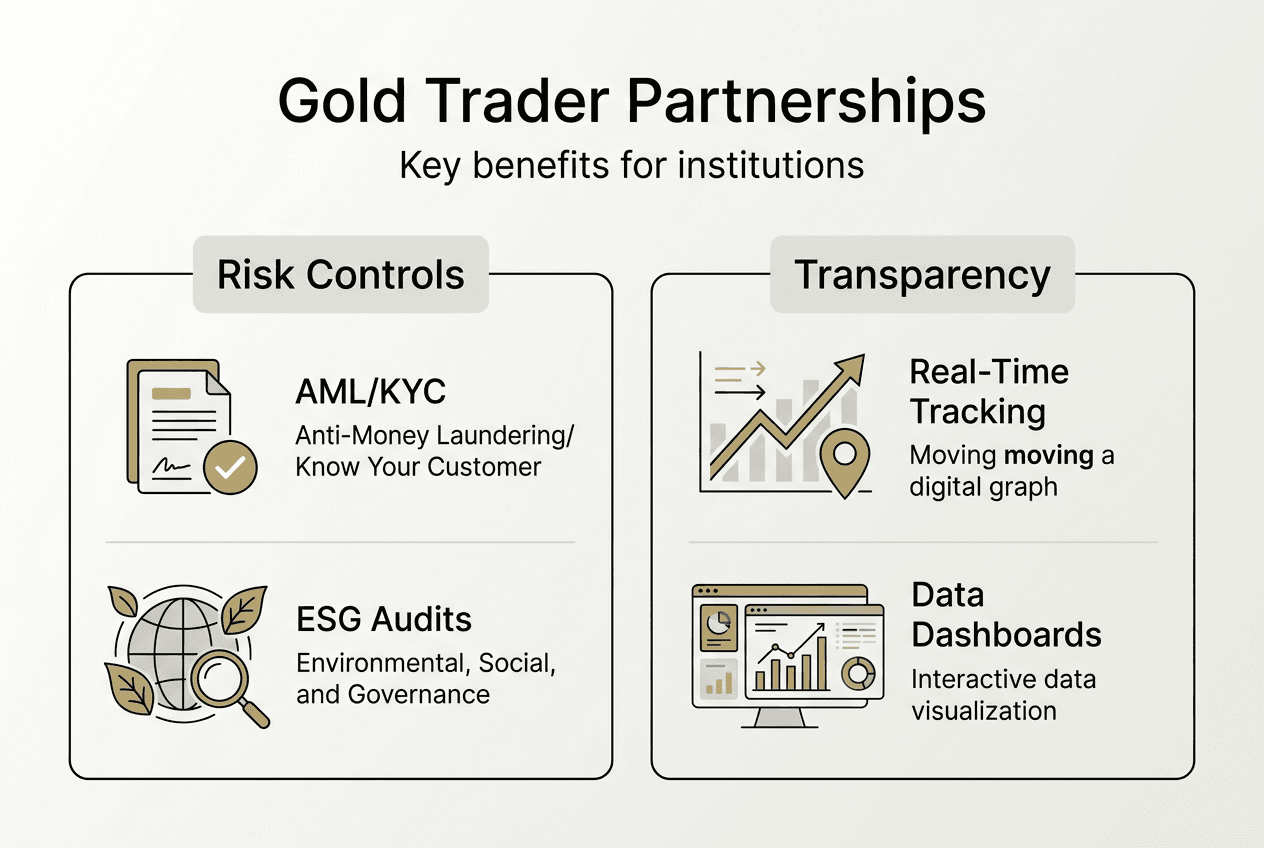
The competitive implications are substantial. Institutional investors increasingly require technology-enabled transparency as a partnership prerequisite. Traders lacking these capabilities lose access to capital as investors migrate toward partners offering superior visibility. This dynamic accelerates technology adoption across the industry.
Leading gold trading platforms 2026 incorporate artificial intelligence to analyze supply chain data, identify risk patterns, and alert investors to emerging concerns before they escalate into crises. Predictive analytics transform reactive compliance into proactive risk management.
Swiss innovation leadership in gold traceability creates natural partnership opportunities for institutional investors seeking cutting-edge solutions. The concentration of refiners, technology providers, and regulatory expertise in Switzerland establishes an ecosystem where transparency standards continuously advance.
The institutional advantage: strategic partnership benefits and best practices
Institutional investors who cultivate relationships with elite gold traders gain multifaceted advantages extending far beyond transaction execution. These partnerships provide market intelligence, regulatory foresight, and operational efficiency that independent operations cannot match. The strategic value compounds over time as relationships deepen and traders align their capabilities with investor priorities.
Selecting the right partner requires rigorous due diligence across multiple dimensions. Compliance track records reveal how traders navigate regulatory challenges and whether they maintain the infrastructure necessary for institutional-grade operations. ESG commitments demonstrate values alignment and future-readiness as sustainability requirements intensify. Supply chain transparency capabilities determine whether traders can deliver the verification institutional stakeholders demand.
Partnership Trait | Trusted Gold Trader | Lesser-Known Trader |
Compliance infrastructure | Dedicated teams, automated systems | Minimal staffing, manual processes |
ESG verification | Third-party certifications, audited | Self-reported claims, limited proof |
Technology integration | Real-time tracking, investor dashboards | Basic reporting, delayed updates |
Regulatory relationships | Established connections, proactive engagement | Reactive approach, limited dialogue |
Market intelligence | Deep networks, strategic insights | Transactional focus, limited analysis |
Institutional investors must prioritize traders with demonstrated commitments to responsible sourcing according to research from leading business schools. This prioritization protects against reputational and financial risks while positioning portfolios for long-term success in evolving markets.
Implementing best practices transforms partnerships from vendor relationships into strategic alliances:
Establish clear due diligence protocols evaluating compliance records, ESG certifications, and technology capabilities before committing capital.
Negotiate transparency requirements into partnership agreements, ensuring access to real-time supply chain data and compliance documentation.
Integrate trader platforms with internal risk management systems, creating unified visibility across portfolio holdings and sourcing.
Schedule quarterly partnership reviews assessing regulatory developments, ESG performance, and market intelligence quality.
Develop contingency plans identifying backup partners and transition procedures if primary relationships deteriorate.
Leverage trader expertise for market entry strategies, regulatory navigation, and portfolio optimization recommendations.
The institutional investors achieving superior returns combine these practices with continuous partnership evaluation. They recognize that gold trader relationships require active management rather than passive maintenance. Regular communication ensures traders understand evolving investor priorities and can adapt their services accordingly.
Competitive advantages emerge when institutional investors view gold traders as strategic partners rather than transaction facilitators. This perspective shift unlocks collaboration opportunities including co-developed investment products, shared market research, and joint advocacy for industry standards improvements.
Exploring institutional gold investing best practices reveals how leading investors structure their trader relationships for maximum strategic value while maintaining appropriate risk controls and operational independence.
Explore galami gold trading solutions for institutional investors
Institutional investors seeking audited physical gold trading with uncompromising transparency find purpose-built solutions at GALAMI GOLD. The platform combines regulatory compliance infrastructure, verified responsible sourcing, and technology-enabled traceability into a comprehensive offering designed for sophisticated portfolios.

GALAMI GOLD’s approach emphasizes disciplined execution across established supply chains where every transaction undergoes rigorous verification. Institutional investors gain high ROI potential while mitigating the compliance, ESG, and operational risks that plague independent gold market participation. Digital integration provides real-time visibility into holdings, sourcing origins, and portfolio performance through intuitive dashboards.
The platform’s commitment to ethical sourcing aligns with institutional sustainability mandates while delivering the transparency stakeholders demand. Partnership with GALAMI GOLD trading platform transforms gold from a complex asset class into a strategic portfolio component backed by verifiable responsible investment practices.
Frequently asked questions about partnering with gold traders
How do gold traders ensure compliance with AML/KYC regulations?
Gold traders maintain dedicated compliance teams who implement automated screening systems, verify beneficial ownership, and monitor transactions against regulatory requirements. They file required reports with authorities and update protocols as regulations evolve. This infrastructure protects institutional investors from the million-dollar penalties that result from compliance failures.
What measures do gold traders take to manage ESG risks?
Reputable traders partner exclusively with certified refiners adhering to responsible mining principles and conduct regular supply chain audits. They maintain relationships with NGOs who verify environmental protections and labor practices. Third-party certifications provide institutional investors with auditable proof of ethical sourcing that satisfies stakeholder scrutiny.
How can technology improve gold supply chain transparency?
Blockchain platforms create immutable records tracking gold from extraction through delivery, with each custody transfer generating verifiable documentation. Mobile applications capture first-mile data from mining operations, while AI analytics identify risk patterns. Institutional investors access this information through real-time dashboards providing complete supply chain visibility.
What should institutional investors look for in a gold trading partner?
Prioritize traders with demonstrated compliance track records, third-party ESG certifications, and integrated technology platforms. Evaluate their regulatory relationships, market intelligence capabilities, and willingness to provide transparent documentation. Strong partners offer strategic guidance beyond transaction execution and adapt their services to evolving investor priorities.
How does partnering with gold traders reduce investment risks?
Traders absorb regulatory complexity, verify supply chain integrity, and provide market expertise that independent investors cannot economically replicate. Their compliance infrastructure prevents penalties, ESG verification protects reputations, and technology platforms enable informed decision-making. These capabilities transform gold from a high-risk asset into a strategically managed portfolio component.
Recommended
Comments