


How to optimize gold transactions for institutional investors
- Shannon B
- Mar 28
- 7 min read


Institutional investors operate in a gold market where the gap between disciplined execution and inefficient transaction structure can cost millions in unrealized value. Optimizing gold transactions means selecting instruments that balance liquidity, capital efficiency, and risk in a way that aligns with your firm’s mandate. Too many institutions default to familiar methods without stress-testing them against current market conditions, regulatory requirements, or cost structures. This guide delivers a practical, evidence-backed blueprint for getting more from every gold transaction, whether you are managing a sovereign wealth fund, a pension portfolio, or a multi-asset institutional book.
Table of Contents
Key Takeaways
Point | Details |
Choose optimal instrument | Match gold instruments such as ETFs, futures, or physical allocations to your capital and risk objectives for maximum efficiency. |
Align objectives and resources | Preparation with clear goals and accurate constraint mapping is essential for optimal gold transaction execution. |
Follow structured execution steps | Adhere to a step-by-step strategy—select, allocate, execute, and monitor—for sustained outperformance and risk controls. |
Continually verify and improve | Measure returns against benchmarks and refine tactics to keep your gold transactions at peak institutional performance. |
Understand core transaction types and their trade-offs
Before you can optimize, you need a clear map of what is available and what each instrument actually costs you in risk, capital, and operational overhead. The institutional gold trading overview covers the full landscape, but here is the essential breakdown for decision-makers.
Gold’s role in the global financial system is well-documented, and gold’s market role spans reserve asset, inflation hedge, and liquidity buffer. The four primary instruments institutions use are physical allocated gold, gold ETFs, gold futures, and digital gold. Each maps differently to institutional priorities.
Primary instrument comparison
Instrument | Liquidity | Capital efficiency | Counterparty risk | Typical cost |
Physical allocated gold | Low to medium | Low | None | 0.5 to 1.0% per year storage |
Gold ETFs (e.g., GLD) | High | High | Low | 0.18 to 0.40% expense ratio |
Gold futures | Very high | Very high | Medium (exchange-cleared) | Margin and roll costs |
Digital gold | Medium | High | Varies by platform | Platform and custody fees |
As the data shows, physical gold carries no counterparty risk but demands 0.5 to 1.0% annually in storage costs. Gold ETFs like GLD offer high liquidity with expense ratios between 0.18 and 0.40%. Futures provide maximum leverage but introduce margin calls and roll risk that require active management.
Key considerations when selecting your instrument:
Transaction size: Physical gold suits large, long-duration allocations. ETFs work for tactical sizing and rebalancing.
Regulatory environment: Some jurisdictions restrict futures leverage or require physical backing for certain fund structures.
Internal policy: Custody agreements, counterparty limits, and board-approved instruments all constrain your menu.
Reporting obligations: Physical gold requires valuation and audit trails that ETFs handle automatically through exchange reporting.
Understanding the key gold trading factors for your specific mandate is what separates reactive allocation from structured optimization.
Preparation: Assess your gold transaction objectives and constraints
Transaction mechanics are only useful when they serve a clearly defined objective. The most common institutional mistake is selecting an instrument before defining what success actually looks like for a given allocation.

Start by answering four questions. Are you seeking pure price exposure, using gold as collateral, hedging portfolio volatility, or maximizing yield through lending or structured products? Each answer points to a different instrument and operational setup. The portfolio diversification benefits of gold are well established, but the mechanism you use to capture them matters enormously for net returns.
Gold transaction objectives mapped to instruments
Objective | Preferred instrument | Key operational requirement |
Pure price exposure | ETF or futures | Brokerage access, margin account |
Collateral posting | Physical allocated | Custodian with tri-party capability |
Portfolio hedge | Futures or options | Active risk desk, daily margin monitoring |
Yield maximization | Gold lending or structured notes | Legal agreements, counterparty vetting |
Long-term reserve | Physical allocated | Secure vault, insurance, audit schedule |
Inventory your available capital, margin capacity, custody partners, and reporting obligations before committing to any structure. Managing risk in gold investments requires knowing your constraints as precisely as you know your targets.
On sizing, volatility-adjusted allocation and the World Gold Council’s recommended 5 to 10% portfolio weight provide a disciplined starting framework. Structure matters more than prediction. Institutions that size positions based on realized volatility and correlation data consistently outperform those that rely on directional calls.
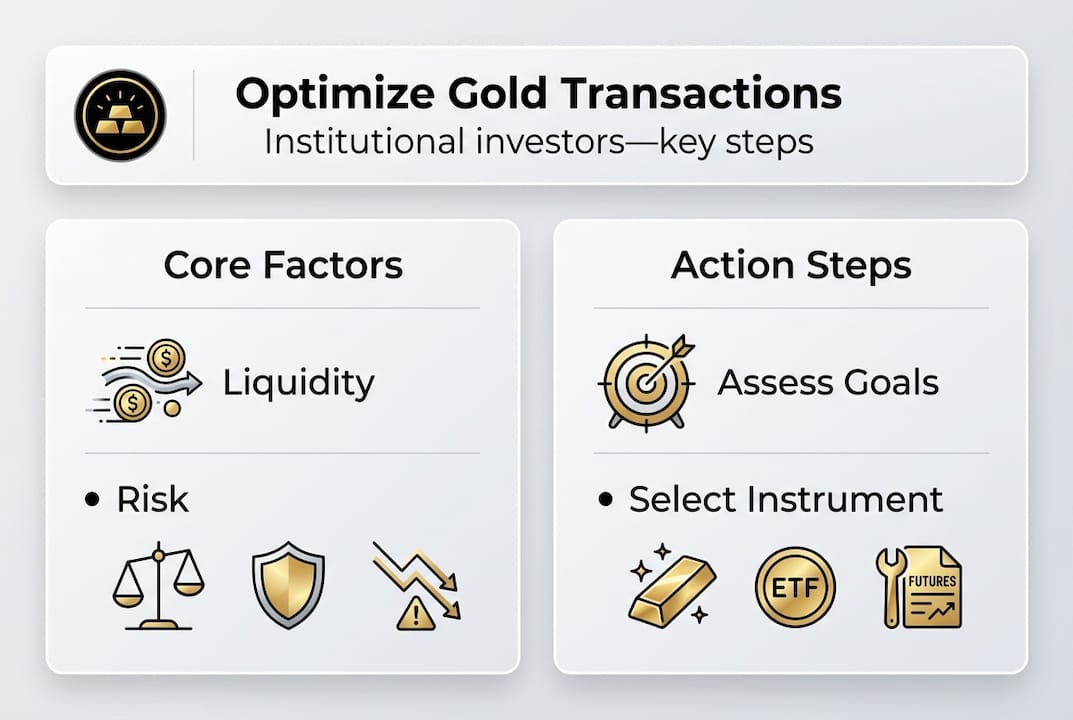
Also consider the WGC analysis on capital efficiency when modeling how gold fits within your broader asset allocation. Real yield trends and geopolitical risk premiums are legitimate timing inputs, but they should inform entry sizing, not replace a rules-based framework.
Pro Tip: Build a pre-trade checklist that includes real yield direction, central bank demand signals, and your current portfolio correlation to gold. This takes 20 minutes and prevents reactive, poorly-timed entries that erode performance.
Execute: A step-by-step process to optimize your gold transactions
With objectives defined and constraints mapped, execution becomes a structured process rather than a judgment call. Follow these steps to move from preparation to optimized performance.
Define position size. Use a volatility-adjusted method or Sharpe-maximizing allocation model. Avoid fixed-dollar sizing that ignores current market conditions.
Select the optimized vehicle. Match your instrument to the objective table from the preparation phase. Do not default to familiarity.
Confirm custody, margin, and settlement. Each instrument has distinct operational requirements. Physical gold needs a custodian confirmation. ETFs need a prime broker or exchange account. Futures require a cleared margin account with daily settlement capacity.
Apply risk overlays. Implement stop-loss levels, hybrid exit rules, or rules-based rebalancing triggers before the position is live. Decide these in advance, not during drawdowns.
Monitor execution costs and slippage in real time. Bid-ask spreads, market impact, and roll costs on futures can silently erode returns. Track them against pre-trade estimates.
The step-by-step gold trading process reinforces that each step builds on the last. Skipping custody confirmation, for example, creates settlement failures that trigger compliance flags and capital holds.
Hybrid strategies on GLD using models like SVR-PPO have demonstrated higher Sharpe ratios than simple buy-and-hold approaches. With 2025 gold demand exceeding 5,000 tonnes and prices up over 55% year over year, the cost of underperforming a disciplined strategy is measurable and significant. Review your gold trading strategies regularly against these benchmarks.
Compliance pitfall: Institutions that fail to document the rationale for instrument selection and position sizing at the time of trade face significant audit and regulatory exposure. Maintain a contemporaneous trade rationale log for every gold transaction above your internal materiality threshold.
Pro Tip: Digital gold platforms that operate on a Gold as a Service model can reduce reconciliation overhead, automate reporting, and free up operational capital that would otherwise sit idle in manual settlement processes.
Verify and refine: Monitoring, benchmarks, and ongoing optimization
Execution without verification is incomplete. Institutional-grade gold transaction management requires a feedback loop that compares outcomes to benchmarks and drives continuous improvement.
Key metrics to monitor on an ongoing basis:
ETF inflow trends: ETF inflows reached $89 billion in 2025 and $19 billion in January 2026 alone. These flows signal institutional sentiment shifts worth tracking.
LBMA price benchmarks: The LBMA average hit $4,135 per ounce in Q4 2025, up 55% year over year. Use this as your price performance anchor.
Sharpe ratio vs. benchmark: Compare your gold allocation’s risk-adjusted return against a relevant ETF or index benchmark quarterly.
Total demand context: With global gold demand at 5,002 tonnes in 2025, structural demand signals remain strong and should inform rebalancing decisions.
Execution cost variance: Track actual versus estimated transaction costs monthly.
Common gold transaction errors and correctives
Error | Impact | Corrective action |
Oversizing without volatility adjustment | Excess drawdown, margin calls | Implement volatility-scaled position limits |
Ignoring roll costs on futures | Silent return drag | Schedule roll reviews 5 days before expiry |
Custody gaps on physical gold | Settlement failure, audit risk | Confirm custodian capacity before trade |
No rebalancing trigger defined | Drift from target allocation | Set rules-based rebalancing bands (e.g., plus or minus 1.5%) |
Failing to document trade rationale | Regulatory and audit exposure | Maintain a real-time trade rationale log |
Use the risk management strategies framework to structure your review cadence. Quarterly reviews should assess allocation drift, custody costs, and instrument fit. Annual reviews should evaluate whether your chosen instruments still match your mandate given regulatory or market structure changes. The portfolio risk management discipline that separates top-tier institutions from the rest is not complexity. It is consistency.
Leverage advanced solutions for gold transaction optimization
For institutions ready to move from framework to execution, the right partner accelerates every step of this process. Galami Gold provides audited, capital-efficient solutions built specifically for institutional gold investors who need disciplined execution, transparent reporting, and scalable custody arrangements.

Working with leading gold trading solutions means your team gains access to structured processes that reduce operational friction, minimize compliance exposure, and optimize capital deployment across physical and digital gold instruments. Whether you are refining an existing allocation or building a new gold transaction framework from the ground up, Galami Gold’s team brings the operational depth and market expertise to support your objectives at scale. Reach out to explore how a purpose-built institutional gold trading program can strengthen your portfolio’s risk-adjusted performance.
Frequently asked questions
What is the most capital-efficient way to invest in gold for institutions?
ETFs and futures typically offer the best capital efficiency for institutions due to low outlay requirements, high liquidity, and minimal custody overhead compared to physical gold.
How much should an institutional portfolio allocate to gold?
Industry consensus, including the WGC’s recommended 5 to 10% allocation, supports this range as optimal for diversification without excessive concentration in a single asset class.
Are digital gold platforms a viable option for institutional transactions?
Yes. Digital gold platforms now support efficient custody, fractional transactions, and collateralized structures that reduce settlement friction and improve capital utilization for institutional users.
What risk management practices are most effective for institutional gold trades?
Volatility-adjusted sizing combined with hybrid exit strategies and real-time compliance monitoring consistently delivers better risk-adjusted outcomes than directional or discretionary approaches.
Recommended


Comments