


How trust shapes gold trading strategies for investors
- Shannon B
- Apr 5
- 8 min read


TL;DR:
Central banks’ gold repatriation signals a shift in trust towards domestic storage.
Trust in physical gold depends on authenticity, provenance, and counterparty credibility.
Digital verification tools complement, but do not replace, rigorous trust assessment and multi-party safeguards.
Central banks bought 863 tonnes of gold in 2025, a figure that remains historically elevated despite a 21% year-over-year dip. That number is not primarily a story about inflation hedging or dollar weakness. It is a story about trust. When sovereign institutions began moving gold back within their own borders, repatriating reserves from foreign vaults, they were sending a signal that the precious metals market has not fully absorbed: in gold trading at the highest levels, trust in counterparties, custodians, and systems is the variable that moves capital. For institutional investors and high-net-worth individuals, understanding this dynamic is no longer optional. It is a core competency.
Table of Contents
Key Takeaways
Point | Details |
Trust is paramount | Institutional and HNWI gold trades depend on verifying asset, custody, and counterparty trust at every step. |
Best practices evolve | Modern strategies blend digital verification tools with LBMA standards and rigorous third-party audits. |
Geopolitics reshape holdings | Trust shocks from sanctions or transparency crises prompt repatriation and higher domestic gold allocation. |
Protect portfolios via diligence | Proactive checks and diverse storage drive resilience in trusted gold strategies for top-tier investors. |
Why trust is foundational in gold trading
Gold occupies a unique position in any serious portfolio because it generates no cash flows. There are no dividends, no coupon payments, no earnings reports to validate your position. What you hold is a physical asset whose value is entirely bound up in its authenticity, its provenance, and the reliability of every party in its chain of custody. This is fundamentally different from equity or fixed income, where independent financial data can be cross-referenced to verify value.
For institutional gold trading, this creates a trust imperative that has no equivalent in other asset classes. When a sovereign wealth fund or family office allocates $500 million to physical gold, the quality of that allocation depends almost entirely on the credibility of the dealer, the vault, and the audit trail. Trust in gold investment is not a soft concept. It is the operational foundation.
The pillars that support this foundation are well-established among sophisticated market participants:
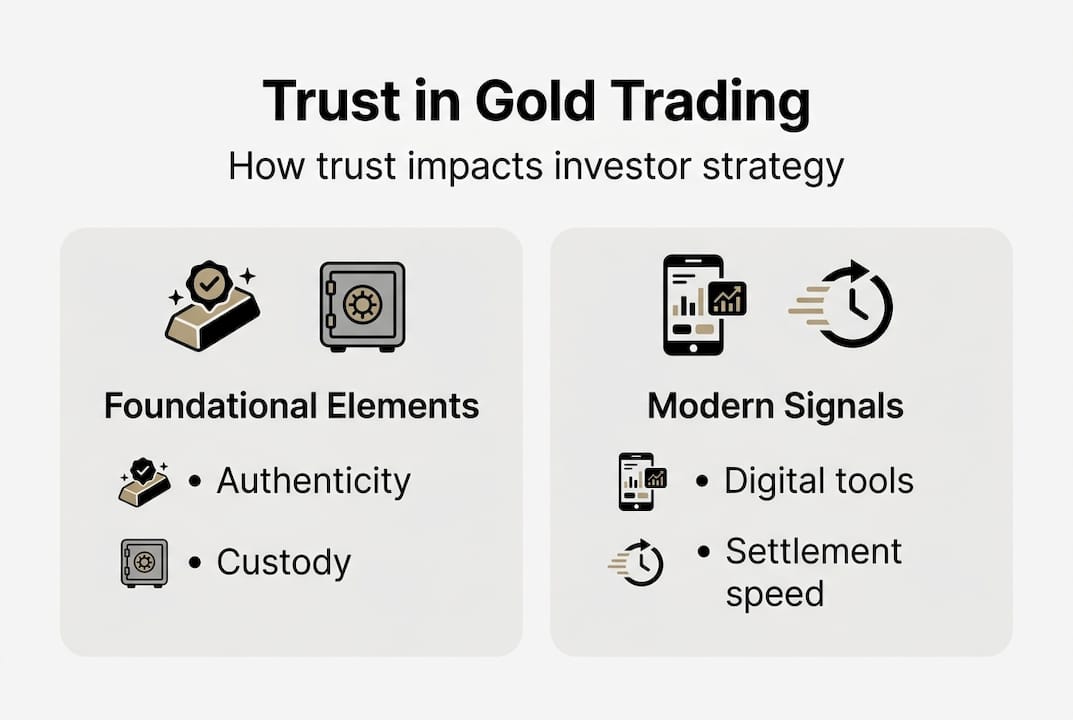
Asset authenticity: Every bar must be verifiable against recognized assay standards, with documented refinery origin.
Provenance records: A complete chain of custody from mine to vault, increasingly supported by blockchain-based ledgers.
Third-party audits: Independent verification by accredited auditors, conducted on a scheduled and surprise basis.
LBMA compliance: Adherence to London Bullion Market Association standards, the de facto global benchmark for institutional-grade gold.
Counterparty integrity: A documented track record of the dealer, custodian, and vault operator.
“Gold’s value relies on authenticity, provenance, and counterparty reliability without intrinsic cash flows — making trust the singular lens through which every institutional trade must be evaluated.”
The repatriation trend among central banks illustrates this perfectly. When the Bundesbank spent years recovering German gold from the Federal Reserve and Banque de France, it was not a logistical exercise. It was a public statement about where trust resided. For UHNW investors, the lesson is identical: custody location is a trust decision, not merely a convenience decision.
Key mechanisms for building trust in gold trading
Understanding why trust matters is only half the equation. The more actionable question is how to build and verify it systematically. In 2026, the institutional toolkit for trust-building combines proven traditional frameworks with emerging digital verification tools.
The minimum threshold for any serious institutional engagement starts with LBMA accreditation. Dealers on the LBMA Good Delivery List have met rigorous standards for bar quality, refinery transparency, and operational integrity. Insured vaults in stable jurisdictions, particularly Switzerland, Singapore, and select U.S. locations, add a contractual layer of protection. Third-party audits from recognized firms complete the baseline.
Beyond the baseline, building trust in gold trading now involves digital provenance tools. The World Gold Council’s Gold Bar Integrity program creates shared, tamper-resistant records that allow multiple parties to verify a bar’s history without relying on any single custodian’s word. Blockchain-based systems complement this by creating immutable audit trails accessible to all authorized parties in real time.

Settlement speed is another trust signal that is often underestimated. Trustworthy trading platforms that offer 24-hour settlement reduce counterparty exposure windows and signal operational confidence. Slow or opaque settlement processes, by contrast, are a red flag worth investigating.
Trust mechanism | Traditional approach | Modern enhancement |
Asset verification | Assay certificates | Blockchain provenance records |
Custody assurance | Vault insurance | Real-time audit dashboards |
Dealer credibility | LBMA accreditation | Verified transaction history |
Settlement integrity | Manual reconciliation | 24-hour automated settlement |
Audit frequency | Annual third-party review | Continuous monitoring systems |
Here is a prioritized approach for structuring trust verification:
Confirm LBMA Good Delivery status for every dealer and refinery in the chain.
Require vault insurance documentation and jurisdiction-specific legal protections.
Demand access to the Gold Bar Integrity database or equivalent provenance records.
Schedule both annual and surprise audits with accredited, independent firms.
Review settlement protocols and insist on documented counterparty exposure limits.
Pro Tip: For any transaction above $10 million, insist on third-party chain-of-custody documentation covering every transfer point, and schedule a vault audit within 90 days of initial allocation. This is not excessive caution. It is standard practice among central banks managing gold at scale.
How shifts in trust drive real-world trading behavior
The 2022 freezing of Russian sovereign assets was a watershed moment for gold markets. Almost overnight, it demonstrated that financial assets held in foreign jurisdictions could be rendered inaccessible by geopolitical action. The response among central banks and large institutional investors was swift and measurable.
Physical gold held in domestic vaults became the preferred structure. The repatriation trend that had been building gradually accelerated sharply. By 2025, 68% of central bank gold was held domestically, and 74% of central banks surveyed planned to increase domestic holdings by 2028. These are not marginal shifts. They represent a structural reallocation driven entirely by trust recalibration.
Key data points shaping the current landscape:
Central banks purchased 863 tonnes of gold in 2025, part of 5,002 tonnes in total global demand.
The dollar’s share of global reserves has declined from 71% to approximately 58% over the past two decades.
74% of central banks plan to increase domestic gold storage by 2028.
Emerging market central banks have been the most aggressive accumulators, led by China, India, and Turkey.
Behavior | Pre-2022 pattern | Post-2022 pattern |
Storage preference | Foreign vaults accepted | Domestic storage prioritized |
Asset mix | Diversified FX reserves | Increased physical gold weight |
Settlement currency | USD-denominated | Local currency and gold-settled |
Repatriation urgency | Low | High and accelerating |
Germany’s experience is instructive as an edge case. The Bundesbank’s multi-year repatriation process, which involved recovering gold from New York and Paris, raised legitimate questions about vault transparency and the practical mechanics of large-scale custody transfers. Institutions that had assumed foreign storage was seamless learned that it carried friction, opacity, and political complexity.
For Western institutional investors, this creates a gap. Emerging market and Chinese institutions have moved faster to adapt key gold trading factors to the new trust environment. A 2026 gold portfolio trust guide approach requires acknowledging that the old assumptions about custodian reliability in any single jurisdiction no longer hold unconditionally.
Designing a trust-centered gold trading strategy
Translating these insights into portfolio action requires a structured approach. The goal is not to eliminate all trust risk, which is impossible, but to distribute it intelligently and verify it continuously.
Start with allocation structure. A well-designed institutional gold position combines physical holdings in insured, audited vaults with a smaller allocation to traded instruments for liquidity management. The physical component should be the anchor, with physical gold allocation strategies guiding the sizing based on portfolio objectives and risk tolerance. The portfolio benefits of gold trading are maximized when the physical base is unambiguously trusted.
Here is a practical checklist for trust-centered strategy design:
Assess custodian risk: Evaluate jurisdiction stability, legal frameworks, and historical transparency of each vault operator.
Demand WGC and LBMA credentials: Accept no substitutes. These credentials represent the minimum viable trust standard.
Diversify storage jurisdictions: Never concentrate physical holdings in a single country or vault operator.
Schedule annual audits: Build audit rights into every custody agreement as a non-negotiable contractual term.
Involve multiple counterparties: Distribute trades and custody across at least two or three accredited partners to eliminate single-point-of-failure risk.
Monitor provenance databases: Use the Gold Bar Integrity database and equivalent tools to track bar-level history on an ongoing basis.
The post-2022 shift toward physical gold and domestic storage is not a temporary reaction. It reflects a durable recalibration of how sophisticated investors think about asset security. Partnering with trusted gold traders who have documented, audited processes is the most direct way to operationalize this recalibration.
Pro Tip: Involving multiple counterparties is not just about redundancy. It creates competitive pressure that keeps each partner accountable and gives you comparative data on pricing, settlement speed, and audit quality. UHNWI gold strategies consistently reflect this multi-counterparty discipline.
Why trust—not technology—remains the ultimate risk filter in gold trading
There is a temptation, particularly among technology-forward institutional teams, to treat digital verification tools as the solution to gold’s trust challenges. Blockchain provenance, real-time audit dashboards, automated settlement systems. These are genuinely useful. But they are not sufficient, and treating them as such is a mistake that experienced gold investors do not make.
Every digital system has failure modes. Blockchain records can be accurate and still represent fraudulent underlying assets if the initial data entry was corrupted. Automated dashboards can display stale or manipulated data if the underlying custody relationship is compromised. Technology surfaces information. It does not replace the judgment required to evaluate the people and institutions behind that information.
The gold market crises that have caused the most damage, from tungsten-filled bars to fraudulent warehouse receipts, did not begin with technology failures. They began with someone skipping a step in the trust verification process because the counterparty seemed credible, the deal moved quickly, or the audit was deferred for convenience. Why trading platforms matter is a legitimate question, but the more important question is always: who is behind the platform, and what is their documented track record?
Seasoned institutional investors treat trust verification as a continuous process, not a one-time onboarding check. The competitive advantage in gold trading is not access to the best technology. It is the discipline to apply rigorous trust standards consistently, even when it slows a transaction or complicates a relationship.
Secure your gold trading strategy with a trusted partner
The frameworks covered in this article reflect how the most disciplined institutional investors approach gold. Verified provenance, accredited custody, continuous audits, and multi-counterparty structures are not theoretical ideals. They are operational requirements for any portfolio where gold plays a meaningful role.

At Galami Gold, these standards are built into every engagement. Our platform is designed specifically for institutional investors and high-net-worth individuals who require LBMA-accredited vault solutions, fully documented audit trails, and streamlined onboarding without sacrificing rigor. If you are ready to apply the trust principles outlined here, explore how building trust in gold trading platforms works in practice with a partner whose processes are engineered for exactly this level of scrutiny.
Frequently asked questions
What are the core elements of trust in institutional gold trading?
Core elements include asset authenticity, transparent custody arrangements, independent third-party audits, and verified counterparty reliability. Without these, gold’s lack of intrinsic cash flows makes valuation and risk assessment fundamentally unreliable.
How do geopolitical risks affect trust and gold trading behavior?
Geopolitical shocks, such as the 2022 Russian asset freeze, erode confidence in foreign custodians and fiat reserves, prompting institutions to repatriate holdings and increase direct physical gold ownership. Central banks bought 863 tonnes in 2025 partly in response to these dynamics.
Can blockchain and digital tools fully resolve trust issues in gold trading?
Digital tools improve transparency and traceability, but physical gold trading still requires robust institutional diligence, reputation checks, and direct verification of custody arrangements. Technology surfaces data. Human judgment evaluates it.
How can HNWIs ensure their gold allocation is protected by trust safeguards?
Use only LBMA-accredited dealers, demand periodic vault audits as a contractual right, and diversify storage across multiple jurisdictions to avoid concentration risk in any single custodian or political environment.
Recommended

Comments