


Physical gold trading guide for institutional investors
- Shannon B
- Mar 7
- 10 min read


Many institutional investors assume physical gold trading is illiquid and cumbersome. Modern platforms now enable rapid settlements within 24 hours, transforming access to tangible assets. This guide clarifies how physical gold trading works, dispels common myths, and helps wealth management firms evaluate platforms that combine transparency with disciplined execution for capital preservation.
Table of Contents
Key takeaways
Point | Details |
Direct ownership reduces risk | Physical gold trading eliminates counterparty exposure through tangible asset control and insured custody. |
Supply chains ensure authenticity | Certified sourcing, refining, and auditing verify gold quality from mine to vault. |
Modern platforms deliver speed | Leading platforms settle trades within 24 hours while maintaining full transparency and security. |
Diversification benefits portfolios | Low correlation with equities and inflation hedging properties enhance risk-adjusted returns. |
Selection requires due diligence | Evaluate audit frequency, insurance coverage, technology standards, and regulatory compliance. |
Introduction to physical gold trading
Physical gold trading involves buying and selling tangible gold bars and coins through established supply chains globally. Unlike paper gold derivatives, this approach delivers actual metal ownership. Institutional investors now participate at unprecedented scale, leveraging physical gold for capital preservation during market volatility.
Global supply chains maintain rigorous quality standards from source to custody. Refiners, mints, and secure vaults form an interconnected network that validates authenticity at every stage. This infrastructure supports trillions in annual transactions while protecting asset integrity.
Wealth management firms integrate physical gold to achieve portfolio diversification objectives. The asset class offers protection against currency devaluation and geopolitical uncertainty. Understanding the operational mechanics of physical gold trading enables informed allocation decisions.
Key characteristics define this market:
Tangible ownership with direct title transfer
Standardized product specifications ensuring global acceptance
Institutional-grade custody with comprehensive insurance
Transparent pricing tied to global spot markets
Settlement processes balancing speed with security verification
Physical gold trading serves as a cornerstone for sophisticated investors seeking assets uncorrelated to traditional securities. The market continues evolving with technology innovations that enhance transparency and reduce operational friction.
Physical gold trading supply chain mechanisms
Certified sourcing and refining combined with minting standards ensure the authenticity and quality of physical gold trading products. Every bar and coin undergoes verification at multiple checkpoints. This multi-layered approach builds institutional confidence in asset provenance.
The supply chain follows these critical steps:
Mine operators extract gold ore and deliver concentrate to certified refiners meeting international standards.
Refiners process material to 99.99% purity, stamping bars with unique serial numbers and assay certificates.
Accredited mints produce coins with standardized weights, designs, and security features preventing counterfeiting.
Secure transportation firms move products between facilities using armored vehicles and real-time GPS tracking.
Specialized vaults store gold in segregated accounts with biometric access controls and 24/7 monitoring.
Independent auditors conduct regular inspections verifying physical inventory matches electronic records.
Secure custody represents the foundation of trust in physical gold supply chains. Vaults maintain insurance coverage exceeding total holdings value. Climate-controlled environments prevent physical degradation while redundant security systems protect against theft.

Provenance verification has become increasingly sophisticated. Blockchain technology now tracks gold from mine to end investor, creating immutable records of ownership transfers. This innovation addresses regulatory requirements and investor demands for ethical sourcing.
Pro Tip: Request detailed vault audit reports showing inspection frequency, insurance limits, and segregation protocols before committing capital to any physical gold platform.
Transportation protocols minimize risk during movement between facilities. Carriers coordinate with local authorities and use unmarked vehicles for high-value shipments. GPS tracking combined with armed escorts ensures gold reaches destination vaults without incident.
Risk management in physical gold trading
Counterparty risk is mitigated through actual physical ownership and insured custody on reputable platforms. When you hold allocated gold in segregated storage, you eliminate exposure to institutional failures affecting paper derivatives. This fundamental advantage attracts wealth managers prioritizing capital preservation.
Insurance policies provide comprehensive protection. Vault operators maintain coverage through Lloyd’s of London and specialized insurers familiar with precious metals. Policies typically cover theft, natural disasters, and transportation incidents at replacement value.
Third-party audits ensure custody integrity through regular physical counts. Independent firms verify serial numbers match electronic records and confirm gold meets purity specifications. Auditors issue certificates institutions can present to regulators and clients.
Robust platform risk management incorporates:
Segregated client accounts preventing commingling with operational assets
Multi-signature authorization requiring multiple approvals for large withdrawals
Cyber security protocols protecting digital systems from unauthorized access
Disaster recovery plans ensuring business continuity during emergencies
Regulatory compliance frameworks addressing anti-money laundering requirements
Reputable platforms publish annual risk management strategies in gold trading disclosures detailing their control environment. Transparency around risk protocols separates professional operations from undercapitalized competitors.
Operational risks receive equal attention to custody concerns. Platforms maintain redundant IT infrastructure preventing single points of failure. Staff undergo background checks and ongoing training in security procedures. Regular penetration testing identifies vulnerabilities before exploitation.
Pro Tip: Prioritize platforms offering gold investment risk management frameworks aligned with institutional governance standards, including independent custody and daily reconciliation processes.
Physical ownership transforms risk profiles compared to derivative exposure. You control the asset directly rather than relying on counterparty performance. This structural advantage proves invaluable during financial market stress when derivative chains face liquidity challenges.
Common misconceptions about physical gold trading
Many investors incorrectly believe physical gold lacks liquidity. Leading physical gold platforms can settle trades within 24 hours, matching or exceeding settlement speeds for many traditional securities. Modern inventory management and logistics enable rapid transactions at institutional scale.
The reality contradicts common physical gold trading misconceptions:
Myth: Physical gold requires weeks to buy or sell. Reality: Professional platforms execute trades and update ownership records same day, with physical delivery options available within 48 hours for urgent needs.
Myth: Transaction costs make physical gold prohibitively expensive. Reality: Spreads on large institutional trades often fall below 1%, justified by tangible ownership and elimination of ongoing management fees common in ETFs.
Myth: Storing physical gold creates unacceptable custody risks. Reality: Insured vault storage with third-party audits reduces risks below levels faced by institutions holding paper claims against unallocated pools.
Cost comparisons require examining total ownership expenses over investment horizons. Physical gold avoids annual management fees charged by funds and trusts. Initial acquisition spreads get amortized across holding periods, often resulting in lower all-in costs for multi-year positions.
Liquidity concerns stem from outdated perceptions of physical markets. Global trading networks now connect buyers and sellers instantly. Standardized products like London Good Delivery bars trade with minimal price discovery friction. Institutional investors access deep markets supporting billion-dollar transactions.
Custody risk management has evolved significantly. Modern vaults employ technology matching or exceeding bank safety deposit standards. Segregated storage means your specific bars remain identifiable and accessible. Insurance coverage provides financial protection exceeding typical FDIC limits on cash deposits.
Comparison: physical gold trading vs paper gold investment
Physical gold offers direct ownership and lowers counterparty risk compared to derivative paper gold products with higher counterparty exposure. Understanding these differences helps institutional gold investing risks assessment and allocation decisions.
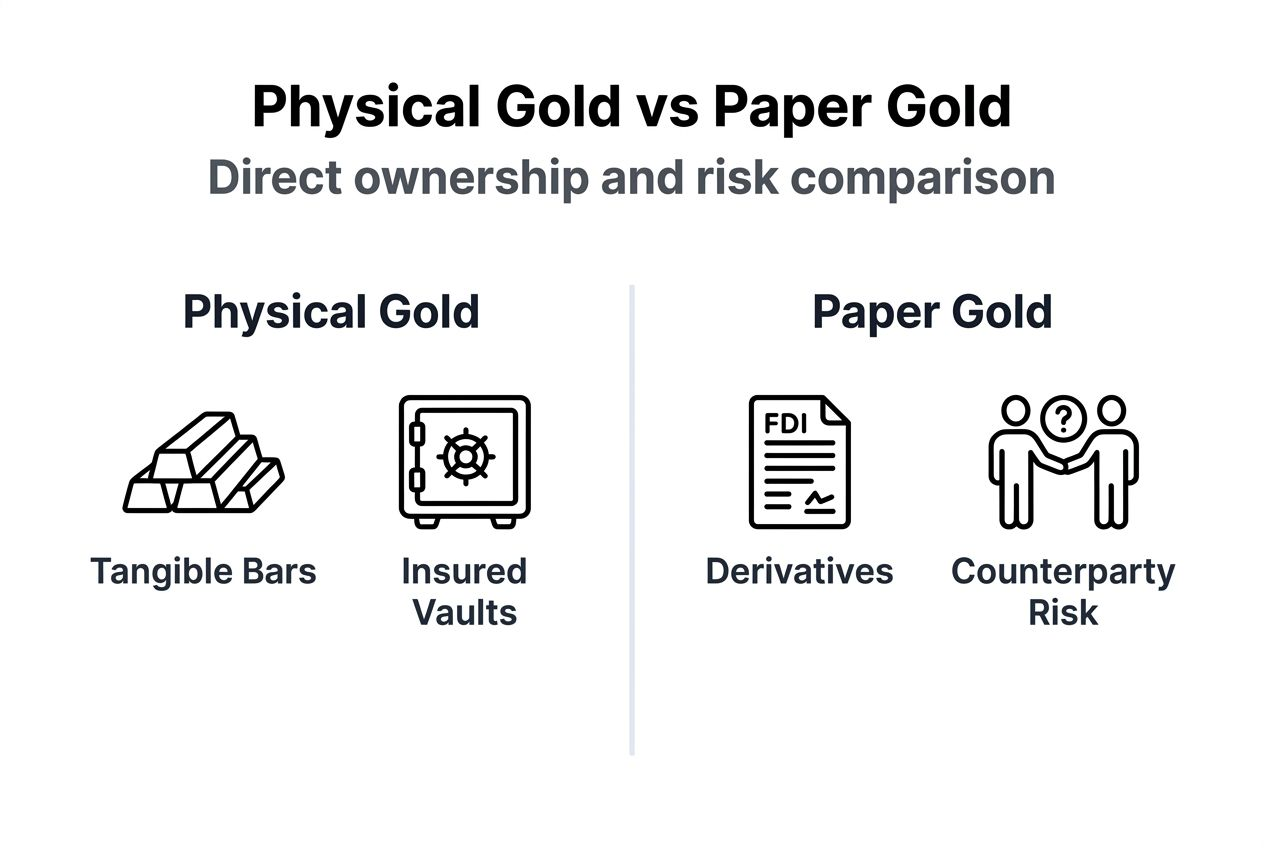
Feature | Physical Gold Trading | Paper Gold Investment |
Ownership structure | Direct title to specific bars or coins with serial numbers | Contractual claim against issuer’s pooled or synthetic exposure |
Counterparty risk | Minimal with allocated storage; limited to vault operator | Significant exposure to ETF manager, bank, or derivative counterparty |
Liquidity speed | 24-48 hours for settlement and delivery | Intraday trading during exchange hours with T+2 settlement |
Storage requirements | Physical vault space with insurance and security | Electronic book entry with custodian bank |
Regulatory treatment | Treated as physical commodity requiring provenance tracking | Securities subject to fund regulations and reporting requirements |
Audit transparency | Serial number verification through independent physical counts | Fund holdings disclosed quarterly with potential for unallocated positions |
Physical gold provides tangible assets you control directly. You can request delivery, inspect bars, and verify authenticity through independent assays. This level of control proves impossible with paper derivatives representing synthetic exposure.
Liquidity profiles differ but converge at institutional scale. Paper gold trades continuously during market hours with tight spreads. Physical gold platforms now match these speeds for standard products while offering delivery options paper investments cannot provide.
Key strategic considerations include:
Physical gold eliminates credit risk inherent in derivative structures
Paper gold offers greater trading flexibility for short-term tactical positions
Physical ownership supports regulatory requirements for tangible reserve assets
Paper investments simplify custody but introduce fund management risks
Regulatory frameworks treat these instruments differently. Physical gold qualifies as a tangible asset for balance sheet purposes. Paper derivatives may face margin requirements and mark-to-market accounting creating volatility in reported values.
Portfolio construction often benefits from combining both approaches. Physical gold serves long-term strategic allocations while paper instruments facilitate tactical adjustments. Institutional investors increasingly adopt this hybrid model balancing liquidity needs with counterparty risk management.
Benefits of physical gold trading in asset diversification
Physical gold’s low correlation with traditional assets and inflation-hedging properties make it a strategic portfolio diversifier. Academic research demonstrates gold’s correlation to equities averages just 0.1, providing genuine protection during equity market drawdowns.
The benefits of gold diversification extend across multiple portfolio objectives:
Portfolio volatility reduction through assets responding differently to economic shocks and monetary policy changes
Inflation protection as gold historically maintains purchasing power during currency devaluation periods
Crisis insurance providing positive returns when traditional assets face simultaneous declines
Currency diversification for investors concerned about fiat money depreciation risks
Capital preservation becomes paramount during market volatility. Physical gold demonstrated this value during 2020’s initial pandemic shock and subsequent inflationary pressures through 2023. Institutions holding physical allocations experienced cushioned portfolio impacts.
Long-term risk-adjusted returns improve with modest gold allocations. Studies suggest 5-15% portfolio weights optimize the efficiency frontier for many institutional mandates. Physical gold’s tangible nature provides psychological comfort during market stress that paper derivatives cannot match.
Inflation hedging effectiveness stems from gold’s finite supply and universal recognition as a store of value. Central bank monetary expansion increases fiat currency supply while gold production grows slowly. This supply dynamic supports gold’s purchasing power preservation across economic cycles.
Physical gold also serves geopolitical risk management. Unlike securities tied to specific jurisdictions, gold maintains value globally. This characteristic proves valuable for institutions managing assets across multiple regulatory environments and political systems.
Choosing reliable physical gold trading platforms
Platform transparency, audit frequency, custody insurance, and regulatory compliance are critical to selecting secure physical gold trading venues. The importance of gold trading platforms extends beyond transaction execution to encompassing custody integrity and operational resilience.
Evaluate platforms using these criteria:
Third-party audit frequency and auditor credentials, with quarterly physical counts representing best practice
Insurance coverage limits and carrier quality, ensuring policies exceed total holdings value
Custody arrangements clearly defining segregated versus allocated storage with your specific serial numbers
Settlement speed and reliability, with platforms guaranteeing execution within documented timeframes
Technology infrastructure supporting real-time reporting and blockchain provenance tracking
Regulatory compliance including anti-money laundering procedures and know-your-customer verification
Operational history and reputation among institutional investors and industry associations
Transparency separates professional platforms from marginal operators. Request detailed information about vault locations, insurance policies, and audit reports. Reputable platforms willingly share this documentation with prospective institutional clients.
Gold trading platform regulations continue tightening globally. Platforms must demonstrate robust anti-money laundering controls and customer due diligence. Verify your selected platform maintains licenses in relevant jurisdictions and submits to regulatory oversight.
Technological innovation enhances platform reliability. Blockchain integration creates immutable ownership records preventing disputes. Real-time inventory tracking ensures your gold remains identifiable and accessible. Mobile applications provide 24/7 account access and transaction capabilities.
Pro Tip: Schedule vault visits to physically inspect facilities and meet custody teams before committing significant capital. Leading platforms welcome client inspections as confidence-building measures.
Transaction costs deserve scrutiny beyond headline spreads. Evaluate all-in expenses including storage fees, insurance charges, and withdrawal costs. Platforms offering artificially low spreads often compensate through elevated ancillary fees.
Platform reputation requires independent verification. Consult industry associations, regulatory databases, and peer institutions. Longevity in business provides some assurance but verify continuous compliance rather than assuming past performance guarantees current standards.
Explore GALAMI GOLD for trusted physical gold trading
Institutional investors seeking secure physical gold trading platforms can explore solutions combining transparency with operational excellence. Understanding supply chain integrity, risk management frameworks, and custody standards prepares you to evaluate platforms effectively.

GALAMI GOLD operates as a physical gold trading platform emphasizing disciplined execution across established supply chains. The platform offers institutional clients access to audited custody, transparent pricing, and settlement processes designed for sophisticated investors. Secure vaults, comprehensive insurance, and regular third-party audits support confident capital deployment in physical gold markets.
Explore the GALAMI GOLD physical gold trading platform to learn how transparent operations and robust risk management frameworks align with institutional investment standards. The platform’s focus on supply chain integrity and custody security addresses core concerns wealth managers face when allocating to physical precious metals.
Frequently asked questions about physical gold trading
What are the key audit standards for physical gold trading platforms?
Reputable platforms undergo quarterly physical inventory audits by independent firms verifying serial numbers match electronic records and confirming gold meets London Good Delivery standards. Auditors should possess credentials from recognized accounting bodies and publish detailed reconciliation reports clients can review.
How quickly can institutional clients expect trade settlement?
Modern platforms settle ownership transfers within 24 hours for standard transactions, updating account records and providing confirmation documentation same day. Physical delivery, when requested, typically occurs within 48 hours for vault-to-vault transfers and up to five business days for remote locations requiring specialized transportation.
What measures protect physical gold during transportation?
Carriers use armored vehicles with GPS tracking and armed escorts for high-value shipments. Insurance covers full replacement value during transit, with policies maintained by Lloyd’s of London and specialized precious metals insurers. Coordination with local authorities and unmarked vehicles minimize security risks during movement between facilities.
Can blockchain improve transparency in physical gold ownership?
Blockchain technology creates immutable records tracking gold from mine extraction through refining, minting, and custody transfers. Each transaction generates a permanent ledger entry linking specific serial numbers to current owners, enabling real-time provenance verification and addressing regulatory requirements for ethical sourcing documentation.
How does physical gold trading fit within regulatory frameworks globally?
Physical gold qualifies as a tangible commodity subject to anti-money laundering regulations requiring customer identification and transaction reporting above specified thresholds. Platforms must maintain licenses in operating jurisdictions and comply with tax reporting obligations. Unlike securities, physical gold avoids certain fund regulations but faces heightened scrutiny around provenance and ethical sourcing.
Recommended

Comments