


Why gold secures portfolio diversification and reduces risk
- Shannon B
- Mar 28
- 8 min read


The classic 60/40 portfolio, long considered the gold standard of institutional risk management, is showing structural cracks. Since 2020, stock-bond correlations have turned positive, meaning bonds no longer reliably cushion equity drawdowns the way they once did. For institutional investors and high-net-worth individuals, this shift is not a minor inconvenience. It is a fundamental challenge to how portfolios are built and protected. Gold, with its distinct correlation profile and centuries-long track record, offers a data-backed solution that deserves serious allocation consideration.
Table of Contents
Key Takeaways
Point | Details |
Gold counters asset correlation | Adding gold reduces reliance on stocks and bonds by introducing unique non-correlation into the portfolio. |
Data-backed allocations matter | Optimal results come from allocating 4-18 percent gold based on empirical risk-return research. |
Performance in market stress | Gold has proven to protect capital during major crises and equity drawdowns more reliably than other assets. |
Multiple implementation vehicles | Physical bullion, ETFs, and gold miners each provide different access and risk profiles for investors. |
Partner for effective execution | Institutional-grade results require secure, transparent trading partners for gold exposure. |
The diversification dilemma: Why stocks and bonds aren’t enough
For decades, the logic was simple: when stocks fall, bonds rise. That inverse relationship made the 60/40 portfolio a reliable framework for balancing growth and stability. But that relationship has broken down. Rising stock-bond correlation reduces bonds’ diversification benefit, particularly during inflationary periods and rate hike cycles, which is precisely when protection matters most.
The result is a portfolio that looks diversified on paper but behaves like a concentrated bet during market stress. Both assets can fall together, leaving investors exposed to risks that traditional allocation models were never designed to handle.
Several critical risk categories remain unaddressed in a stocks-and-bonds-only portfolio:
Inflation risk: Bonds lose real value when inflation accelerates, and equities often follow.
Monetary policy shocks: Aggressive rate hikes compress both asset classes simultaneously.
Geopolitical risk: Systemic global events can trigger correlated selloffs across traditional assets.
Tail risk: Low-probability, high-impact events expose the limits of standard diversification.
This is where portfolio risk management demands a broader toolkit. Understanding gold’s role for institutional investors starts with recognizing what traditional assets simply cannot provide.
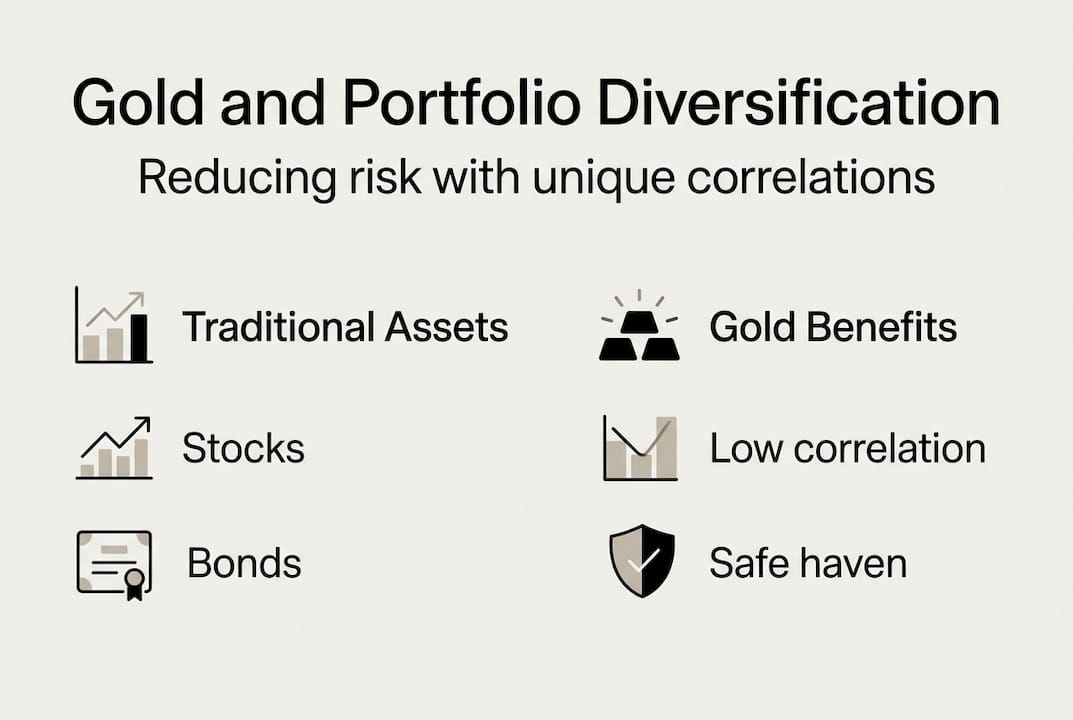
Gold’s unique correlation profile: The evidence explained
Correlation, in asset allocation terms, measures how two assets move relative to each other. A correlation of +1 means they move in lockstep. A correlation of 0 means they move independently. A negative correlation means they tend to move in opposite directions. For diversification, lower is better.
Gold’s low or negative correlation with equities and bonds is one of its most powerful and consistent characteristics. This is not a recent phenomenon. It holds across bull markets, bear markets, inflationary regimes, and financial crises.
Market condition | Gold vs. equities | Gold vs. bonds |
Bull market | Near zero | Slightly negative |
Bear market | Negative to low | Negative |
High inflation | Negative | Negative |
Financial crisis | Negative | Near zero to negative |
Gold’s correlation with equities hovers near zero across most market environments, and its correlation with bonds is frequently negative, making it one of the few assets that genuinely diversifies a traditional portfolio.
The practical implication is significant. Adding gold to a 60/40 portfolio does not just add another asset. It introduces a fundamentally different return driver. The safe-haven characteristics of gold mean it tends to hold or gain value precisely when other assets are under pressure.

Pro Tip: Even a 5% gold allocation can meaningfully reduce portfolio volatility without sacrificing long-term return potential. The math works because gold’s low correlation reduces the overall variance of the portfolio, not just the individual asset’s risk. You can explore a detailed diversification case study to see this effect modeled across historical periods.
Optimal gold allocation: How much to add for maximum impact?
Empirical studies show that optimal gold allocations of 4% to 18% improve risk-adjusted returns over traditional 60/40 portfolios. That is a wide range, and the right number depends on your specific risk tolerance, investment horizon, and current macro environment. But the direction is clear: some gold is almost always better than none.
Gold allocation | Estimated volatility reduction | Sharpe ratio improvement |
5% | 3 to 5% | Moderate |
10% | 6 to 9% | Significant |
15% | 8 to 12% | Strong |
18% | Up to 14% | Near optimal |
These figures are drawn from backtested and forward-looking research across multiple market cycles. The optimal allocation evidence consistently points to a sweet spot between 10% and 15% for most institutional mandates.
Here is a practical framework for determining your ideal gold percentage:
Assess your current correlation exposure. Run a correlation matrix on your existing holdings. If bonds and equities are moving together, your effective diversification is lower than it appears.
Define your inflation and rate sensitivity. Portfolios with heavy fixed-income exposure benefit most from gold’s inflation hedge properties.
Set a baseline allocation. Start with 5% to 10% and model the impact on your portfolio’s Sharpe ratio and maximum drawdown.
Stress-test against historical crises. Simulate how your portfolio would have performed in 2008, 2020, and other major drawdowns with and without gold.
Establish a rebalancing schedule. Gold’s price can move sharply. Quarterly or semi-annual rebalancing keeps your allocation within target bands.
Pro Tip: In environments where equity volatility is elevated or bond yields are rising, consider moving toward the upper end of the 10% to 18% range. The allocation strategies that outperform tend to be those that adjust dynamically rather than staying fixed. Review your trading strategy frameworks to align execution with your allocation targets.
Gold in crisis: Safe-haven performance under market stress
The theoretical case for gold is compelling. The historical record is even more persuasive. Gold outperformed equities in 8 of 11 major stock crashes since 1990, delivering positive returns when equity markets were in freefall. That is not luck. It reflects gold’s structural role as a store of value during systemic uncertainty.
Consider the pattern across major drawdowns:
2000 to 2002 (dot-com bust): The S&P 500 fell over 49%. Gold gained approximately 12% over the same period.
2008 to 2009 (global financial crisis): Equities dropped more than 50%. Gold ended the period positive and surged in the recovery.
March 2020 (COVID crash): Gold initially dipped with everything else, then quickly recovered and hit all-time highs within months.
2022 (rate shock): Both stocks and bonds fell sharply. Gold held its value far better than either asset class.
Gold has demonstrated consistent safe-haven behavior across G7 and major emerging market economies, outperforming in 5 of 9 G7-plus countries during periods of acute financial stress, underscoring that its defensive role is not limited to any single market.
Why does gold behave this way? During systemic shocks, investors flee to assets with no counterparty risk and no default risk. Gold has neither. It cannot go bankrupt. It cannot be inflated away by a central bank. These properties make it uniquely valuable when the financial system itself is under strain. You can review market scenario analysis for a deeper look at gold’s behavior across different crisis types.
The advantages during crises extend beyond simple price appreciation. Gold also provides liquidity in markets where other assets become difficult to trade. For institutional portfolios, that liquidity premium is often underappreciated until it is urgently needed. The country-specific safe-haven data reinforces that gold’s protective role holds across geographies, not just in the United States.
Applying gold diversification: Implementation strategies and nuances
Knowing you need gold is one thing. Executing the allocation efficiently is another. The vehicle you choose matters significantly for cost, liquidity, and operational complexity.
Implementation vehicles:
Physical bullion: Maximum security and no counterparty risk. Requires custody solutions and has higher transaction costs. Ideal for long-term, large-scale institutional holdings.
Gold ETFs: Highly liquid, low-cost, and easy to rebalance. Suitable for most institutional mandates. Introduces some counterparty exposure through the fund structure.
Gold miners: Leveraged exposure to gold prices with added equity risk. Useful for tactical overweights but not a substitute for direct gold exposure.
Gold futures: Capital-efficient and highly liquid. Requires active management and roll cost awareness. Best suited for sophisticated trading desks.
For most institutional investors and HNWIs, a combination of physical gold and ETFs provides the best balance of security, liquidity, and cost efficiency. The practical investment steps for building this exposure are straightforward once you have a clear allocation target.
Here is a step-by-step approach to implementation:
Define your allocation target based on the framework outlined in the previous section.
Select your primary vehicle. For most institutions, a core physical holding supplemented by ETFs for liquidity is optimal.
Identify a custody solution. For physical gold, institutional-grade custody is non-negotiable. Vaulting, insurance, and audit trails are essential.
Execute in tranches. Avoid deploying the full allocation at once. Dollar-cost averaging over three to six months reduces timing risk.
Set rebalancing triggers. Define the bands within which your gold allocation can drift before you rebalance. A plus or minus 2% band is a common institutional standard.
The strategy guide for building a resilient gold position also emphasizes the importance of working with trading partners who can provide evidence-backed allocation mechanics, including ETF and physical options that maintain near-zero correlation with equities while reducing drawdowns and volatility over time.
Secure your portfolio: Partner with a trusted gold provider
The evidence for gold’s role in institutional portfolios is clear. Executing that strategy at scale requires more than conviction. It requires a trading partner with the infrastructure, transparency, and track record to support institutional-grade gold allocations.

At Galami Gold, we specialize in physical gold trading built on disciplined execution, audited supply chains, and full transparency at every stage of the transaction. Whether you are establishing a core physical position or optimizing an existing allocation, our team provides the operational rigor that institutional mandates demand. Our approach to portfolio risk management is grounded in the same evidence-based frameworks outlined in this article. If you are ready to move from analysis to action, we invite you to connect with our team and explore how Galami Gold can support your diversification objectives with precision and integrity.
Frequently asked questions
How does gold improve portfolio risk-adjusted returns?
Gold’s near-zero correlation with equities and negative correlation with bonds lowers overall portfolio volatility and enhances Sharpe ratios, delivering better returns per unit of risk.
What is the optimal gold allocation for diversification?
Empirical studies recommend adding 4% to 18% gold to conventional 60/40 portfolios, with most institutional mandates finding the strongest results between 10% and 15%.
Does gold always act as a safe-haven asset?
Gold has outperformed equities in 8 of 11 major market drawdowns since 1990, though safe-haven effectiveness can vary by country, crisis type, and duration.
What are the main ways institutions can invest in gold?
Institutions typically use physical bullion, ETFs, gold miners, or futures, with the optimal mix via ETFs and physical providing near-zero equity correlation while reducing volatility and drawdowns.
Why is working with a reliable gold trading partner essential?
Trusted partners provide audited, transparent, and operationally secure gold transactions, which are non-negotiable requirements for institutional-grade portfolio execution and custody compliance.
Recommended


Comments