


Why Invest in Gold: Stability for Global Portfolios
- Shannon B
- Feb 17
- 6 min read


Volatile markets have pushed many institutional investors to rethink how they protect and grow assets. Gold stands out for its ability to act as a hedge against inflation and preserve value through shifting economic cycles, a trait supported by academic research. The article explains gold’s strategic role, investment formats, and risk management principles, helping wealth managers navigate misconceptions and build transparent gold trading solutions for stable portfolio diversification.
Table of Contents
Key Takeaways
Point | Details |
Gold as a Strategic Asset | Gold serves as a store of value, a hedge against economic uncertainty, and a mechanism for portfolio diversification. |
Investment Approaches | Various gold investment forms include physical gold, financial instruments, and digital gold, each suited for different investor profiles. |
Institutional Use | Institutional investors value gold for its resilience during market disruptions and its ability to enhance portfolio stability. |
Risk Management Principles | Comprehensive risk management and ethical sourcing are essential for maintaining integrity in gold investment practices. |
Gold as an Asset: Core Definition and Misconceptions
Investors have long recognized gold as a strategic financial instrument, but misconceptions often cloud its true potential. Understanding gold requires moving beyond simplistic narratives to appreciate its nuanced role in sophisticated investment portfolios. Gold’s strategic asset allocation represents a complex financial tool with multifaceted characteristics.
At its core, gold functions as more than just a traditional commodity. It operates as a:
A store of financial value
A hedge against economic uncertainty
A portfolio diversification mechanism
A potential inflation protection instrument
Traditional investment approaches frequently misunderstand gold’s sophistication. Many investors mistakenly view gold as a static, unchanging asset. However, academic research reveals gold’s dynamic nature across different economic cycles. Its performance is not uniform but strategically variable, offering institutional investors flexible risk management opportunities.
Professional portfolio managers typically allocate between 1-4% of total assets to gold, recognizing its unique properties. These allocations are not arbitrary but carefully calculated based on:
Risk tolerance levels
Global economic conditions
Specific portfolio composition requirements
Potential hedging needs
Pro tip: Conduct periodic portfolio reviews to assess gold’s optimal allocation, understanding that its strategic value shifts with changing macroeconomic landscapes.
Types of Gold Investment and Trading Approaches
Investors have multiple pathways to engage with gold as a financial asset, each presenting unique advantages and strategic considerations. Various forms of gold investment offer sophisticated approaches tailored to different risk profiles and investment objectives.
The primary gold investment categories include:
Physical Gold
Bullion bars
Investment-grade coins
Jewelry with investment potential
Financial Instruments
Exchange-traded funds (ETFs)
Gold futures contracts
Mutual funds with gold exposure
Digital Gold
Electronic trading platforms
Gold-backed digital currencies
E-gold investment accounts
Physical gold investments remain popular among risk-averse investors seeking tangible assets. These formats provide direct ownership and serve as a hedge against economic volatility. Financial instruments like ETFs offer greater liquidity and lower transaction costs, allowing investors to gain gold exposure without physical storage challenges.
Professional investors often diversify across multiple gold investment approaches to optimize portfolio performance. Strategic considerations include:
Here’s how the main gold investment formats compare across critical factors:
Investment Format | Liquidity Level | Storage Requirement | Typical Investor Type |
Physical Gold | Low to Medium | Secure physical vault | Risk-averse, long-term saver |
Financial Instruments | High | None | Active traders, institutions |
Digital Gold | High | Digital account | Tech-savvy, global investor |
Transaction costs
Storage requirements
Liquidity preferences
Risk management objectives
Tax implications
Pro tip: Evaluate your investment goals and risk tolerance before selecting gold investment approaches, considering the unique characteristics of each investment format.
Key Characteristics of Gold in Institutional Portfolios
Institutional investors recognize gold as a sophisticated asset with unique portfolio dynamics. Institutional portfolios evaluate gold through a strategic lens that transcends traditional investment perspectives, emphasizing its nuanced risk-mitigation capabilities.
The core characteristics that make gold attractive to institutional investors include:
Resilience during Market Disruptions
Maintains value across economic cycles
Provides consistent purchasing power preservation
Offers protection against systemic financial risks
Macroeconomic Hedging Capabilities
Counterbalances inflationary pressures
Reduces portfolio volatility
Mitigates currency debasement risks
Strategic Diversification Mechanism
Low correlation with traditional asset classes
Enhances overall portfolio stability
Supports long-term wealth preservation strategies
Unlike conventional assets, gold demonstrates remarkable adaptability across different economic environments. Institutional investors appreciate its ability to maintain intrinsic value during periods of economic uncertainty, geopolitical tension, and market volatility. The asset’s performance is not directly tied to corporate earnings or government monetary policies, making it a unique risk management tool.
Professional portfolio managers typically consider the following strategic dimensions when incorporating gold:
Allocation percentage
Investment vehicle selection
Liquidity requirements
Long-term performance expectations
Geopolitical risk management
Pro tip: Continuously reassess your gold allocation strategy, recognizing that optimal portfolio composition evolves with changing macroeconomic landscapes.

Risk Management, Transparency, and Compliance Principles
Navigating the complex landscape of gold investment demands rigorous risk management and unwavering commitment to ethical sourcing standards. Comprehensive due diligence processes are fundamental to maintaining institutional integrity and mitigating potential financial and reputational risks associated with gold trading.
Key risk management principles for gold investments include:
Financial Risk Mitigation
Detailed supply chain screening
Comprehensive counterparty assessments
Regular compliance audits
Ethical Sourcing Standards
Verification of conflict-free origins
Human rights impact assessments
Environmental sustainability checks
Regulatory Compliance
Adherence to international trading regulations
Transparent reporting mechanisms
Anti-money laundering protocols
Institutional investors must implement sophisticated screening mechanisms that extend beyond traditional financial metrics. This involves comprehensive risk mapping, third-party audits, and alignment with international standards like the Responsible Minerals Assurance Process (RMAP) and OECD Due Diligence Guidance. These frameworks provide structured approaches to identifying and mitigating potential risks throughout the gold supply chain.
Critical compliance dimensions for gold investment strategies include:
Comprehensive documentation
Transparent transaction records
Regular independent audits
Continuous risk assessment
Stakeholder communication protocols
Pro tip: Develop a dynamic risk management framework that adapts to evolving regulatory landscapes and emerging ethical sourcing challenges.
Costs, Risks, and Comparisons With Alternatives
Investors seeking comprehensive portfolio strategies must critically analyze gold’s performance relative to alternative assets. Gold’s unique market positioning offers distinctive advantages that transcend traditional investment categories, providing strategic flexibility across volatile economic landscapes.
Compared to alternative investment vehicles, gold demonstrates unique characteristics:
Performance Attributes
High liquidity
Low correlation with other assets
Downside market resilience
Zero counterparty risk
Cost Considerations
Storage expenses
Insurance premiums
Transaction fees
Tax implications
Risk Management Features
Inflation hedge
Crisis protection
Geopolitical stability indicator
Portfolio stabilization mechanism
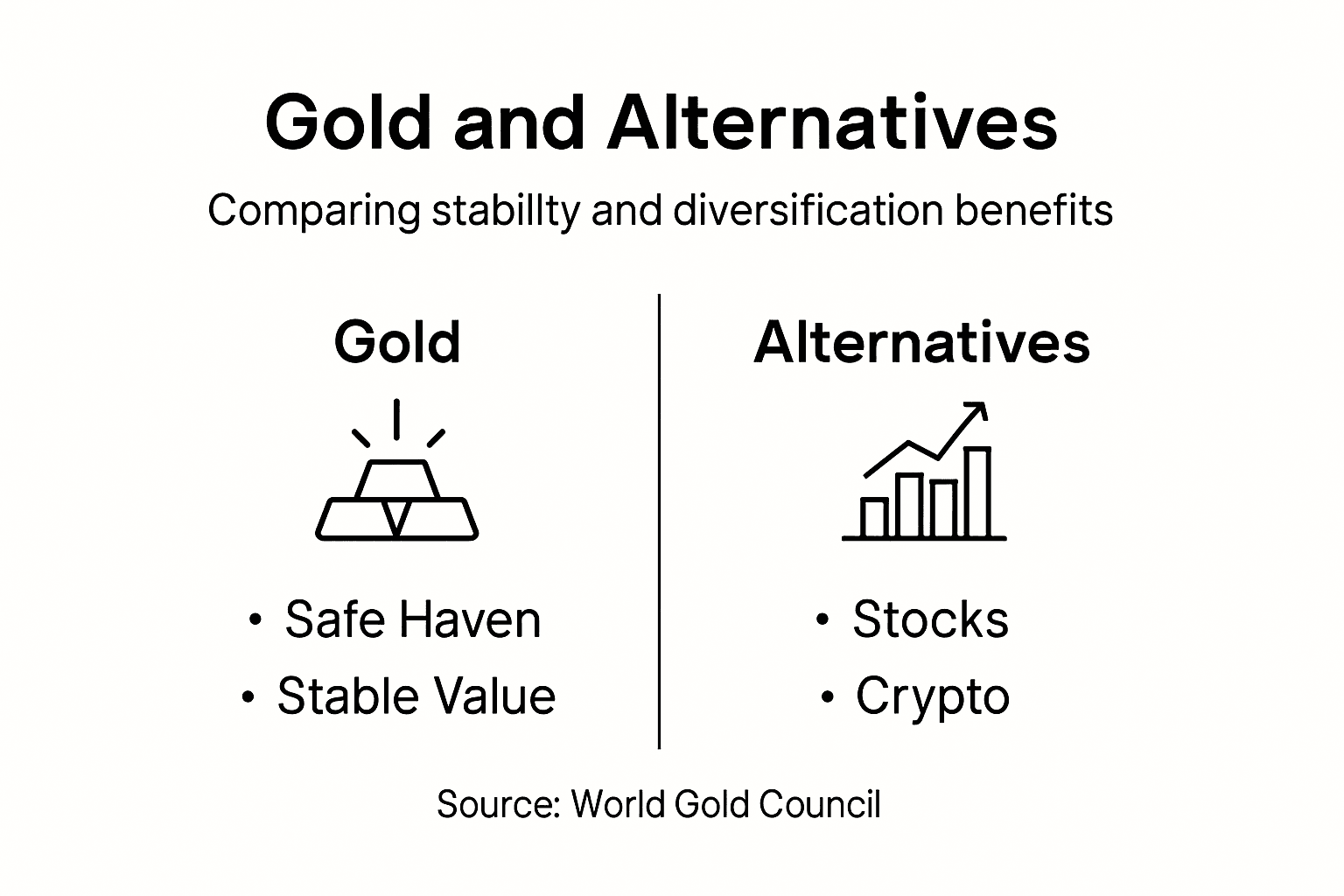
Traditional alternatives like stocks, bonds, real estate, and cryptocurrencies each present distinct investment profiles. Gold uniquely bridges public and private market characteristics, offering capital flexibility that many alternative investments cannot match. While equities might provide higher long-term average returns, gold excels during systemic market stress, demonstrating consistent performance across economic disruptions.
This table highlights how gold’s investment attributes differ from other alternative assets:
Attribute | Gold | Bonds | Real Estate |
Liquidity | High | Medium to High | Low to Medium |
Inflation Response | Strong hedge | Variable protection | Partial hedge |
Market Correlation | Low | Moderate | Moderate to High |
Storage/Upkeep Cost | Moderate | Minimal | High (maintenance/taxes) |
Investors must evaluate comparative investment dimensions through multiple lenses:
Historical return performance
Volatility metrics
Correlation coefficients
Liquidity constraints
Macroeconomic sensitivity
Pro tip: Conduct comprehensive comparative analysis using multiple economic scenarios to understand gold’s relative performance across different market conditions.
Strengthen Your Portfolio with Trusted Physical Gold Solutions
If you are seeking stability and strategic diversification for your global portfolio investing in gold is a proven way to hedge against market volatility and inflation as highlighted in the article. Challenges such as managing risk through disciplined allocation and ensuring transparency in the gold supply chain are critical concerns sophisticated investors face today. Galami Gold specializes in addressing these pain points by offering a secure physical gold trading platform grounded in trust integrity and efficient capital deployment.
Their approach covers comprehensive risk management and ethical sourcing to protect investors from financial uncertainties and reputational risks. With a focus on clear and transparent execution across well-established gold supply chains Galami Gold aligns with the article’s emphasis on gold’s resilience and portfolio stabilization capabilities.

Explore how you can integrate physical gold into your investment strategy through Galami Gold’s trading program. Take action now to safeguard your portfolio against economic disruptions by partnering with a platform that delivers both credibility and strategic flexibility. Visit Galami Gold today and discover tailored gold investment opportunities designed for discerning global investors.
Frequently Asked Questions
What are the primary benefits of investing in gold?
Gold serves as a store of financial value, a hedge against economic uncertainty, and a mechanism for portfolio diversification. It also offers potential protection against inflation, making it a strategic asset in turbulent times.
How does gold perform during economic downturns?
Gold tends to maintain its value during market disruptions and can provide consistent purchasing power preservation, making it an attractive option for risk-averse investors.
What types of gold investments are available?
Investors can choose from physical gold (like bullion and coins), financial instruments (such as ETFs and futures), and digital gold options, each catering to different risk profiles and investment objectives.
How does gold compare to other investment assets?
Gold shows high liquidity, low correlation with other assets, and serves as a strong inflation hedge compared to traditional investments like stocks, bonds, and real estate, making it a unique portfolio stabilizer.
Recommended


Comments