


Why Gold Trading Attracts Investors Worldwide
- Shannon B
- Feb 24
- 12 min read


Market volatility can leave even the most seasoned institutional investors searching for resilient solutions that truly safeguard portfolios. The enduring appeal of gold stems from more than its visual allure—its role as a reliable store of value and a dynamic financial instrument is recognized by central banks and global participants. This article clarifies key misconceptions about gold trading and uncovers how diversification with gold can reduce risk and strengthen portfolio stability, especially when conventional assets falter.
Table of Contents
Key Takeaways
Point | Details |
Understanding Gold Trading | Gold trading involves active engagement in gold contracts and futures, differentiating it from merely holding physical gold. Investors can leverage market movements for returns rather than just relying on long-term appreciation. |
Dispelling Misconceptions | Common myths, like the belief that gold trading requires little expertise or that all platforms offer the same quality, can lead to costly mistakes. Comprehensive knowledge about the market is essential for success. |
Diversification Benefits | Gold serves as an effective diversification tool within portfolios, often moving inversely to stocks during market downturns, which can mitigate overall risk. Allocating even a small percentage to gold can enhance portfolio stability. |
Risks and Costs | Investors should be aware of the risks associated with gold trading, including price volatility and trading costs, which can erode returns if not managed properly. Regulatory compliance is also crucial for safe trading. |
Gold Trading Defined and Common Misconceptions
Gold trading operates differently than simply buying physical bars and storing them in a vault. It involves the active buying and selling of gold contracts, futures, or positions through established markets and trading platforms. For institutional investors, understanding this distinction separates profitable strategy from costly mistakes.
At its core, gold trading means engaging with gold as a financial instrument rather than a physical commodity alone. Traders capitalize on price movements, market inefficiencies, and economic cycles to generate returns. This contrasts sharply with static gold ownership, where value depends primarily on long-term appreciation.
What Gold Trading Actually Is
Gold trading centers on three main mechanisms:
Spot trading involves buying or selling gold at current market prices for immediate delivery
Futures contracts allow you to lock in prices for future delivery dates, enabling leverage and risk management
Options and derivatives provide hedging tools that protect against adverse price movements
These instruments serve different purposes. Spot trading works best for direct gold acquisition. Futures trading appeals to institutional investors seeking exposure without physical storage logistics. Understanding the operational mechanics of physical gold trading helps clarify which approach aligns with your investment objectives.
Debunking Five Major Misconceptions
Investors worldwide hold persistent beliefs about gold that simply don’t reflect market reality.
Misconception 1: Gold only serves as jewelry or ornamentation. Gold’s value extends far beyond aesthetics. It has essential industrial uses due to superior electrical conductivity and corrosion resistance. Technology manufacturers, medical device producers, and aerospace companies depend on gold for critical applications.
Misconception 2: Gold prices move independently from economic conditions. This misses the real story entirely. Gold prices reflect global uncertainties, economic crises, and inflation protection. During recessions and inflationary periods, prices rise as investors seek safe havens. During stable markets, prices often decline as capital flows toward speculative assets like equities.
Misconception 3: Gold trading requires minimal knowledge or preparation. Successful traders understand technical analysis, macroeconomic indicators, and geopolitical risk factors. Market timing demands discipline and research.
Misconception 4: All gold trading platforms offer the same execution quality. This couldn’t be further from the truth. Execution speed, transparency, risk management protocols, and supply chain integrity vary dramatically across providers. Your choice of platform directly impacts profitability and safety.
Misconception 5: Physical gold ownership and trading are interchangeable. They serve different purposes. Ownership provides tangible security; trading generates capital from price movements. Many sophisticated portfolios use both strategies.
Gold trading success depends on understanding what you’re actually trading and why market prices move, not on holding physical assets in a vault.
Pro tip: Before executing your first gold trade, clearly define whether you’re seeking price appreciation through active trading or portfolio diversification through strategic positioning. These require entirely different approaches and risk tolerances.
Types of Gold Trading and Key Market Participants
Gold trading doesn’t happen in one place or through one mechanism. It occurs across multiple venues, each serving different investor needs and market functions. Understanding these channels reveals why gold attracts such diverse participants worldwide.
The market structure itself reflects complexity. Spot markets handle immediate physical delivery, while futures exchanges allow traders to lock in prices months ahead. Over-the-counter (OTC) markets provide customized contracts between institutions. Exchange-traded funds (ETFs) let retail investors gain exposure without storing physical bars. Each serves a distinct purpose in the global gold ecosystem.

Primary Trading Venues
Gold trades across multiple platforms with varying characteristics:
Spot markets offer physical gold at current prices, ideal for direct acquisition and immediate settlement
Futures exchanges (like COMEX) enable leverage and price discovery through standardized contracts
OTC markets connect institutional investors directly, bypassing exchanges for customized deals
ETF platforms provide stock-like convenience with lower barriers to entry
Physical bullion dealers sell bars, coins, and ingots to investors seeking tangible assets
Trading volumes across these venues rival major stock markets, demonstrating gold’s liquidity and importance. This variety means institutional investors can structure positions precisely matching their risk tolerance and time horizons.
Here’s a quick comparison of gold exposure methods for institutional investors:
Exposure Method | Liquidity | Storage Requirement | Typical Users |
Spot market trading | High | Physical storage needed | Dealers, large investors |
Futures contracts | Very high | No physical gold | Institutional traders |
ETFs | High | None | Retail, funds |
OTC contracts | Customizable | Varies | Banks, large institutions |
Physical bullion | Low to moderate | Required | Collectors, safe havens |
Who Actually Participates in Gold Markets
Gold attracts a remarkably diverse participant base. Understanding the key differences between buying physical gold and gold trading operations reveals how different actors operate.
Market participants include:
Central banks managing national reserves and implementing monetary policy
Commercial banks facilitating trades and providing liquidity across venues
Mining companies hedging production risk and selling extracted gold
Refiners processing raw ore into investment-grade bars meeting global standards
Institutional investors allocating portions of portfolios to precious metals
Hedge funds using gold for tactical positioning and volatility plays
Retail investors gaining exposure through ETFs, coins, or small bullion purchases
Key market participants consist of miners, refiners, central banks, institutional investors, and retail investors interacting across these various channels. Each brings distinct motivations and timeframes, creating the liquidity that makes markets function efficiently.
Central banks, for example, hold gold as monetary reserves—a completely different rationale than a hedge fund trading futures for quarterly returns. Mining companies sell to lock in prices; refiners purchase to maximize processing margins. This convergence of interests creates the deepest, most liquid precious metals market globally.
Gold’s diversity of participants and trading venues creates unmatched liquidity, allowing institutional investors to enter and exit large positions without moving prices substantially.
Pro tip: Identify which participant category matches your investment profile, then focus on the trading venues where that group concentrates its activity—this ensures better execution quality and tighter spreads.
How Gold Trading Supports Portfolio Diversification
Most institutional investors understand that concentrating capital in a single asset class creates unnecessary risk exposure. Gold trading solves this problem by providing genuine diversification benefits that stocks and bonds simply cannot replicate.
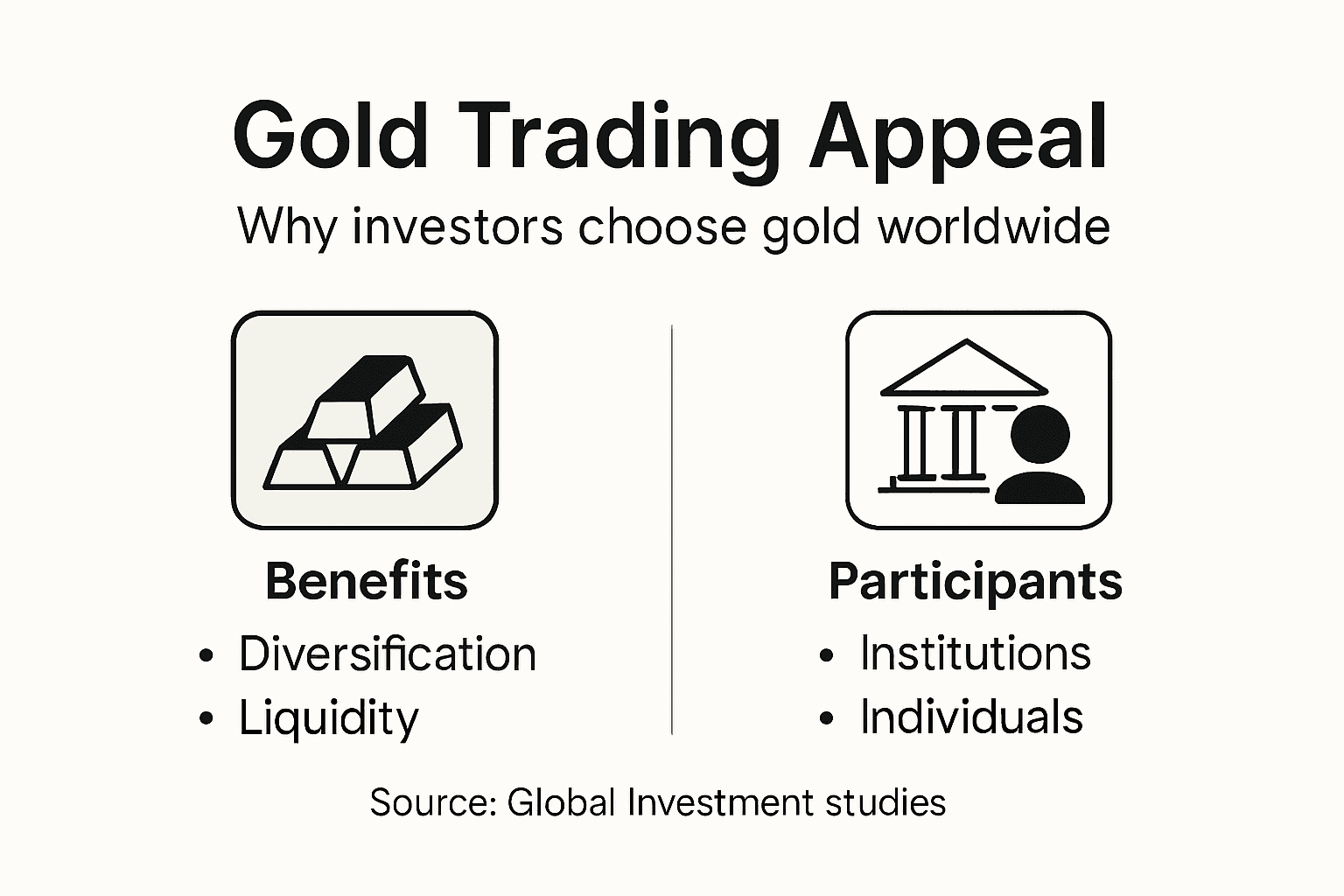
When stock markets decline, gold typically moves in the opposite direction. This inverse correlation creates a natural hedge within your portfolio. During inflationary periods, gold gains value while bond purchasing power erodes. This protective behavior is precisely why gold attracts wealth management professionals seeking resilient portfolio structures.
The Diversification Advantage
Diversification reduces risk by spreading investments across different asset classes, and gold performs this role exceptionally well. Unlike bonds that rise and fall with interest rates, or stocks tied to corporate earnings, gold follows its own path through market cycles.
Consider these real-world scenarios:
Market crashes trigger gold rallies as investors flee equities—your gold positions gain while stocks decline
Inflation spikes erode bond returns while gold preserves purchasing power and often appreciates
Currency weakness boosts gold denominated in depreciating currencies, protecting international portfolios
Geopolitical crises drive safe-haven demand, lifting gold prices when traditional assets falter
Low interest rates reduce bond appeal while gold’s non-yielding nature becomes irrelevant compared to zero returns
Gold’s independence from economic cycles fundamentally distinguishes it from traditional portfolio components. It doesn’t pay dividends like stocks or interest like bonds—it simply performs differently.
Strategic Portfolio Positioning
Wealthy investors allocate gold differently based on their risk tolerance and market outlook. Some maintain 5 percent allocations as baseline protection; others increase exposure to 15-20 percent during elevated uncertainty.
Gold as a safe-haven asset class provides tangible security when markets destabilize. Active gold trading allows tactical adjustments without the friction of physical ownership logistics.
Key allocation considerations include:
Baseline allocation (5-10%) protects against unexpected systemic shocks
Crisis periods (15-20%) hedge severe market downturns and currency instability
Inflationary environments warrant higher exposure as purchasing power protection
Portfolio rebalancing allows systematic profit-taking when gold outperforms
The flexibility of trading gold through multiple venues—spot markets, futures, or ETFs—enables precise portfolio sizing without operational complexity.
Gold’s uncorrelated behavior transforms portfolio mathematics, reducing overall volatility while maintaining growth potential through equity exposure.
Pro tip: Establish a baseline gold allocation tied to your risk tolerance, then systematically increase or decrease based on real-time market conditions and your outlook for currency stability—this dynamic approach captures diversification benefits while maintaining flexibility.
Risks, Costs, and Regulatory Considerations for Investors
Gold trading carries real risks that institutional investors must understand before deploying capital. Unlike stocks backed by earnings or bonds secured by credit quality, gold prices move based on sentiment, geopolitical events, and macroeconomic shifts. Smart money managers acknowledge these realities and build safeguards accordingly.
Market volatility represents the most obvious risk. Gold prices can swing 10-15 percent within weeks during periods of uncertainty. For leverage positions using futures, these swings can amplify losses dramatically. Your risk tolerance determines whether gold trading suits your portfolio.
Understanding Market and Operational Risks
Multiple risk categories demand attention:
Price volatility can erase gains quickly, especially when using leveraged instruments
Counterparty risk emerges when trading through brokers or exchanges that could fail
Liquidity risk affects large institutional positions, potentially widening spreads during stress
Geopolitical risk including sanctions, mine closures, or supply disruptions
Currency risk impacts returns when gold is priced in foreign currencies
Fraud and scams remain persistent threats, particularly with unvetted dealers
Investors should recognize market volatility and fraud risks in precious metals trading to protect capital. Regulatory organizations like the CFTC provide guidance on identifying legitimate market participants versus bad actors.
Costs That Erode Returns
Often overlooked, trading costs compound significantly over time. Every gold position carries multiple expense layers that reduce net returns.
Common costs include:
Bid-ask spreads (0.1-0.5% per trade) widen during market stress
Storage and insurance for physical gold add 0.5-1% annually
Trading commissions on futures and spot contracts vary by venue
Fund management fees for ETFs typically range 0.2-0.4% annually
Financing costs when using leverage through margin accounts
Production costs reflected in mining economics and all-in sustaining costs
These expenses shrink returns incrementally. A 0.75 percent annual cost structure means gold must appreciate that amount just to break even, before considering volatility or downside risk.
Regulatory Framework and Compliance
Gold trading operates within strict regulatory environments that vary globally. United States traders must comply with Securities and Exchange Commission (SEC) rules for certain products, Commodity Futures Trading Commission (CFTC) regulations for derivatives, and banking regulations for leveraged positions.
International traders face additional complexity:
Import/export tariffs vary by country and can impact supply costs
Government stockpile policies influence global supply dynamics
Anti-money laundering rules require documented origin verification
Know Your Customer requirements authenticate all institutional participants
Institutional gold investing requires understanding key risks and best practices to ensure compliant operations. Working with platforms emphasizing transparency and regulatory adherence protects your firm from costly violations.
Regulatory compliance isn’t optional—it’s foundational. Gold trading platforms demonstrating discipline, transparency, and risk management track records protect institutional capital better than cheaper alternatives cutting corners.
Pro tip: Before committing capital to any gold trading platform, verify regulatory standing, review their risk management protocols, and understand their fee structure completely—these three factors separate profitable operations from costly mistakes.
Comparing Gold Trading to Other Asset Classes
Institutional investors evaluate gold against stocks, bonds, and alternative investments to optimize portfolio construction. Gold behaves fundamentally differently from traditional assets, creating strategic advantages that pure equity or fixed-income portfolios cannot achieve alone.
The critical distinction lies in correlation patterns. Stocks and bonds respond to earnings, interest rates, and credit quality. Gold responds to fear, inflation expectations, and currency weakness. These separate drivers create the diversification magic that attracts sophisticated capital worldwide.
How Gold Differs from Equities
Stocks represent ownership in companies producing goods and services. Gold represents none of that. Stock returns depend on earnings growth, dividends, and valuation expansion. Gold returns depend entirely on price appreciation—nothing more.
Key differences emerge clearly:
Earnings dependence: Stocks require profitable operations; gold requires no earnings
Dividend income: Stocks generate cash flow; gold generates zero cash returns
Volatility drivers: Stock prices follow corporate performance; gold follows sentiment and macroeconomic fear
Correlation timing: Stocks and gold move inversely during crises—exactly when you need protection
Liquidity characteristics: Both are liquid, but gold resists manipulation by company-specific factors
During the 2008 financial crisis, stock markets collapsed 50 percent while gold appreciated 5 percent. This inverse relationship isn’t coincidence—it’s structural. Fear drives gold demand when equity investors flee to safety.
Gold Versus Bonds and Fixed Income
Bonds offer predictable income through coupon payments. Gold offers no income whatsoever. Yet during inflationary periods, gold outperforms bonds dramatically while bond values decline.
Gold correlates positively with stocks during favorable conditions but inversely during market stress, providing superior inflation protection than bonds. This behavioral difference appears most clearly during stagflation—when inflation rises while growth stalls, precisely the scenario that devastates traditional bond portfolios.
Below is a summary of key differences between gold, stocks, and bonds:
Attribute | Gold | Stocks | Bonds |
Income Produced | None | Dividends possible | Fixed interest payments |
Main Value Driver | Market sentiment | Company earnings | Interest rates, credit risk |
Inflation Impact | Often rises | Variable | Often declines |
Crisis Behavior | Safe-haven asset | Can decline sharply | May provide moderate hedge |
Consider three scenarios:
Low inflation, stable growth: Bonds outperform gold; stocks outperform both
High inflation, strong growth: Gold outperforms bonds; stocks vary by sector
Market crisis or recession: Gold outperforms both bonds and stocks consistently
Gold’s Unique Monetary Status
Gold differs from other commodities by serving as monetary asset used by central banks for wealth preservation alongside jewelry and industrial demand. This dual nature creates supply-demand dynamics unlike oil, copper, or agricultural commodities.
Other commodities respond primarily to economic growth rates. When growth slows, copper demand falls and prices collapse. Gold, conversely, gains value during economic slowdowns as investors prioritize safety over speculation.
This fundamental distinction explains why gold attracts capital during geopolitical crises, currency instability, and systemic financial stress—conditions that typically hurt other commodities.
Why This Matters for Portfolio Construction
These behavioral differences create mathematical benefits. A portfolio containing 10 percent gold and 90 percent stocks experiences lower overall volatility than pure equity exposure, without sacrificing meaningful growth potential.
Gold provides key advantages for investor portfolios through uncorrelated returns and inflation protection that stocks and bonds cannot replicate independently.
Gold’s inverse correlation with equities during crises transforms portfolio mathematics, reducing peak drawdowns while maintaining long-term appreciation potential—a mathematical advantage no single other asset class provides.
Pro tip: Analyze your portfolio’s drawdown history during past crises, then calculate how 5-10 percent gold allocation would have reduced those peak losses—this exercise clarifies gold’s true portfolio value beyond theoretical diversification concepts.
Unlock the Power of Gold Trading with Confidence
Navigating the complexities of gold trading requires more than just understanding price movements and market mechanics. If you are seeking a trusted partner that prioritizes disciplined execution, transparency, and risk management across established gold supply chains your search ends here. At Galami Gold we transform the promising but often confusing world of gold trading into a strategic advantage that aligns with your goals for portfolio diversification and capital preservation.

Discover how working with a specialized platform like Galami Gold empowers institutional and sophisticated investors to confidently engage with gold as a financial instrument. Whether you want to leverage futures, participate in spot trading, or combine physical gold ownership with dynamic market exposure learning from our approach ensures you avoid common pitfalls and costly mistakes. Visit our site now to explore how our gold trading program delivers reliable execution and integrity that matches your investment outlook. Take the first step toward efficient capital deployment and secure your position in the global gold market today.
Frequently Asked Questions
What is gold trading?
Gold trading involves the active buying and selling of gold contracts, futures, or positions through established markets and trading platforms rather than simply acquiring physical gold.
How does gold trading provide diversification benefits to investors?
Gold trading offers diversification by behaving differently from traditional assets like stocks and bonds. It often moves in the opposite direction during market downturns, thus acting as a hedge against risk.
What types of trading mechanisms are available for gold?
Gold trading primarily utilizes spot trading, futures contracts, and various options and derivatives, each serving distinct purposes for different types of investors.
What are the main risks associated with gold trading?
The main risks of gold trading include price volatility, counterparty risk, liquidity risk, geopolitical risk, and potential fraud, which investors must understand before trading.
Recommended


Comments