


What is OTC gold trading: A guide for institutional investors
- Shannon B
- Mar 25
- 9 min read


Most investors assume gold trading happens on exchanges like COMEX, but the majority of institutional gold transactions occur in a parallel universe: the over-the-counter market. OTC gold trading is bilateral, principal-to-principal trading in the over-the-counter market, centered in London via LBMA with customized spot, forwards, swaps, and options deals. Understanding this bespoke trading environment is essential for institutional investors seeking portfolio diversification, inflation hedging, and strategic risk management through physical gold exposure. This guide unpacks the mechanics, risks, and portfolio strategies that define OTC gold trading for sophisticated investors.
Table of Contents
Key Takeaways
Point | Details |
OTC is bilateral | OTC gold trading is principal to principal and conducted outside centralized exchanges in London. |
LBMA hub standards | The London Bullion Market Association sets quality and settlement standards and connects market participants. |
Customizable contracts | Spot, forwards, swaps, and options can be tailored for size, timing, and risk management. |
Settlement framework | Settlement follows Loco London with 5,000 oz dealing sizes and LBMA price benchmarks settled electronically. |
Liquidity requires relationships | Investors maintain relationships with multiple LBMA dealers to ensure competitive pricing and backup liquidity. |
What is OTC gold trading? Understanding the fundamentals
OTC gold trading operates as principal-to-principal bilateral transactions conducted outside centralized exchanges. Unlike exchange-traded gold futures or ETFs, these trades involve direct negotiation between two parties, typically a bullion bank and an institutional investor. The London Bullion Market Association serves as the global hub for this activity, establishing standards and facilitating connections between market participants.
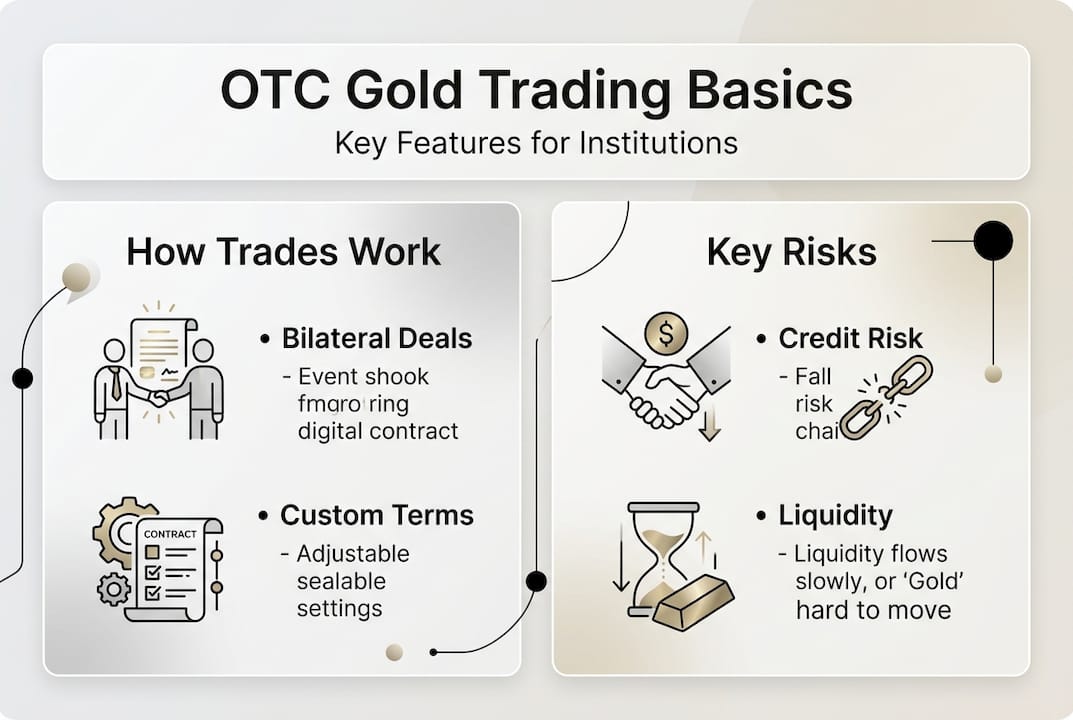
The contract types available in OTC markets offer remarkable flexibility compared to standardized exchange products. Spot contracts settle within two business days at agreed prices. Forwards lock in future delivery dates and prices tailored to client needs. Swaps exchange cash flows based on gold price movements. Options provide rights to buy or sell at predetermined prices. Each instrument can be customized for size, timing, and specific risk management objectives.
This customization comes with a tradeoff: reduced transparency. Without a centralized order book, price discovery happens through direct dealer quotes rather than visible market depth. Institutional investors must maintain relationships with multiple dealers to ensure competitive pricing and adequate liquidity access.
The bespoke nature of OTC trading addresses institutional needs that exchanges cannot accommodate. Large positions can be executed without moving markets visibly. Settlement terms can align with specific portfolio rebalancing schedules. Counterparties can negotiate collateral arrangements that match their risk appetites and balance sheet constraints.
Pro Tip: Establish relationships with at least three LBMA member dealers before initiating OTC gold positions to ensure competitive pricing and backup liquidity sources during market stress periods.
Understanding gold trading types explained helps investors compare OTC approaches with exchange alternatives. The Loco London OTC market overview provides comprehensive detail on market structure and participant roles.
OTC gold trades occur directly between principals without exchange intermediation
LBMA establishes global standards for quality, settlement, and documentation
Contract customization allows precise alignment with institutional risk management needs
Price transparency is lower than exchanges but flexibility is substantially higher
Relationship banking with multiple dealers ensures competitive execution quality
Mechanics and settlement of OTC gold trades
The settlement infrastructure for OTC gold trades centers on the Loco London standard, where physical gold remains stored in London vaults while ownership transfers electronically. OTC gold trading uses Loco London settlement via LPMCL clearing, referencing LBMA Gold Price benchmarks with standard 5,000 oz dealing sizes. This system eliminates transportation costs and delivery logistics for most institutional trades.

Pricing references the LBMA Gold Price, determined through electronic auctions held twice daily at 10:30 AM and 3:00 PM London time. These benchmarks provide transparent reference points for trade confirmation and settlement calculations. Market participants can trade at the fix price or negotiate spreads relative to the benchmark based on timing and size.
Standard dealing sizes reflect institutional scale requirements. The typical transaction involves 5,000 fine troy ounces, though client minimums often start around 2,000 ounces depending on dealer relationships and credit terms. Larger positions are common, with some institutional trades exceeding 50,000 ounces when portfolio rebalancing or major allocation shifts occur.
Documentation follows industry standards established through LBMA and International Swaps and Derivatives Association frameworks. Master agreements govern ongoing trading relationships, establishing netting provisions that reduce counterparty exposure. Trade confirmations detail specific transaction terms including price, quantity, settlement date, and delivery location. These documents create legally binding obligations that protect both parties.
The London Precious Metals Clearing Limited system facilitates settlement by maintaining electronic records of gold ownership and processing transfers between member vaults. This infrastructure reduces operational risks associated with physical movement while maintaining the integrity of allocated gold positions. During settlement, LPMCL verifies that transferring parties hold sufficient gold and receiving parties have adequate credit lines.
Pro Tip: Request allocated gold storage rather than unallocated positions when credit risk concerns outweigh the convenience and cost savings of unallocated accounts, especially during periods of financial system stress.
Institutional investors benefit from reviewing gold trading standards 2026 to understand evolving best practices. The LBMA OTC FAQs address common operational questions about settlement mechanics.
Settlement Component | Standard Practice | Institutional Consideration |
Location | Loco London vaults | Reduces transportation costs and delivery logistics |
Pricing reference | LBMA Gold Price AM/PM | Transparent benchmark for trade confirmation |
Standard size | 5,000 fine ounces | Minimum typically 2,000 ounces for client trades |
Clearing system | LPMCL electronic transfer | Mitigates physical movement risks |
Documentation | LBMA-ISDA master agreements | Establishes netting and credit terms |
Confirm dealer membership in LPMCL clearing system before initiating trades
Negotiate master agreement terms that align with institutional credit policies
Specify allocated versus unallocated storage based on risk tolerance
Establish price reference methodology in advance to avoid settlement disputes
Maintain adequate credit lines to support intended position sizes
Risks and challenges in OTC gold trading for institutions
Counterparty credit risk represents the most significant exposure in OTC gold trading. Unlike exchange-traded instruments with central clearinghouse guarantees, bilateral trades create direct exposure to dealer creditworthiness. This risk manifests in bid-ask spreads, where dealers price their credit risk into transaction costs. Institutions manage exposure through Credit Support Annexes that require collateral posting when exposures exceed agreed thresholds.
Liquidity fragmentation creates execution challenges absent from centralized exchanges. With no consolidated order book, institutional investors must contact multiple dealers to discover competitive pricing. During market stress, this fragmentation intensifies as dealers widen spreads and reduce position limits. The result is higher transaction costs and potential difficulty exiting large positions quickly.
The distinction between allocated and unallocated gold holdings carries profound risk implications. Allocated gold represents specific bars stored on behalf of the investor, creating a bailment relationship where the institution owns identifiable assets. Unallocated positions are creditor claims against the dealer’s gold inventory, exposing investors to dealer insolvency risk. Key risks for institutions include counterparty/credit risk, balance-sheet constraints, liquidity fragmentation, opacity, and delivery failures under stress.
Operational risks include potential delivery failures during periods of market dislocation. When multiple institutions simultaneously demand physical delivery, vault capacity and logistics can become strained. The 2020 gold market disruption illustrated this vulnerability when physical premiums spiked due to transportation restrictions and refinery closures, creating temporary disconnects between paper and physical gold prices.
“The OTC gold market’s opacity and bilateral nature mean institutions must conduct rigorous due diligence on counterparties and maintain diversified dealer relationships to ensure execution quality and manage concentration risks effectively.”
Mitigation strategies focus on diversification and documentation rigor. Institutions should maintain trading relationships with multiple LBMA members to reduce concentration risk and ensure competitive pricing. Credit Support Annexes with appropriate collateral thresholds protect against counterparty defaults. Regular review of dealer creditworthiness through financial statement analysis and credit default swap monitoring provides early warning of deteriorating counterparty quality.
Position sizing relative to dealer credit lines prevents situations where institutions cannot execute intended trades or exit positions when needed. Stress testing portfolio liquidity under adverse scenarios helps identify potential bottlenecks before they materialize. Documentation review ensures that allocated gold positions are properly segregated and that unallocated exposures remain within acceptable risk parameters.
Understanding institutional gold risk considerations helps investors develop comprehensive risk frameworks. Additional perspective on OTC counterparty risk provides context for mitigation strategies.
Counterparty credit risk embedded in spreads requires active collateral management
Liquidity fragmentation increases execution costs and exit difficulty during stress
Allocated gold provides ownership protection versus unallocated creditor claims
Operational delivery failures can occur when physical demand surges unexpectedly
Diversified dealer relationships and rigorous due diligence mitigate concentration risks
Incorporating OTC gold trading into portfolio strategies
Institutional portfolios typically allocate between 5-10% to gold for strategic diversification and inflation hedging benefits. Portfolio strategies often allocate 5-10% to gold, reducing volatility by about 5% at 5% weighting; OTC forwards and swaps provide tactical hedging. This allocation range balances gold’s low correlation with equities and bonds against its lack of yield generation.
The volatility reduction effect becomes measurable at meaningful allocation levels. Research indicates that a 5% gold weighting reduces overall portfolio volatility by approximately 5%, primarily through gold’s negative correlation with risk assets during market stress. This defensive characteristic makes gold particularly valuable for institutions managing downside risk in multi-asset portfolios.
Tactical applications of OTC instruments extend beyond simple spot exposure. Forward contracts lock in future gold prices, allowing institutions to hedge anticipated currency depreciation or inflation concerns without immediate capital deployment. Swaps exchange fixed payments for floating gold price returns, creating synthetic exposure without physical settlement requirements. These instruments provide flexibility for dynamic portfolio management.
Comparing OTC gold exposure with alternatives reveals distinct risk-return profiles. Physical OTC gold offers direct ownership and eliminates counterparty risk in allocated form, but requires storage costs and lacks liquidity of paper instruments. Gold ETFs provide liquid exposure with lower transaction costs but introduce fund management fees and potential tracking error. Futures contracts offer leverage and exchange clearing but require margin management and face rollover costs.
Blending physical OTC gold with paper instruments creates optimized strategies. Core strategic allocations might utilize physical allocated gold for long-term holdings, while tactical positions employ futures or swaps for shorter-term views. This layered approach balances the security of direct ownership with the operational efficiency of derivatives.
Pro Tip: Rebalance gold allocations quarterly rather than monthly to reduce transaction costs while maintaining strategic exposure, adjusting rebalancing frequency based on portfolio size and gold’s correlation with other holdings.
Institutions benefit from exploring gold importance institutional investors to understand strategic rationale. The gold portfolio allocation analysis provides data-backed allocation recommendations.
Approach | Advantages | Considerations | Best Use Case |
Physical OTC allocated | Direct ownership, no counterparty risk | Storage costs, lower liquidity | Core strategic holdings |
Physical OTC unallocated | Lower costs, operational simplicity | Creditor risk, dealer exposure | Tactical positions with trusted dealers |
Gold ETFs | High liquidity, low transaction costs | Management fees, tracking error | Liquid tactical exposure |
Gold futures | Leverage, exchange clearing | Margin requirements, rollover costs | Short-term hedging |
OTC forwards/swaps | Customized terms, flexible settlement | Counterparty risk, documentation complexity | Specific hedging needs |
Determine strategic allocation target based on portfolio risk tolerance and inflation outlook
Select core exposure method balancing ownership security with operational efficiency
Implement tactical overlay using derivatives for dynamic risk management
Establish rebalancing discipline that maintains target allocation within defined bands
Monitor correlation patterns to ensure gold continues providing diversification benefits
Evaluate total cost of ownership including storage, insurance, and transaction expenses
Explore professional gold trading solutions with GALAMI GOLD
Institutional investors seeking sophisticated OTC gold trading capabilities should explore GALAMI GOLD physical gold trading services designed specifically for professional portfolio management. GALAMI GOLD specializes in audited physical gold transactions that provide the transparency and security institutional investors require when executing significant precious metals allocations.

The platform emphasizes disciplined execution across established gold supply chains, ensuring trade integrity and settlement reliability. Institutions benefit from comprehensive risk management frameworks that address counterparty, operational, and liquidity concerns inherent in OTC markets. For investors implementing the strategies discussed in this guide, GALAMI GOLD offers the infrastructure and expertise necessary for professional-grade gold trading.
Explore institutional gold trading standards to understand best practices, and review institutional gold investing best practices for comprehensive portfolio integration guidance. Contact GALAMI GOLD to discuss tailored trading solutions that align with your institutional objectives.
Frequently asked questions about OTC gold trading
What distinguishes OTC gold trading from exchange trading?
OTC gold trading involves bilateral negotiations between principals with customized contract terms, while exchange trading uses standardized contracts cleared through central counterparties. OTC markets offer greater flexibility for size, timing, and settlement terms but provide less price transparency and require direct counterparty risk management.
How does Loco London settlement protect investors?
Loco London settlement keeps gold in secure London vaults with electronic ownership transfers via LPMCL clearing, eliminating transportation risks and reducing costs. The system maintains audit trails and segregates allocated gold positions, providing ownership protection while facilitating efficient settlement.
What size of gold positions can institutions take OTC?
Standard OTC dealing sizes start at 5,000 fine ounces, though institutional minimums often begin around 2,000 ounces depending on dealer relationships. Large institutions regularly execute positions exceeding 50,000 ounces when implementing strategic allocations or portfolio rebalancing.
How do counterparty risks manifest in OTC gold trading?
Counterparty risks appear through dealer credit exposure in unallocated positions, potential delivery failures during market stress, and bid-ask spreads that price credit risk. Institutions manage these exposures through Credit Support Annexes, diversified dealer relationships, and preference for allocated storage when credit concerns outweigh cost considerations.
Can OTC gold trading be combined with ETFs for diversified exposure?
Combining physical OTC gold with ETFs creates optimized strategies where core strategic holdings use allocated physical gold for security, while tactical positions employ ETFs for liquidity and operational efficiency. This layered approach balances direct ownership benefits with the flexibility of paper instruments for dynamic portfolio management.
Recommended


Comments