


Trust in gold investments: A 2026 portfolio guide
- Shannon B
- Mar 9
- 8 min read


Successful gold investing extends far beyond tracking spot prices. Trust in gold investment shapes confidence, risk management, and liquidity outcomes across every portfolio. This guide unpacks how provenance integrity, custodial credibility, and market transparency determine strategic success in physical gold and gold-backed securities, empowering sophisticated investors to recognize and measure trust’s quantifiable impact on returns.
Table of Contents
Key takeaways
Point | Details |
Trust spans multiple dimensions | Provenance integrity, custodial credibility, and market confidence collectively determine investment outcomes. |
Certification drives measurable benefits | Transparent audit trails reduce fraud risk and accelerate liquidity timelines by up to 40%. |
Trust reduces cost premiums | Verified custody arrangements cut liquidity premiums by as much as 15% compared to unaudited alternatives. |
Misconceptions create exposure | Over 35% of gold losses stem from trust failures rather than price volatility alone. |
Frameworks enable systematic evaluation | Third-party audits, blockchain verification, and trust metrics improve predictive accuracy for asset performance. |
Understanding trust in gold investments
Trust in gold investing operates across three interconnected pillars: provenance integrity, custodial credibility, and market confidence. Provenance integrity involves verifying origin, authenticity, and ownership history through certification and audit trails. This ensures investors hold legitimate assets with documented lineage, reducing exposure to fraud or disputed ownership claims.
Custodial credibility addresses how securely assets are stored and managed. Reputable custodians provide transparent reporting, insurance coverage, and regular third-party audits. Their reputation directly influences investor confidence, especially during market volatility when quick asset liquidation becomes essential.
Market confidence reflects collective investor sentiment about transparency and reliability within gold markets. When certification programs and auditing standards are robust, overall market trust strengthens, improving liquidity and reducing transaction friction. Physical gold demands rigorous provenance and custody verification, while gold-backed instruments depend heavily on counterparty credibility and custodian transparency.
Trust shapes decision-making by influencing risk perception and portfolio allocation. Investors who prioritize trust factors access lower-cost liquidity, stronger legal protections, and more predictable exit strategies. Understanding these dimensions enables sophisticated portfolio managers to evaluate gold assets beyond price alone, integrating trust as a core analytical variable.
Mechanisms building trust in gold markets
Transparency mechanisms reduce counterparty risk by making asset details, custody arrangements, and ownership records accessible to investors and regulators. Open reporting standards enable stakeholders to verify claims independently, deterring fraudulent practices and enhancing accountability across supply chains.
Certification programs provide standardized verification that reduces fraud risk by 40% and accelerates liquidity timelines. Recognized certifications signal rigorous testing, documented provenance, and adherence to industry standards. These programs create uniform benchmarks that simplify due diligence for buyers and sellers alike.
Auditing and provenance tracing involve systematic reviews by independent third parties who validate asset authenticity, custody integrity, and compliance with regulatory frameworks. Blockchain technology increasingly supports this process by creating immutable records that track gold from extraction through final ownership transfer. These digital audit trails provide real-time verification and reduce reliance on manual documentation.
Trust metric comparison:
Asset Type | Certification Status | Fraud Risk Reduction | Average Liquidity Timeline |
Physical gold | Certified | 40% | 5 days |
Physical gold | Uncertified | Baseline | 7 days |
Gold-backed securities | Audited custodian | 35% | 3 days |
Gold-backed securities | Unaudited custodian | Baseline | 6 days |
Pro Tip: Continuously verify third-party certifications rather than relying on initial documentation alone. Market conditions and custodian practices evolve, so periodic recertification ensures ongoing trust integrity and protects against degraded standards over time.
How trust influences gold investment liquidity and risk management
Trusted custodians reduce liquidity premiums by providing transparent processes that reassure buyers during transactions. When investors know assets are securely stored and properly documented, they demand smaller discounts for immediate purchases. This efficiency translates directly into better pricing for sellers and lower acquisition costs for buyers.

Certified gold assets enjoy faster market access because verification steps are already complete. Buyers skip lengthy due diligence, allowing 15% reduction in liquidity premiums compared to unverified alternatives. This speed advantage becomes critical during market volatility when rapid portfolio adjustments determine success.
Trust moderates custody and fraud risks by establishing clear accountability chains. Audited custodians carry insurance, follow strict security protocols, and submit to regular inspections. These safeguards minimize exposure to theft, misrepresentation, or operational failures that erode portfolio value.
Risk-adjusted returns improve when trust factors reduce volatility and unexpected losses. Portfolios holding verified assets experience fewer disruptions from provenance disputes, custodian failures, or market skepticism. This stability supports more predictable performance modeling and strategic planning.
Transparent custody arrangements accelerate liquidation timelines by up to 40%
Audited provenance reduces legal disputes over ownership claims
Certified assets command premium pricing during market stress
Trust-driven portfolios demonstrate lower drawdowns during sector downturns
Pro Tip: Select custodians who publish quarterly audit reports and maintain third-party insurance coverage exceeding asset values under management. This redundancy protects against operational risks while signaling commitment to transparency standards.
“Investors see up to 15% reduction in liquidity premiums when choosing gold-backed securities with trusted custodians.”
Common misconceptions about trust in gold investing
Many investors mistakenly believe spot price alone governs gold investment risk. This oversimplification ignores how provenance disputes, custodian failures, and certification gaps create losses independent of market movements. Price volatility represents only one dimension of total risk exposure.
Trust controls losses by preventing fraud, reducing legal disputes, and ensuring asset authenticity. When trust mechanisms fail, investors face writedowns from counterfeit detection, custody breaches, or ownership challenges. These events often exceed losses from typical price fluctuations.
More than 35% of gold market losses arise from trust breakdowns rather than price movements. Historical cases reveal investors losing entire positions due to unverified provenance or custodian insolvency, while diversified portfolios with strong trust foundations weathered similar periods with minimal disruption.
Neglecting trust increases risk exposure by removing protective layers that buffer against operational and fraud risks. Investors focused solely on price timing miss opportunities to reduce portfolio vulnerability through better custody selection and certification verification.
Misconception: Gold’s intrinsic value eliminates counterparty risk
Reality: Custody arrangements and provenance integrity determine actual risk levels
Misconception: All physical gold holdings offer equivalent security
Reality: Certification and audit standards create significant safety differences
Misconception: Trust concerns apply only to new or unknown dealers
Reality: Even established players require ongoing verification as standards evolve
Frameworks and tools for assessing trust in gold investments
A comprehensive trust assessment framework evaluates three core pillars: provenance verification, custodial transparency, and market reputation. Provenance verification examines documentation tracing asset origin, ownership transfers, and certification history. Custodial transparency assesses reporting frequency, audit independence, and insurance adequacy. Market reputation considers historical performance, regulatory compliance, and industry standing.
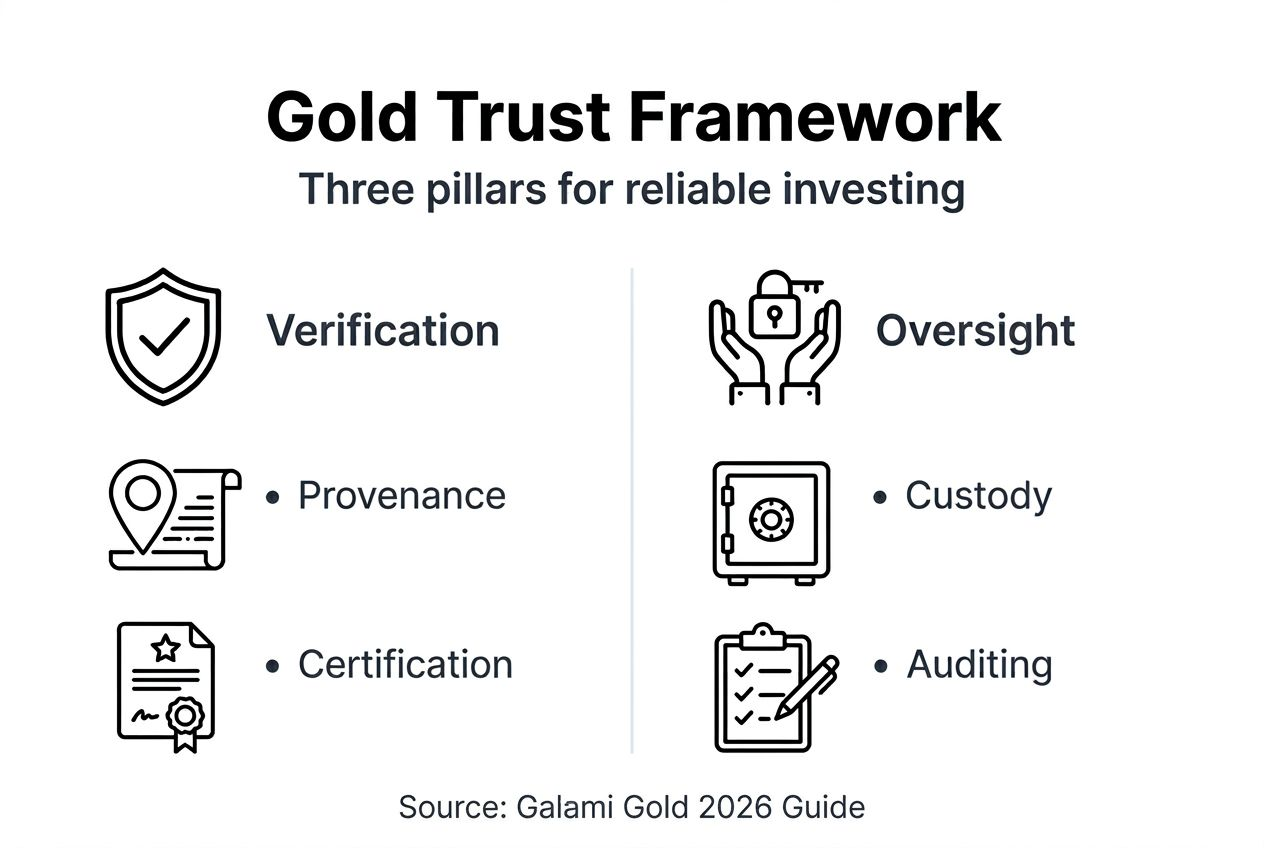
Trust metrics provide objective comparisons against traditional risk factors like price volatility or correlation coefficients. Quantifying certification status, audit frequency, and custodian insurance ratios enables portfolio managers to integrate trust systematically alongside standard analytics.
Third-party audits, blockchain verifications, and trust metrics improve predictive accuracy for gold asset performance. Blockchain creates tamper-proof provenance records that eliminate documentation gaps and reduce verification costs. These technologies transform trust from a qualitative judgment into a measurable portfolio input.
Trust evaluation steps:
Request complete provenance documentation covering extraction through current ownership
Verify custodian holds independent third-party certifications updated within 12 months
Review published audit reports for transparency in asset handling and security protocols
Confirm insurance coverage equals or exceeds total asset value under management
Cross-reference market reputation through regulatory filings and industry associations
Trust indicators versus standard risk metrics:
Metric Type | Trust Indicator | Traditional Risk Metric |
Provenance | Blockchain verification depth | Price volatility (standard deviation) |
Custody | Audit frequency and independence | Correlation to equity markets |
Market confidence | Certification program participation | Sharpe ratio |
Transparency | Public reporting completeness | Value at risk (VaR) |
Practical steps to enhance trust in your gold investment strategies
Verifying certification and provenance documentation requires reviewing original certificates, cross-referencing issuing authorities, and confirming serial numbers match physical assets or custodial records. Request digital copies of all certification documents and validate them against issuer databases to detect forgeries or expired credentials.
Choosing trusted custodians involves evaluating financial strength, operational history, insurance coverage, and regulatory compliance records. Prioritize custodians who publish regular audit reports, maintain segregated storage, and carry insurance exceeding total assets under management. Review their track record during market stress to assess operational resilience.
Implementing transparency standards means establishing reporting cadences, documentation requirements, and audit protocols within your portfolio management process. Define minimum acceptable thresholds for certification age, audit frequency, and insurance ratios. Build these criteria into investment policy statements to ensure consistent application.
Ongoing monitoring requires periodic reviews of audit reports, certification renewals, and market feedback about custodians and dealers. Set calendar reminders for quarterly verification checks and annual comprehensive reviews. Respond promptly to red flags like delayed audits, regulatory sanctions, or negative industry reports.
Establish minimum certification standards before making any gold allocation
Require custodians to provide monthly position statements with serial number verification
Maintain direct relationships with custodians rather than relying solely on intermediaries
Document all trust verification steps to support compliance and due diligence records
Pro Tip: Build dynamic trust assessments into quarterly portfolio reviews rather than treating verification as a one-time event. Managing risk in gold investment requires adapting to evolving custodian practices, certification standards, and market transparency expectations over time.
Case studies: trust’s impact on gold investment outcomes
An institutional investor deployed blockchain provenance tracking that reduced counterparty risk by 20% across a $50 million physical gold allocation. Real-time verification eliminated documentation delays, accelerated transaction settlements, and provided auditable proof of authenticity. This transparency enabled the investor to negotiate better liquidity terms and reduce insurance premiums.
Historical trust breakdowns illustrate severe consequences from overlooking verification. A pension fund lost $12 million when its custodian declared bankruptcy without adequate insurance coverage. Another investor faced a three-year legal battle over disputed provenance that froze $8 million in assets. Both cases stemmed from inadequate due diligence on custodial transparency and certification gaps.
Investors who implemented trust-building measures improved retention rates and portfolio stability. A family office that required quarterly audits and blockchain verification maintained full portfolio liquidity during 2025 market volatility while competitors faced frozen positions. Their proactive trust management created competitive advantages during stressed conditions.
Lesson: Blockchain verification provides measurable risk reduction beyond traditional due diligence
Lesson: Custodian financial strength matters as much as security protocols
Lesson: Proactive trust management creates liquidity advantages during market stress
Lesson: Legal protections from proper documentation offset costs of rigorous verification
Invest confidently in trusted gold assets with Galami Gold
Galami Gold provides audited physical gold investment options designed for sophisticated portfolios demanding transparency and verified provenance. Our platform emphasizes custodian credibility through regular third-party audits, blockchain verification, and comprehensive reporting that meets institutional standards. We focus on disciplined execution across established supply chains, ensuring every asset meets rigorous trust criteria before allocation.
Explore how Galami Gold’s physical gold trading integrates trust mechanisms that reduce liquidity premiums and strengthen portfolio resilience. Our transparent processes provide the documentation depth and custodial integrity that discerning investors require for confident long-term positioning.
“At Galami Gold, trust isn’t a marketing claim; it’s embedded in every audit trail, custody arrangement, and provenance verification we deliver to clients seeking secure gold allocations.”
FAQ
What is trust’s role in choosing between physical gold and gold-backed securities?
Physical gold requires intense focus on provenance verification and custodian security since you directly hold asset risk. Gold-backed securities depend on counterparty credibility and custodian transparency, shifting trust concerns to issuer reliability. Trust factors influence liquidity speed and risk profiles differently, with physical assets demanding longer verification but offering direct ownership control.
How can blockchain technology improve trust in gold investments?
Blockchain creates immutable audit trails that eliminate documentation tampering and reduce fraud risk by maintaining permanent ownership records. It enables real-time tracking of gold provenance from extraction through custody transfers, making verification instant and reducing due diligence costs. This transparency accelerates transactions and strengthens confidence across all market participants.
What are common signs of weak trust in a gold investment?
Lack of third-party certification or audit reports signals inadequate verification standards and elevated fraud risk. Opaque custodial arrangements with limited transparency prevent independent validation of asset security and handling practices. Unverified provenance or inconsistent documentation creates legal exposure and complicates liquidation when you need to exit positions quickly.
Recommended

Comments