


Why Manage Risk in Gold Investment Strategies
- Shannon B
- Feb 15
- 7 min read


Market turbulence puts seasoned investors on edge as traditional asset classes struggle to deliver consistent value. The pursuit of portfolio stability has made gold a strategic asset for institutional investors worldwide, offering distinctive benefits in times of geopolitical uncertainty and low bond yields. This article explores comprehensive gold investment risk management strategies designed to enhance institutional portfolios and preserve capital amid global volatility, highlighting the importance of dynamic risk assessment and adaptive allocation frameworks.
Table of Contents
Key Takeaways
Point | Details |
Understanding Risk | Institutional investors must recognize the complexity of gold investment risks, including market volatility, liquidity, and geopolitical factors, and develop multi-dimensional risk management strategies. |
Optimal Allocation | Maintaining gold allocations between 2% to 10% of total investment strategies offers meaningful diversification without excessive exposure to market shifts. |
Continuous Monitoring | A dynamic approach to risk assessment is essential, requiring quarterly evaluations of gold investment strategies aligned with macroeconomic trends and regulatory changes. |
Common Pitfalls | Investors should avoid overconcentration, neglecting liquidity, and inadequate custody practices to prevent significant losses in gold investments. |
Defining Risk in Institutional Gold Investment
Gold investment risk represents a complex strategic landscape for institutional investors seeking portfolio diversification and capital preservation. Understanding these risks requires a nuanced approach that moves beyond simplistic financial models. Strategic gold asset analysis demonstrates that gold’s unique characteristics make it both a potential safeguard and a sophisticated investment vehicle.
Institutional gold investment risks can be categorized across multiple dimensions:
Market Volatility Risk: Fluctuations in global gold prices
Currency Exchange Risk: Impact of international monetary shifts
Liquidity Risk: Potential challenges in rapid asset conversion
Geopolitical Risk: Disruptions from international political events
Systemic Market Risk: Broader economic ecosystem interactions
The multifaceted nature of gold investment risk demands comprehensive assessment strategies. Islamic financial institutions provide an excellent framework demonstrating how risk definition varies by transaction type and institutional requirements. Sophisticated investors recognize that risk management is not about elimination, but strategic mitigation.
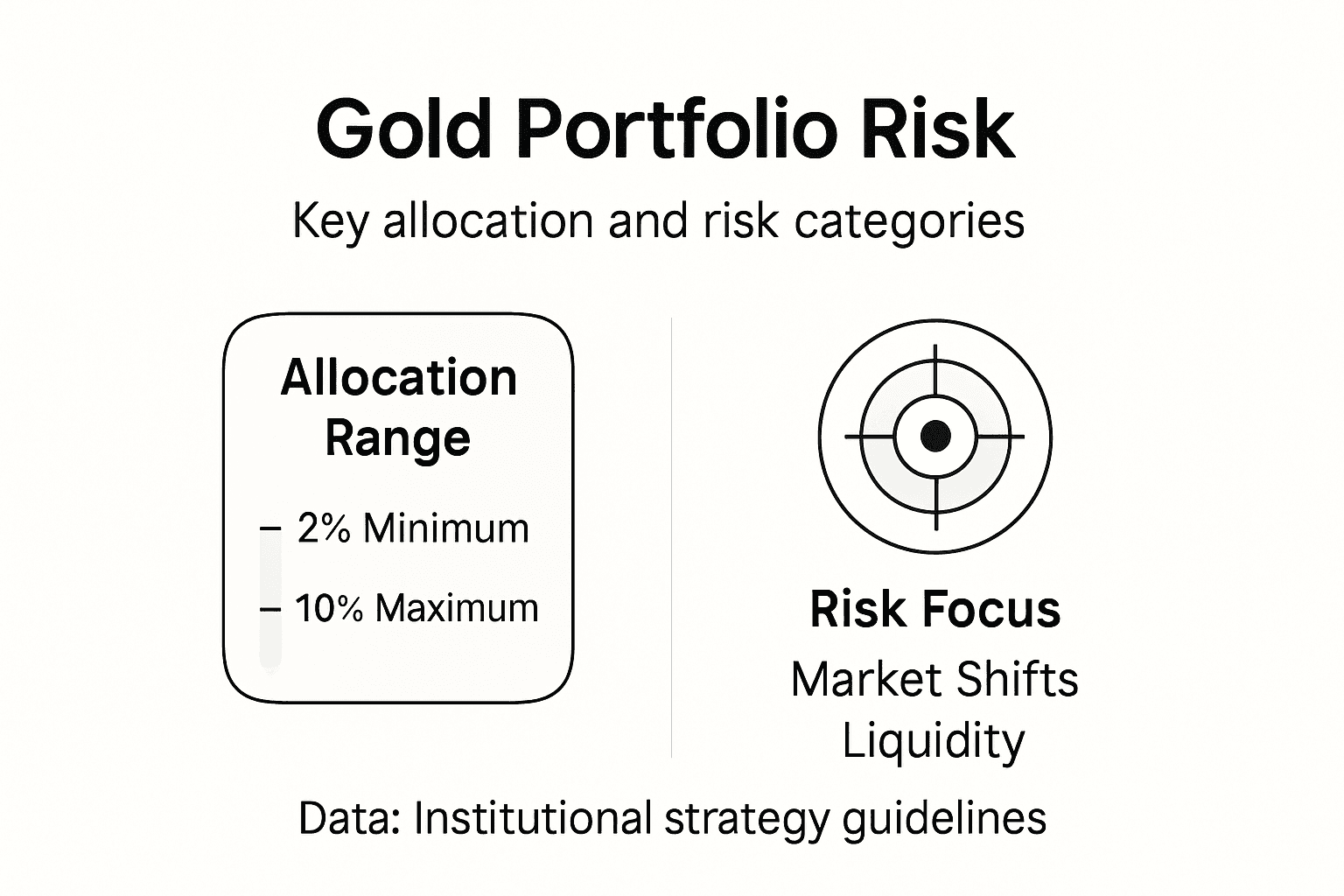
Risk allocation recommendations typically suggest gold portfolios represent between 2% to 10% of total institutional investment strategies. This range allows meaningful diversification without overexposing capital to potential market fluctuations. Effective risk management requires continuous monitoring, adaptive strategies, and a deep understanding of global economic interconnections.
Pro tip: Develop a dynamic risk assessment protocol that reassesses gold investment strategies quarterly, incorporating macroeconomic trend analysis and geopolitical intelligence updates.
Common Types of Risk in Gold Markets
Gold markets present a complex risk landscape that demands sophisticated understanding from institutional investors. Investment risk analysis reveals multiple interconnected risk dimensions that can significantly impact portfolio performance and strategic decision-making.
The primary categories of gold market risks include:
Market Risk: Price volatility and systemic economic fluctuations
Credit Risk: Potential counterparty defaults in gold transactions
Operational Risk: Challenges in execution, settlement, and transaction management
Liquidity Risk: Potential difficulties in rapid asset conversion
Geopolitical Risk: International political events affecting gold valuation
Currency Risk: Impact of exchange rate fluctuations on gold investments
Each risk category requires distinct mitigation strategies. Market risk, for instance, involves understanding global economic trends, central bank policies, and investment sentiment. Credit risk demands rigorous counterparty assessment and robust contractual frameworks that protect institutional interests.
Here’s a summary comparing common risk types in institutional gold investment and their unique impacts:
Risk Type | Impact on Portfolio | Institutional Concern |
Market Volatility | Influences asset value | Requires active management |
Liquidity | Limits quick conversion | May hinder portfolio adjustments |
Geopolitical | Alters global demand | Necessitates contingency plans |
Currency Exchange | Affects returns overseas | Demands hedging strategies |
Institutional investors must develop comprehensive risk management protocols that dynamically assess and respond to these multifaceted challenges. This approach involves continuous monitoring, predictive modeling, and adaptive strategies that can quickly respond to emerging market conditions and potential disruptions.
Pro tip: Implement a multi-layered risk assessment framework that incorporates quantitative metrics, geopolitical intelligence, and real-time market monitoring to enhance gold investment resilience.
Diversification and Portfolio Stability Benefits
Portfolio stability represents a critical objective for institutional investors seeking robust investment strategies. International portfolio analysis demonstrates that gold plays a crucial role in achieving this fundamental goal through its unique diversification characteristics.
The key diversification benefits of gold investments include:
Low Correlation: Minimal relationship with traditional stock and bond markets
Crisis Protection: Consistent performance during economic downturns
Inflation Hedge: Maintaining value during periods of currency devaluation
Geopolitical Risk Mitigation: Stable asset during international economic uncertainties
Strategic Asset Allocation: Reducing overall portfolio volatility
Institutional portfolio frameworks suggest optimal gold allocations typically range between 5% to 10% of total portfolio value. These allocations provide meaningful diversification without overexposing institutional capital to potential market fluctuations.

This comparison shows strategic gold allocation ranges and their effect on portfolio stability:
Allocation Range | Diversification Benefit | Risk Exposure |
2% - 4% | Basic volatility buffer | Low market sensitivity |
5% - 7% | Enhanced crisis resilience | Moderate fluctuation |
8% - 10% | Maximum diversification | Higher gold exposure |
Sophisticated investors recognize gold’s strategic value extends beyond traditional asset classes. Its performance during market stress periods demonstrates a unique ability to preserve capital and provide portfolio resilience. By integrating gold strategically, institutional investors can develop more robust, adaptable investment approaches that withstand complex economic environments.
Pro tip: Implement a dynamic gold allocation strategy that adjusts quarterly based on macroeconomic indicators and portfolio performance metrics.
Strategic Approaches to Risk Mitigation
Institutional investors require sophisticated risk mitigation strategies that go beyond traditional investment approaches. Comprehensive hedging strategies reveal multiple nuanced techniques for managing gold investment risks effectively.
Key strategic risk mitigation approaches include:
Diversification: Spreading investments across multiple gold asset types
Derivative Instruments: Using financial contracts to limit potential losses
Dynamic Allocation: Adjusting portfolio composition based on market conditions
Correlation Analysis: Understanding asset interactions during market volatility
Scenario Planning: Developing robust contingency frameworks
Risk mitigation requires a multi-layered approach that combines quantitative analysis with strategic flexibility. Short-term volatility management might involve derivative instruments, while long-term strategies frequently emphasize physical gold holdings with proven stability during economic uncertainties.
Sophisticated institutional investors recognize that risk management is not about eliminating risk entirely, but about creating resilient investment frameworks that can adapt to changing market dynamics. This approach involves continuous monitoring, predictive modeling, and maintaining sufficient liquidity to navigate potential market disruptions.
Pro tip: Develop a comprehensive risk scoring model that dynamically evaluates gold investment risks across multiple dimensions, updating allocation strategies quarterly.
Operational, Regulatory, and Counterparty Considerations
Institutional gold investment demands rigorous attention to complex operational frameworks that extend far beyond simple asset acquisition. Comprehensive legal frameworks underscore the critical importance of understanding multifaceted regulatory environments.
Key operational and regulatory considerations include:
Compliance Requirements: Adherence to international financial regulations
Counterparty Risk Assessment: Evaluating financial stability of transaction partners
Liquidity Standards: Maintaining adequate asset convertibility
Operational Security: Implementing robust transaction monitoring systems
Capital Allocation: Meeting prudential regulatory capital requirements
Basel Framework regulations provide critical guidance for institutional investors, defining precise parameters for gold ownership, transaction protocols, and risk management strategies. These frameworks establish essential standards for credit risk mitigation, collateral eligibility, and institutional investment practices.
Sophisticated institutional investors must develop comprehensive operational strategies that seamlessly integrate regulatory compliance, risk management, and strategic investment objectives. This approach requires continuous monitoring of evolving regulatory landscapes, maintaining flexible yet robust operational frameworks that can adapt to changing international financial standards.
Pro tip: Develop a dynamic compliance checklist that maps regulatory requirements across multiple jurisdictions, updating quarterly to ensure ongoing investment alignment.
Mistakes to Avoid in Gold Risk Management
Institutional gold investments demand meticulous risk management strategies to prevent potentially costly errors. Gold investment risk handbook highlights critical mistakes that can significantly undermine investment performance and capital preservation.
Common mistakes in gold risk management include:
Overconcentration: Allocating excessive portfolio percentage to gold
Neglecting Liquidity: Failing to assess asset conversion capabilities
Inadequate Custody: Poor physical or digital asset storage practices
Regulatory Ignorance: Overlooking complex international compliance requirements
Price Volatility Miscalculation: Underestimating market fluctuation potential
Insufficient Diversification: Limiting gold investment strategies
Sophisticated investors recognize that risk management extends beyond simple asset allocation. Understanding the nuanced interactions between gold markets, global economic conditions, and institutional investment frameworks requires continuous learning and adaptive strategies.
Effective risk management demands a holistic approach that integrates comprehensive due diligence, dynamic portfolio rebalancing, and proactive compliance monitoring. Institutional investors must develop robust frameworks that anticipate potential challenges and create flexible response mechanisms.
Pro tip: Implement a quarterly risk assessment protocol that systematically reviews gold investment positions, analyzing performance metrics, regulatory changes, and potential market disruptions.
Mastering Gold Investment Risk with Galami Gold
Managing the complex risks of institutional gold investment requires more than just knowledge. It demands disciplined execution and transparency to safeguard your capital in volatile markets. This article highlights key challenges like market volatility, liquidity risk, and regulatory complexities that sophisticated investors face when integrating gold into their portfolios. At Galami Gold, we understand these pain points deeply and specialize in providing a secure, well-established gold trading program built on trust, integrity, and efficient capital deployment.
Our physical gold trading platform offers a strategic advantage for investors aiming to mitigate risk dynamically. By partnering with Galami Gold, you gain access to a transparent and resilient gold supply chain designed to support your evolving risk management strategies. Learn how our approach aligns with best practices discussed in the article by visiting Galami Gold Trading Program and discover how you can enhance portfolio stability through disciplined gold investment.
Looking to convert gold risk management insights into real-world investment strength?

Take control of your gold investment strategy today with Galami Gold. Visit Galami Gold to explore how our trusted platform can help you manage risk while efficiently deploying capital in the precious metals market. Act now to build a more resilient portfolio that thrives through economic uncertainties.
Frequently Asked Questions
Why is it important to manage risk in gold investments?
Managing risk in gold investments is essential for institutional investors to safeguard portfolio value, ensure capital preservation, and achieve diversification amid market volatility.
What are the main types of risks associated with gold investments?
The main types of risks include market volatility risk, currency exchange risk, liquidity risk, geopolitical risk, and systemic market risk, each requiring different management strategies.
How can institutional investors mitigate risks in gold investment strategies?
Investors can mitigate risks using strategies like diversification, dynamic asset allocation, derivative instruments, and continuous risk assessment frameworks to respond to market changes effectively.
What is the recommended allocation range for gold in institutional portfolios?
A recommended allocation for gold in institutional investment portfolios typically ranges from 2% to 10%, allowing for meaningful diversification without excessive exposure to market fluctuations.


Comments