


How to Optimize Investment Strategies Gold for Maximum Return
- Shannon B
- Feb 15
- 7 min read


Market volatility creates tough questions for institutional investors aiming to preserve capital and drive performance. Gold stands out as a powerful hedge, especially as central banks worldwide keep demand strong and prices hit record highs. Understanding the interplay of geopolitical risks, currency shifts, and supply dynamics is crucial. This guide reveals actionable strategies for gold investment, providing clear, data-driven steps to enhance risk management and optimize returns as global uncertainty rises.
Table of Contents
Quick Summary
Key Insight | Explanation |
1. Analyze gold market trends | Understanding global demand, price drivers, and economic conditions is essential for informed investment decisions. |
2. Assess risk tolerance and allocation | Determine your comfort level with risk and allocate 5-10% of your portfolio to gold for balance and protection. |
3. Diversify investment methods | Use a mix of physical, paper, and digital gold investments to mitigate risk and capture market opportunities. |
4. Regularly monitor performance | Continuously track key metrics and adjust your portfolio based on market changes and personal financial goals. |
5. Document findings for future reference | Create a structured framework to record investment outcomes and insights, helping refine future strategies. |
Step 1: Assess Market Trends and Gold Fundamentals
Successful gold investment begins with understanding comprehensive market fundamentals and current economic trends. In this section, you’ll learn how to systematically evaluate gold market dynamics, using data-driven insights to inform your investment strategy.
Start by examining global gold demand patterns. Gold demand trends provide critical context for investment decisions. Key areas to investigate include:
Central bank purchasing behavior
Investment and jewelry consumption rates
Mine production levels
Global recycling volumes
The most effective market trend assessment involves analyzing multiple data sources. Look for comprehensive reports from:
World Gold Council
US Geological Survey
International monetary institutions
Independent economic research firms
Pay special attention to factors driving gold prices, such as geopolitical risks, currency fluctuations, and inflation indicators. US Geological Survey reports highlight how economic conditions directly impact gold supply and demand.
Gold’s value transcends mere commodity status - it represents a critical economic hedge in uncertain market environments.
Critical analysis requires continuous monitoring. Track weekly and monthly trend reports, comparing historical data with current market movements to identify emerging patterns and potential investment opportunities.
Pro tip: Develop a systematic tracking process using digital dashboards and automated alerts to stay informed about real-time gold market shifts.
Step 2: Define Risk Tolerance and Set Capital Allocation
Optimizing gold investment requires a strategic approach to understanding your personal risk profile and intelligently allocating capital. This step will help you develop a nuanced investment strategy that balances potential returns with your individual financial capacity and comfort level.
Strategic asset allocation begins with an honest assessment of your risk tolerance. Consider the following critical factors:
Your current financial stability
Investment time horizon
Overall portfolio diversification
Personal financial goals
Capacity to absorb potential losses
Most sophisticated investors recommend allocating between 5-10% of total investment portfolio to gold as a strategic hedge. This allocation provides several key benefits:
Portfolio risk reduction
Protection against market volatility
Hedge against inflation
Potential long-term value preservation
Your gold investment strategy should reflect your unique financial landscape, not a one-size-fits-all approach.
Calculating appropriate capital allocation requires carefully analyzing your overall financial picture. Consider consulting with a financial advisor who can provide personalized guidance tailored to your specific investment profile and risk appetite.

Pro tip: Regularly reassess your gold allocation every 12-18 months, adjusting for changes in personal financial circumstances and broader market conditions.
Step 3: Implement Diversified Gold Investment Tactics
Building a robust gold investment strategy requires understanding multiple investment approaches that minimize risk and maximize potential returns. This step will guide you through creating a comprehensive gold investment portfolio that leverages different investment vehicles and tactical approaches.
Central bank diversification strategies offer valuable insights into effective gold investment tactics. Consider these primary investment approaches:
Physical Gold
Bullion coins
Gold bars
Collectible coins
Paper Gold
Exchange-traded funds (ETFs)
Gold mining stocks
Gold certificates
Digital Gold
Gold-backed cryptocurrencies
Online trading platforms
Digital gold accounts
Each investment method offers unique advantages. Allocate your investments across multiple channels to reduce overall portfolio risk. Strategic gold investment typically involves spreading investments to capture different market opportunities:
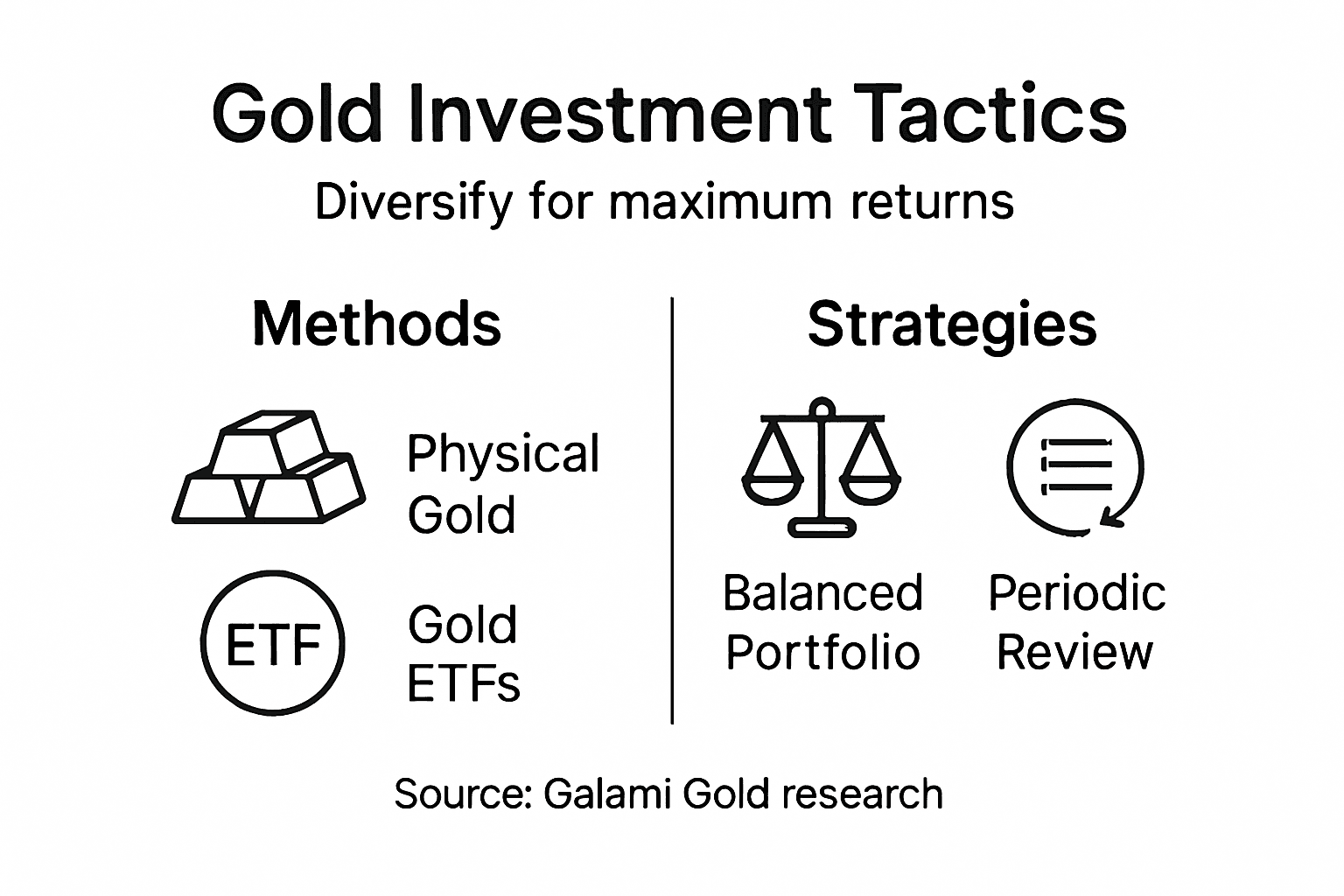
Here is a comparison of common gold investment methods and their unique characteristics:
Investment Type | Liquidity | Storage/Security Needs | Potential for Market Exposure |
Physical Gold | Moderate to Low | Requires secure storage | Direct exposure to gold price |
ETFs/Paper Gold | High | Minimal | Tracks gold price, market-traded |
Digital Gold | Very High | None, platform-managed | May track gold price or crypto trends |
Maintain 50-60% in physical gold
Invest 20-30% in gold-related securities
Reserve 10-20% for emerging digital gold platforms
Successful gold investing is about balance, not placing all resources in a single approach.
Tactical allocation requires continuous monitoring of market conditions, geopolitical events, and economic indicators. Stay informed about global trends that might impact gold valuations.
Pro tip: Create a quarterly review process to rebalance your gold investments, ensuring your portfolio remains aligned with your risk tolerance and financial objectives.
Step 4: Monitor Portfolio Performance and Adjust Positions
Successful gold investment demands continuous performance tracking and strategic repositioning. This step will teach you how to systematically evaluate your gold investments, ensuring they remain aligned with your financial objectives and market dynamics.
Portfolio management strategies emphasize the importance of regular performance review. Develop a comprehensive monitoring framework that includes:
Tracking gold price movements
Analyzing portfolio correlation
Evaluating macroeconomic indicators
Reviewing geopolitical risk factors
Assessing personal financial goals
Key performance metrics to monitor include:
This summary highlights key metrics for effectively monitoring your gold portfolio:
Performance Metric | What It Shows | Why It Matters |
Total Portfolio Return | Overall gain or loss | Measures investment success |
Gold Price Volatility | Price fluctuations over time | Indicates market risk |
Asset Correlation | Gold vs. other investments | Helps diversify effectively |
Inflation-Adjusted Return | Real net profit | Assesses true purchasing power |
Total portfolio return
Gold price volatility
Correlation with other asset classes
Inflation-adjusted performance
Gold portfolio differentiation requires proactive adjustment strategies. Implement a systematic review process that allows for nimble repositioning based on emerging market trends.
Successful investors view portfolio management as an ongoing dialogue with market conditions, not a one-time decision.
Critical performance indicators should trigger specific actions:
Price drops over 10%: Reassess allocation
Significant geopolitical shifts: Review risk exposure
Personal financial changes: Adjust investment strategy
Tactical rebalancing helps maintain portfolio resilience by preventing overexposure to any single market condition or investment approach.
Pro tip: Leverage digital tracking tools and set up automated alerts to ensure you never miss critical performance thresholds that might require strategic repositioning.
Step 5: Verify Outcomes and Document Strategic Insights
The final stage of your gold investment journey involves systematic verification and strategic documentation. This critical step transforms your investment experiences into valuable institutional knowledge that will inform and refine future decision-making.
Investment outcome verification requires a comprehensive analysis approach. Develop a rigorous documentation framework that captures:
Performance metrics and returns
Risk management strategies
Market condition interpretations
Strategic decision rationales
Investment environment context
Key documentation elements should include:
Quantitative performance data
Qualitative market insights
Investment thesis validation
Lessons learned from each investment cycle
Global investment reporting emphasizes transparency and continuous learning. Implement a structured review process that enables systematic performance evaluation and strategic refinement.
Effective documentation transforms individual investment experiences into institutional wisdom.
Critical verification steps involve:
Comparing actual outcomes against initial projections
Identifying unexpected market behaviors
Understanding performance drivers
Highlighting potential improvement areas
Detailed documentation helps build long-term investment intelligence by creating a comprehensive knowledge base that evolves with market dynamics.
Pro tip: Utilize digital investment tracking platforms that automatically log performance data and generate comprehensive reports to streamline your verification and documentation process.
Unlock the Full Potential of Your Gold Investment Strategy
The challenge many investors face when optimizing gold investments is balancing risk tolerance, capital allocation, and diversification while keeping pace with market dynamics and geopolitical shifts. This article highlights critical strategies like assessing market fundamentals, defining your risk profile, and implementing diversified tactics to maximize returns and protect wealth. If you find managing physical and paper gold options complex or struggle with continuous portfolio monitoring, you are not alone.
At Galami Gold, we specialize in providing a trusted, transparent platform for disciplined physical gold trading that respects these very challenges. Our proven approach helps sophisticated investors execute efficient capital deployment and manage risk across established gold supply chains. Through our gold trading program, you gain direct exposure to reliable gold assets alongside expert guidance that aligns with your investment goals. Discover how to move beyond theory and confidently apply proven strategies with an experienced partner.
Explore how our transparent gold trading program physical gold trading at Galami Gold can enhance your portfolio at every stage—from initial allocation to ongoing management.

Elevate your gold investment strategy now with Galami Gold. Visit Galami Gold to start refining your approach with disciplined execution and trusted expertise designed for maximum return and lasting security.
Frequently Asked Questions
How can I assess market trends to optimize my gold investment strategies?
Start by examining global gold demand patterns and key economic indicators. Utilize comprehensive reports from organizations that provide insights on central bank purchasing, mine production, and geopolitical risks. Analyze this data regularly to identify emerging trends that may influence your investment decisions.
What factors should I consider when defining my risk tolerance for gold investments?
Evaluate your current financial stability, investment time horizon, and overall portfolio diversification. Ensure your risk tolerance aligns with your personal financial goals and capacity to absorb potential losses, aiming to allocate between 5-10% of your total investment portfolio to gold for balance.
What are effective diversified investment tactics for maximizing returns on gold?
Adopt a balanced investment approach by combining physical gold, paper gold, and digital gold assets. Maintain approximately 50-60% in physical gold while investing 20-30% in gold-related securities, and allocating 10-20% for emerging digital gold platforms to minimize risk and enhance returns.
How should I monitor my gold portfolio performance to ensure optimal returns?
Develop a systematic monitoring framework that includes tracking gold price movements and analyzing portfolio correlation with other asset classes. Review performance metrics regularly and adjust your positions accordingly to maintain alignment with your financial objectives.
What should I document to verify outcomes from my gold investment strategies?
Create a comprehensive documentation framework that captures performance metrics, market insights, and decision rationales. Focus on comparing actual outcomes against projections, identifying lessons learned, and understanding performance drivers to inform future investment strategies.


Comments