


Institutional Gold Investing: Key Risks and Best Practices
- Shannon B
- Feb 21
- 12 min read


Market volatility has forced many institutional investors to rethink traditional asset allocation. When currencies face pressure and regulatory frameworks tighten, gold stands apart as a proven safe haven. Since the Global Financial Crisis, central banks worldwide have significantly increased their gold holdings as a strategic reserve asset, reflecting gold’s unique role in risk management and capital preservation. This article unpacks how transparent, risk-managed gold strategies help modern portfolios withstand financial shocks and meet evolving compliance standards in both European and North American markets.
Table of Contents
Key Takeaways
Point | Details |
Institutional Investors Favor Gold | Gold serves as a structural insurance policy for institutions, providing protection against market volatility and currency risks. |
Diverse Gold Exposure Vehicles | Institutions choose between physical gold, ETFs, and derivatives, balancing liquidity, cost, and risk management strategies. |
Regulatory Frameworks Impact Strategies | Compliance with Basel III and other regulations influences how institutions allocate and hold gold, affecting capital costs and risk assessments. |
ESG Considerations Drive Sourcing | Institutional investors prioritize responsible sourcing of gold to mitigate reputational risks and comply with evolving ESG standards. |
Institutional Appeal of Gold as an Asset
Institutional investors view gold fundamentally differently than retail buyers. This isn’t about jewelry or speculation—it’s about systemic risk management at scale.
Gold has become essential for major institutions because it performs when traditional assets struggle. Since the Global Financial Crisis, central banks increased gold holdings significantly as a strategic reserve asset. This trend accelerated during periods of financial volatility and geopolitical tension.
Why Institutions Prioritize Gold
Institutional appeal stems from gold’s unique portfolio characteristics:
Low correlation with equities and bonds means gold moves independently when markets panic
Immediate liquidity allows rapid conversion to cash without significant price slippage
No counterparty risk unlike deposits, derivatives, or securities held through intermediaries
Global recognition and standardization makes it tradeable across all markets simultaneously
Regulatory acceptance as a tier-one liquid asset for capital adequacy requirements
These characteristics explain why gold functions as a safe-haven asset during volatility. When geopolitical tensions rise or financial institutions face stress, institutional money flows into gold.
The Reserve Currency Connection
Gold’s institutional value intensified as reserve currency risks emerged. Emerging market central banks particularly accelerated their gold accumulation. The reasoning is straightforward: gold cannot be frozen, sanctioned, or devalued through monetary policy.
This shift reflects institutional recognition that gold provides protection against currency debasement and financial sanctions. Holdings aren’t speculative—they’re structural hedge positions maintained across decades.
Portfolio Diversification at Scale
Large asset managers incorporate gold to reduce portfolio volatility without sacrificing returns. During equity market downturns averaging 20-30 percent losses, gold typically maintains value or appreciates.
The mathematical benefit is measurable. A 5 percent gold allocation reduces portfolio standard deviation while improving risk-adjusted returns. For a $10 billion fund, this translates to millions in preserved capital during market stress.
Institutions view gold not as an investment vehicle, but as a structural insurance policy within their asset allocation framework.
Institutional Demand Drivers
Several factors sustain institutional demand:
Central bank policy uncertainty creates demand for non-correlated assets
Inflation protection as monetary expansion reaches levels unseen in decades
Balance sheet transparency where gold appears as unambiguous value
Compliance requirements mandating diversified reserves across asset classes
These drivers operate independently from spot price movements. Institutions buy gold when valuations are attractive, but also when they’re expensive—the allocation requirement remains constant regardless of cost.
Pro tip: When evaluating institutional gold positioning, examine central bank accumulation trends rather than retail sentiment. Institutional demand provides stability that filters out short-term price noise.
Primary Vehicles for Institutional Gold Exposure
Institutional investors don’t approach gold exposure the same way retail buyers do. The vehicle you select shapes everything: tax treatment, custody costs, liquidity speed, and regulatory compliance.
Institutional gold exposure methods vary significantly in structure, operational requirements, and suitability for different portfolio objectives. Each vehicle carries distinct advantages and trade-offs that directly impact net returns.
Physical Gold Holdings
Direct ownership of gold bars and coins remains the most straightforward approach. Institutions maintain physical bars in allocated accounts within professional vaults.
Key characteristics of physical holdings:
Full ownership and control with no counterparty risk or intermediary dependencies
No tracking of price movements through securities or derivative instruments
Highest storage and insurance costs relative to other vehicles
Custody requirements demanding professional vault facilities with segregated storage
Settlement delays for large purchases due to physical delivery logistics
Physical gold works best for institutions prioritizing absolute security over transaction speed. Central banks exclusively use this method for strategic reserves.
Gold Exchange-Traded Funds (ETFs)
Gold ETFs offer institutional-scale liquidity with simplified operational overhead. Large funds can trade positions equivalent to multiple metric tons in seconds.
ETF advantages include:
Daily liquidity matching equity market hours and settlement timelines
Lower custody costs compared to private vault arrangements
Minimal operational overhead with no physical handling requirements
Tax-efficient structures in certain jurisdictions
The trade-off: ETFs introduce counterparty risk through the fund manager and custodian. Your gold allocation depends on the fund’s operational integrity.

Derivative Products and Futures
Gold futures and forwards enable leveraged exposure without capital commitment matching underlying value. A $1 million margin deposit controls $10+ million in gold equivalent.
These instruments serve specific purposes:
Hedging portfolio volatility without major capital deployment
Tactical positioning when spot prices seem attractive but settlement isn’t immediate
Cash management maintaining gold exposure while keeping capital liquid
Derivatives introduce structural complexity and counterparty exposure. Your profit depends on the contract holder remaining solvent through settlement.
Strategic Vehicle Selection
The optimal vehicle depends on three variables: investment timeline, capital constraints, and custody preferences. Most institutions use multiple vehicles simultaneously for different portfolio functions.
Consider this framework:
Long-term strategic reserves → physical gold in professional vaults
Portfolio rebalancing and tactical moves → ETF positions for liquidity
Short-term hedges and cash management → futures contracts with managed leverage
Large institutions typically combine all three. A $50 billion fund might hold 40 percent in physical bars, 50 percent in ETFs, and 10 percent in tactical futures positions.
Pro tip: Evaluate custodial infrastructure before selecting your vehicle—storage costs and counterparty risk often outweigh price advantages, so match the vehicle to your operational capacity rather than chasing marginal savings.
Here’s a quick comparison of institutional gold exposure vehicles and their operational impact:
Vehicle Type | Liquidity Speed | Operational Complexity | Capital Efficiency |
Physical Gold | Days for settlement | High: storage and audit | Efficient (0% risk weight) |
ETF Shares | Intraday trading | Moderate: custody management | Moderate (20% risk weight) |
Gold Futures/Derivatives | Instant execution | High: margin and contracts | Varies by collateral |
Basel III, Compliance, and Regulatory Landscape
Regulatory frameworks directly shape how institutions hold and value gold on their balance sheets. Basel III wasn’t designed with gold in mind, but its rules fundamentally altered institutional gold strategies across the world.
Understanding these rules matters because they affect your cost of capital, balance sheet efficiency, and competitive positioning against institutions in different jurisdictions. Compliance isn’t optional—it’s baked into every gold allocation decision.
How Basel III Changed Gold Holdings
Basel III liquidity standards introduced the Net Stable Funding Ratio (NSFR), which measures whether banks can survive one year under stressed conditions. Gold requires an 85 percent Required Stable Funding factor, meaning you need $0.85 in stable funding for every dollar of gold held.
Compare this to other assets:
Cash and government bonds = 0-5% funding requirement
Corporate bonds = 20-50% funding requirement
Gold bars = 85% funding requirement
This treatment initially increased the cost of holding gold significantly. A bank with $100 million in gold needed $85 million in stable funding just to meet NSFR requirements.
Exemptions and Institutional Advantages
Not all institutions face identical compliance burdens. Clearing members of major precious metals clearing houses receive exemptions from certain NSFR requirements, reducing their effective funding costs.
This creates a competitive advantage for:
Large multinational banks with clearing house memberships
Bullion dealers participating in London Bullion Market Association (LBMA) structures
Central banks operating outside traditional Basel III frameworks
Smaller institutions and asset managers without clearing house access pay higher effective costs for identical gold exposure.
Capital Requirements and Risk Weighting
Basel Committee capital standards assign gold a 0% risk weight in certain circumstances when held as tier-one liquid assets. This recognition improved from earlier frameworks but remains more restrictive than sovereign debt.
Your capital requirement depends on gold’s classification:
Allocated physical gold in approved vaults = 0% risk weight
Unallocated or pool accounts = 20% risk weight
Gold derivatives or futures = varies by counterparty and collateral
These distinctions mean that $1 million in allocated bars requires zero capital buffer, while $1 million in ETF shares requires $200,000 in capital reserves.
To clarify regulatory impact, here is how Basel III requirements affect institutional gold holdings:
Asset Type | NSFR Stable Funding Needed | Risk Weight (Capital) | Typical Setup Cost |
Cash/Gov’t Bonds | 0-5% | 0% | Minimal |
Corporate Bonds | 20-50% | 20-100% | Moderate |
Allocated Gold Bars | 85% | 0% | High (vault/insurance) |
Gold ETFs | 85% | 20% | Lower than physical |
Unallocated Gold | 85% | 20% | Moderate |
Derivatives | 85% | Varies | High (margin, audit) |
Regulatory Evolution and Industry Advocacy
Regulatory frameworks continue evolving as central banks and institutions advocate for more appropriate gold treatment. Current standards recognize liquidity improvements but haven’t fully aligned with gold’s risk characteristics.
Recent developments include:
Recognition of gold’s reduced volatility compared to equities
Acceptance of gold as a high-quality liquid asset in stress scenarios
Gradual alignment across jurisdictions toward consistent treatment
Institutions should monitor Basel Committee communications and regulatory guidance in your operating jurisdiction, as compliance requirements shift annually.
Pro tip: Engage your compliance team early when structuring gold allocations—regulatory treatment of your specific vehicle (physical, ETF, or derivative) directly affects funding costs and capital efficiency, often by 200-400 basis points.
Operational, Liquidity, and Custody Risk Factors
Gold sits in your vault. But getting it there, keeping it safe, and selling it when you need liquidity involves layers of operational complexity that most institutional investors underestimate.
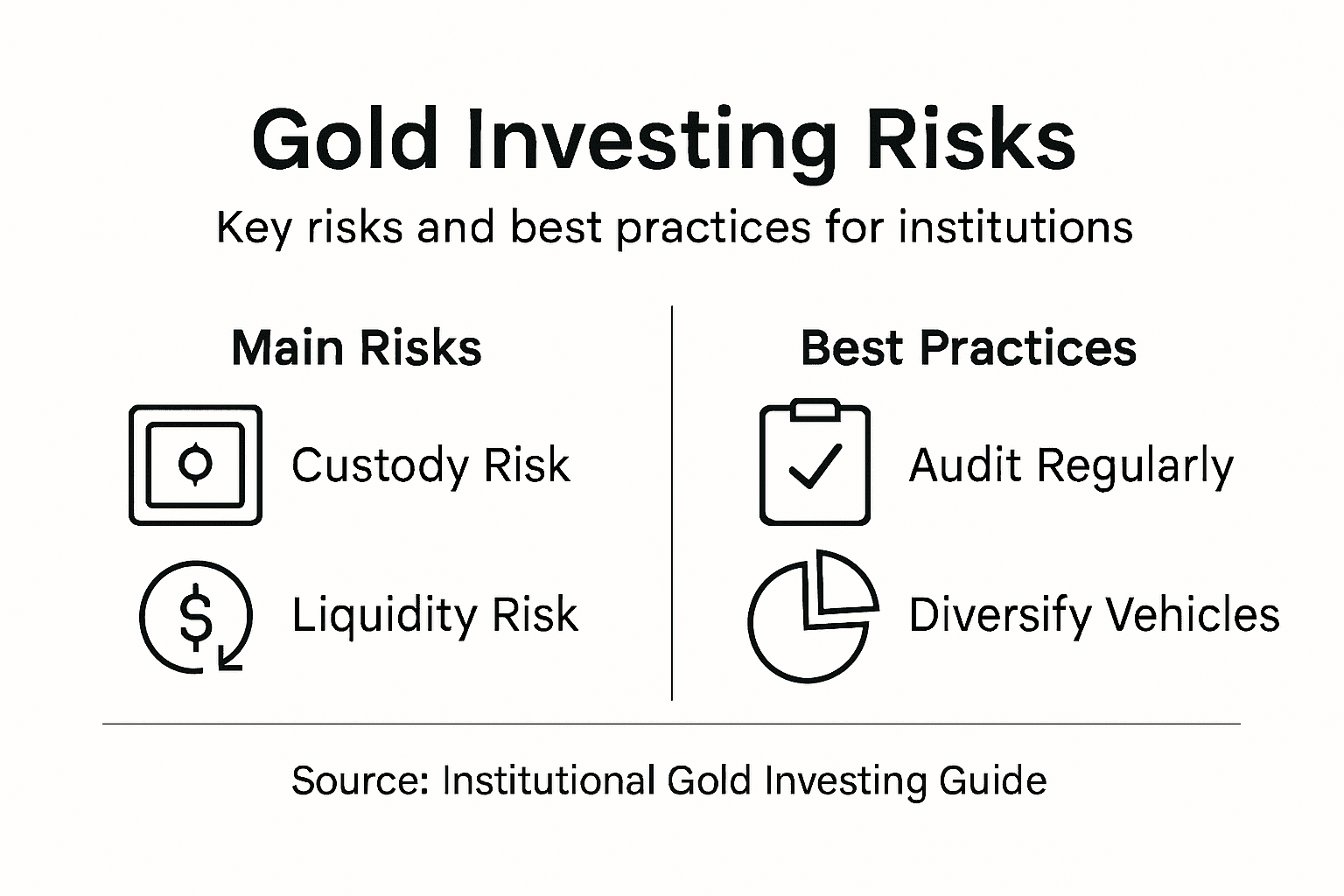
These risks aren’t theoretical—they directly reduce returns and can create catastrophic losses if mishandled. Understanding operational frameworks separates disciplined institutions from those that discover problems under stress.
Custody and Security Standards
Custody frameworks for institutional gold involve rigorous standards addressing theft, fraud, and geopolitical instability. Your gold exists in physical form, which means someone must guard it.
Rigorous custody requires:
Segregated storage where your bars remain physically separated from other clients’ holdings
Regular audits and reconciliations verifying inventory matches records
Insurance coverage protecting against theft and natural disasters
Geopolitical diversification distributing bars across multiple jurisdictions and vaults
Vault certification from established precious metals custodians with decades of operational history
Weaker custody arrangements introduce unacceptable risk. Pool accounts where gold sits commingled expose you to operational failure at other institutions.
Liquidity Performance Under Stress
Gold markets demonstrate resilience even during financial crises when equities crash 40 percent in weeks. You can actually access liquidity when you need it most.
Liquidity characteristics vary by vehicle:
Physical gold bars require days for delivery; selling happens at quoted prices within hours
ETFs settle within standard market hours; liquidity matches equity market depth
Futures contracts execute instantly with intraday price discovery
The catch: physical gold requires vault logistics, ETFs introduce counterparty exposure, and futures demand active management. No vehicle offers perfect liquidity without trade-offs.
Operational Risk and Settlement
Operational failures cascade quickly in gold markets. A vault audit discrepancy, logistics delay, or custodian error can trap capital for weeks during precisely when you need access.
Common operational risks include:
Settlement delays when physical delivery timelines extend unexpectedly
Audit exceptions requiring investigation before you can liquidate holdings
Logistics disruption from geopolitical events affecting transport routes
Custodian concentration risk if your entire holding sits with one vault operator
Operational integrity directly determines whether gold functions as a liquid asset or illiquid insurance policy. Weak operations transform your hedge into a trap.
Risk Management and Accounting
Proper accounting frameworks and risk management protocols underpin investor confidence in gold holdings. You need clear visibility into:
Bar-level tracking identifying individual gold pieces
Real-time mark-to-market valuations at settlement prices
Custody cost accounting separating insurance, storage, and handling fees
Counterparty exposure assessment for derivative positions
Institutions without rigorous operational controls cannot answer basic questions: Where exactly is my gold? What does it cost annually? Can I access it in 48 hours?
Pro tip: Require quarterly unannounced audits of your physical gold holdings and establish backup vault relationships before you need them—operational redundancy costs money but prevents catastrophic failures when market stress hits.
ESG, Transparency, and Supply Chain Integrity
Institutional investors increasingly face pressure from stakeholders to verify that their gold comes from responsible sources. This isn’t about corporate virtue signaling—it’s a structural requirement affecting asset valuations, regulatory compliance, and reputational risk.
Gold supply chains span continents, involve dozens of intermediaries, and often originate in regions with weak governance. Understanding where your gold actually comes from determines whether your investment aligns with your stated ESG commitments.
The ESG Transparency Challenge
Gold’s physical nature creates transparency gaps that equities don’t face. You can audit a mining company’s disclosures, but verifying that your specific bars came from conflict-free sources requires chain-of-custody documentation across entire supply networks.
Institutional investors promote credible ESG practices by engaging in sustained monitoring and advocating for stringent reporting standards. Long-term institutional investors have leverage that retail buyers lack—you can demand transparency as a condition of purchasing volume.
This creates competitive advantage:
Larger investors negotiate better sourcing terms with mine operators and refiners
Direct relationships with suppliers enable continuous ESG verification
Reputation protection from avoiding conflict gold or artisanal mining concerns
Regulatory alignment with emerging ESG reporting requirements in North America and Europe
Supply Chain Integrity Standards
Responsible gold sourcing requires standards and certification frameworks. The Responsible Gold Standard and London Bullion Market Association (LBMA) standards establish minimum requirements for member refineries.
Key integrity measures include:
Mine origin documentation tracing gold back to specific locations and operators
Conflict screening excluding gold from sanctioned jurisdictions or armed groups
Environmental compliance verifying mining operations meet host country standards
Labor practices assessment ensuring workers receive fair wages and safe conditions
Third-party audits validating refineries meet certification requirements
Weaker supply chains skip these steps, buying gold with limited traceability. This creates exposure to reputational damage if supply sources later prove problematic.
Accountability and Governance
Governance, transparency, and accountability directly determine supply chain credibility. Investors cannot claim ESG compliance while purchasing gold from unverified sources.
Responsible institutional gold investing requires:
Written sourcing policies defining what constitutes acceptable gold
Supplier vetting processes before making purchases
Annual compliance reporting documenting where gold originated
Board-level oversight of ESG performance in precious metals allocations
These practices add operational overhead—compliance teams, auditor fees, documentation management. But institutional investors increasingly recognize ESG compliance as mandatory, not optional.
The Decoupling Risk
Some institutions claim ESG commitments while purchasing gold without verification. This ESG decoupling exposes them to regulatory and reputational risk when discrepancies emerge.
Regulatory bodies in Canada, the United States, and Europe are tightening requirements for precious metals sourcing transparency. Institutions that haven’t implemented rigorous governance now face compliance deadlines and potential penalties.
Pro tip: Require LBMA-certified refineries as a baseline standard and request annual third-party audit reports confirming supply chain compliance—this documentation protects you against regulatory scrutiny and demonstrates genuine ESG commitment to stakeholders.
Secure Your Institutional Gold Strategy with Confidence
Navigating the intricacies of institutional gold investing demands disciplined execution and transparency to manage operational, regulatory, and supply chain risks effectively. Gold is not just an asset but a strategic insurance policy that requires trusted custody, clear ESG compliance, and efficient capital deployment. At Galami Gold, we understand these critical factors and offer a physical gold trading platform tailored for sophisticated investors seeking to optimize their gold allocations while minimizing counterpart risk and compliance burdens.

Ensure your portfolio benefits from robust gold exposure through our trusted trading operations. Visit Galami Gold to explore how our transparent supply chains, secure vault storage, and risk-managed processes align perfectly with best practices highlighted in “Institutional Gold Investing: Key Risks and Best Practices.” Take control of your gold strategy today with solutions built for institutional standards and designed to safeguard your capital in uncertain markets. Learn more directly on our physical gold trading platform and discover why disciplined execution matters.
Frequently Asked Questions
What are the main advantages of investing in gold for institutions?
Investing in gold provides several advantages for institutions, including low correlation with equities and bonds, immediate liquidity, no counterparty risk, global recognition, and regulatory acceptance as a tier-one liquid asset. These characteristics make gold an effective safe-haven asset during times of financial volatility.
How do Basel III regulations affect institutional gold holdings?
Basel III regulations impose requirements on liquidity and capital that affect how institutions hold and value gold. Gold has an 85% Net Stable Funding Ratio requirement under Basel III, meaning institutions need $0.85 in stable funding for every dollar of gold held. This can increase the cost of holding gold compared to other assets.
What are the different vehicles for institutional gold exposure and their risks?
Institutions can gain gold exposure through physical gold holdings, gold ETFs, or derivative products like futures. Physical gold provides full ownership but has high storage costs and settlement delays. Gold ETFs offer liquidity but introduce counterparty risk. Derivative products allow leveraged exposure with margin requirements but come with structural complexities.
What factors should be considered when evaluating the custody of gold holdings?
When evaluating custody for gold holdings, consider factors such as segregated storage, regular audits, insurance coverage, geopolitical diversification, and the reputation of the vault operator. Robust custody arrangements help mitigate operational risks and ensure the security of gold investments.
Recommended


Comments