


How to trade gold for strategic portfolio growth in 2026
- Shannon B
- Mar 13
- 8 min read


Institutional investors and wealth managers face mounting pressure to diversify portfolios and manage risk effectively in 2026’s volatile markets. Physical gold trading offers proven strategic advantages, acting as a safe haven and stabilizer during economic turbulence. This guide delivers actionable insights on how to trade gold to enhance portfolio stability, optimize risk-adjusted returns, and navigate market complexities. You’ll discover preparation essentials, execution strategies, and verification best practices tailored for sophisticated investors seeking measurable portfolio growth through disciplined gold trading.
Table of Contents
Key takeaways
Point | Details |
Gold provides safe-haven benefits | Physical gold acts as a safe haven in five major economies, offering protection during equity market corrections. |
Optimal allocation improves returns | Research shows 18% portfolio allocation to gold optimizes risk-adjusted performance. |
Market conditions influence effectiveness | Gold’s protective properties vary with market volatility and interest rate dynamics. |
Structured execution reduces risk | Following systematic trading steps from analysis through rebalancing enhances outcomes. |
Ongoing verification ensures benefits | Regular audits and risk management practices sustain portfolio stability and minimize drawdowns. |
Understanding gold’s role in institutional portfolios
Physical gold serves multiple strategic functions in institutional portfolios, making it essential for sophisticated risk management. Gold is a safe haven in five out of nine countries, namely Canada, Germany, Italy, the UK and the US, demonstrating its effectiveness varies by jurisdiction. This geographic specificity matters when structuring global portfolios.
The metal’s low correlation with equities and bonds creates genuine diversification benefits. During market downturns, gold typically maintains or increases value while traditional assets decline. Gold is relevant for strategic asset allocation as it may offer investors in some countries protection against significant equity market corrections. This protective quality becomes particularly valuable during volatile economic regimes when portfolio stability is paramount.
Gold’s effectiveness depends on prevailing market conditions. Interest rate environments and volatility levels directly impact how well gold performs its hedging role. When rates rise sharply, gold may underperform temporarily. Conversely, during periods of heightened uncertainty or negative real rates, gold strengthens as a portfolio anchor.
Institutional investors leverage gold as a safe-haven asset class through several mechanisms:
Safe haven during geopolitical crises and systemic financial stress
Inflation hedge protecting purchasing power over long horizons
Portfolio stabilizer reducing overall volatility and drawdowns
Diversification asset with minimal correlation to traditional holdings
Currency debasement protection during monetary expansion periods
Physical gold remains a cornerstone of strategic asset allocation for institutions seeking to balance growth objectives with robust risk management across market cycles.
Understanding these dynamics prepares wealth managers to make informed decisions about when and how to integrate physical gold into portfolios. The next critical step involves ensuring you have the necessary prerequisites in place before executing trades.
Preparation: Essential requirements for trading physical gold
Successful physical gold trading requires thorough preparation across knowledge, operational, and regulatory dimensions. Wealth managers must understand spot price mechanisms, premium structures over spot, and how global supply chains affect pricing. Market volatility and interest rate movements create timing opportunities and risks that demand continuous monitoring.
Selecting reputable dealers is non-negotiable. Institutional buyers need counterparties with proven track records, transparent pricing, and robust audit trails. Physical verification capabilities matter equally, whether through third-party vault inspections or allocated storage with clear chain of custody documentation. Security protocols for storage facilities should meet institutional standards, including insurance coverage, physical security measures, and disaster recovery plans.
Geographic considerations extend beyond safe-haven effectiveness. Tax treatment of physical gold varies significantly by jurisdiction, affecting net returns. Import duties, value-added taxes, and capital gains treatment require careful analysis before committing capital. Regulatory compliance obligations differ for institutional versus retail buyers, with reporting requirements and licensing potentially applicable.
The benefits of gold depend on the existing market environment as proxied by market volatility and interest rates dynamics. This relationship creates strategic entry points when conditions align favorably.
Market Indicator | Effect on Gold Prices | Institutional Implication |
Rising volatility | Positive | Increases safe-haven demand and premiums |
Higher real rates | Negative | Reduces opportunity cost advantage |
Currency weakness | Positive | Enhances purchasing power preservation |
Geopolitical stress | Positive | Drives institutional allocation increases |
Pro Tip: Time physical gold purchases during periods of elevated volatility but before interest rate hikes materialize, capturing safe-haven premiums while avoiding negative rate impacts.
Essential prerequisites for institutional gold trading include:
Established relationships with multiple vetted dealers for price comparison
Legal framework addressing ownership, custody, and succession rights
Secure storage solution meeting institutional security and insurance standards
Tax and regulatory compliance strategy for relevant jurisdictions
Portfolio integration plan specifying allocation targets and rebalancing triggers
Liquidity management approach balancing accessibility with security
Implementing effective risk management in gold trading from the outset prevents costly mistakes and enhances long-term outcomes. With preparation complete, you can proceed confidently to execution.

Execution: Step-by-step trading strategies for physical gold
Systematic execution transforms preparation into portfolio results. Follow this structured approach for physical gold trading:
Conduct comprehensive market analysis examining current volatility levels, interest rate trajectories, currency trends, and geopolitical developments affecting gold demand.
Compare multiple dealer quotes for physical gold products, evaluating premiums over spot, delivery timelines, and authentication guarantees.
Execute purchase through chosen dealer, documenting all transaction details including serial numbers, weights, purity certifications, and provenance records.
Arrange secure storage in allocated accounts or approved vault facilities with full insurance coverage and regular audit schedules.
Integrate purchased gold into portfolio accounting systems, updating allocation percentages and risk metrics.
Establish rebalancing protocols triggered by allocation drift beyond predetermined thresholds or significant market regime changes.
Institutional investors face important structural choices when implementing gold exposure. Understanding these options helps optimize liquidity, security, and cost efficiency.
| Approach | Liquidity | Security | Cost Structure | | — | — | — | | Direct physical ownership | Lower | Highest | High upfront, ongoing storage | | Allocated gold accounts | Medium | High | Moderate fees, easier trading | | Pooled gold products | Highest | Medium | Lower costs, counterparty risk |
Optimal portfolio allocation to gold is 18%, though individual circumstances may warrant adjustments. Portfolios with higher equity concentrations or emerging market exposure may benefit from allocations toward the upper end of the 15-20% range. Conservative portfolios with significant fixed income holdings might target lower allocations while still capturing diversification benefits.
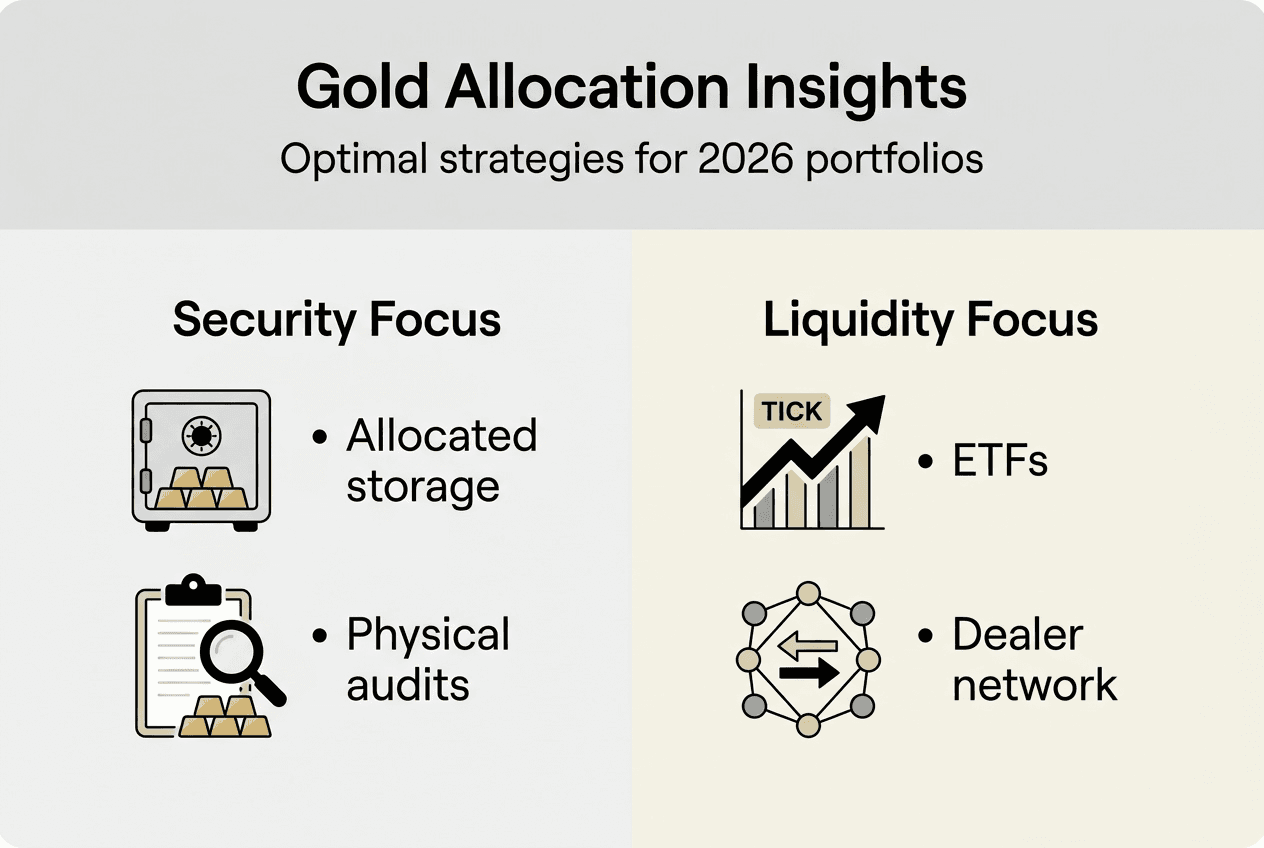
Pro Tip: Balance liquidity needs against security by maintaining 60-70% of gold holdings in maximum security allocated storage and 30-40% in more liquid pooled products, enabling rapid rebalancing without compromising core holdings.
Portfolio integration requires systematic review cycles. Quarterly assessments examine whether gold allocation remains within target bands and whether market conditions warrant tactical adjustments. During equity bull markets, gold allocations naturally decline through appreciation elsewhere, creating rebalancing opportunities. Conversely, market corrections often push allocations above targets, suggesting profit-taking or redistribution.
Optimizing gold investment strategies involves continuous refinement based on performance attribution and changing market dynamics. Successful wealth managers treat gold trading as an ongoing process rather than a one-time allocation decision.
Effective physical gold allocation strategies vary by portfolio objectives, but disciplined execution following these steps consistently produces superior risk-adjusted outcomes. With positions established, attention shifts to verification and ongoing risk management.
Verification and risk management in physical gold trading
Maintaining portfolio benefits from physical gold requires rigorous verification and proactive risk management. Institutional standards demand regular confirmation that holdings exist, remain secure, and deliver expected diversification.
Verification protocols should include scheduled physical audits conducted by independent third parties, typically annually or semi-annually depending on holding size. These audits confirm serial numbers match records, weights and purity meet specifications, and storage conditions remain appropriate. Third-party certifications from recognized assayers provide additional validation of authenticity and quality.
Vault inspections by institutional representatives or designated auditors verify security measures, insurance coverage, and operational procedures. Documentation reviews ensure chain of custody remains intact and all transactions are properly recorded. This systematic approach prevents discrepancies from escalating into significant problems.
Physical gold trading involves distinct risks requiring active management:
Counterparty risk from dealer insolvency or fraud, mitigated through diversified relationships and due diligence
Liquidity risk during market stress when bid-ask spreads widen dramatically
Storage security risks including theft, damage, or facility failures
Authentication risk from sophisticated counterfeits entering supply chains
Regulatory risk from changing tax treatment or ownership restrictions
Operational risk in custody transfers and documentation processes
Pro Tip: Deploy market intelligence tools tracking volatility indicators, central bank policies, and supply-demand dynamics to anticipate conditions affecting gold holdings, enabling proactive position adjustments before major moves.
Risk mitigation techniques proven effective for institutional gold holdings include comprehensive insurance covering full replacement value plus business interruption, diversified storage across multiple secure facilities in different jurisdictions, and rigorous vendor due diligence with ongoing performance monitoring. Maintaining relationships with multiple dealers ensures competitive pricing and alternative execution channels if primary counterparties face difficulties.
Including gold in a hypothetical multi-asset portfolio improved cumulative return and lowered maximum drawdowns between 2010 and 2025. These benefits persist only through disciplined risk management aligned with portfolio objectives.
Ongoing review cycles should align with broader portfolio governance processes. Monthly monitoring tracks allocation drift and market conditions. Quarterly reviews assess whether strategic assumptions remain valid and tactical adjustments are warranted. Annual comprehensive evaluations examine whether gold continues serving intended portfolio functions or whether allocation targets require revision.
Managing risk in gold investment extends beyond physical security to encompass market timing, allocation sizing, and integration with overall portfolio strategy. Institutions that excel at these practices consistently realize gold’s protective properties while minimizing associated costs and operational burdens.
These verification and risk management practices complete the full lifecycle of institutional physical gold trading, from initial preparation through ongoing portfolio maintenance. For wealth managers seeking proven solutions to implement these strategies, professional platforms offer valuable support.
Invest confidently with GALAMI GOLD
Institutional investors implementing the strategies outlined above benefit from partnering with platforms offering transparent, audited physical gold solutions. GALAMI GOLD specializes in physical gold trading services designed specifically for sophisticated investors requiring disciplined execution and robust risk management.

The platform provides secure allocated storage, competitive pricing through established supply chains, and portfolio advisory tailored to institutional objectives. Wealth managers gain access to verified physical gold products with full audit trails, enabling confident integration into diversified portfolios. Liquidity provisions and flexible rebalancing support ensure gold holdings adapt to changing market conditions while maintaining security standards.
Explore proven physical gold trading options through GALAMI GOLD’s comprehensive gold investment strategy guide, designed to help institutions achieve safer portfolio growth through strategic precious metals allocation.
GALAMI GOLD delivers the transparency, security, and execution quality institutional investors demand for physical gold trading that enhances portfolio stability and risk-adjusted returns.
Frequently asked questions
What is the recommended percentage of physical gold in an institutional portfolio?
Research indicates 18% represents the optimal allocation for balancing risk-adjusted returns. Individual portfolios may adjust within a 15-20% range based on equity concentration, risk tolerance, and existing diversification. Higher equity allocations often benefit from positions toward the upper end of this range.
How does market volatility affect gold’s safe-haven role?
Elevated volatility typically strengthens gold’s safe-haven properties, increasing demand and premiums during market stress. However, effectiveness varies by geography and interest rate environment. Gold performs best as a safe haven when volatility rises while real interest rates remain low or negative, creating optimal conditions for institutional accumulation.
What are the key risks in trading physical gold and how can they be managed?
Primary risks include counterparty failures, storage security breaches, liquidity constraints, and authentication challenges. Mitigation strategies involve diversifying dealer relationships, implementing comprehensive insurance, conducting regular third-party audits, and maintaining allocated storage across multiple secure facilities. Ongoing monitoring and vendor due diligence reduce operational and fraud risks.
How often should institutions review their gold holdings?
Monthly monitoring tracks allocation drift and market conditions, while quarterly reviews assess strategic alignment and tactical adjustment needs. Annual comprehensive evaluations examine whether gold continues serving intended portfolio functions. This tiered approach balances responsiveness with operational efficiency, preventing both neglect and excessive trading costs.
Are physical gold and gold ETFs interchangeable in terms of risk and return?
Physical gold and ETFs differ significantly in counterparty risk, liquidity, costs, and tax treatment. Physical ownership eliminates fund management risk but requires storage and insurance. ETFs offer superior liquidity and lower transaction costs but introduce counterparty exposure. Institutions often combine both, using physical holdings for core strategic allocation and ETFs for tactical adjustments. Understanding gold investment risks for institutions helps determine the appropriate mix for specific portfolio objectives.
Recommended

Comments