


Harnessing technology to optimize gold trading strategies
- Shannon B
- Mar 24
- 8 min read


Advanced AI and machine learning models achieve Sharpe ratios above 12 with minimal drawdowns in gold trading, fundamentally transforming how institutional investors approach precious metals markets. Technology now enables sophisticated strategies that were impossible just years ago, from real-time sentiment analysis to noise-resilient algorithmic execution. This article explores the AI models, trading platforms, and risk management frameworks reshaping institutional gold trading, providing actionable insights for wealth management firms seeking competitive advantages in precious metals allocation.
Table of Contents
Key Takeaways
Point | Details |
AI ML impact | Advanced AI and machine learning models boost Sharpe ratios and reduce drawdowns in institutional gold trading. |
Integrated trading platforms | Platforms provide real time data, integrated risk tools, realistic backtesting with cost modeling, and bullion inventory tracking across physical and derivative positions. |
Noise filtering | Kalman filtering and other filters reduce microstructure noise that creates false signals and harms model accuracy. |
Risk controls crucial | Institutions must align AI driven strategies with portfolio constraints and regulatory requirements to manage risk at speed. |
Advanced AI and machine learning in gold trading algorithms
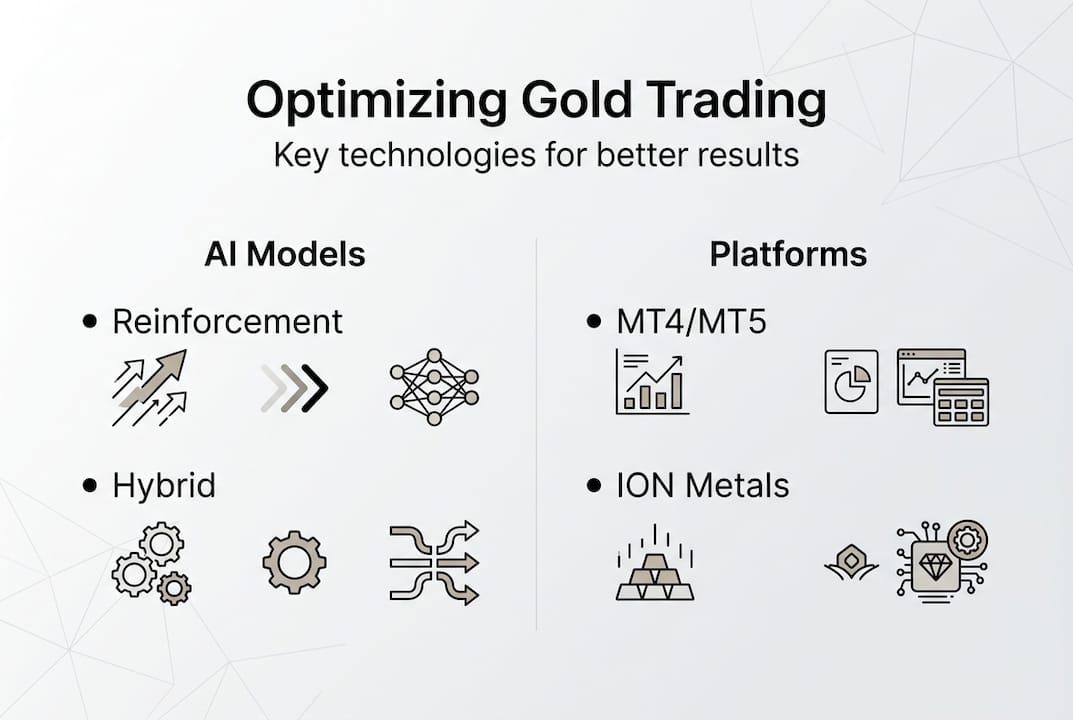
Deep reinforcement learning algorithms combined with noise reduction techniques are revolutionizing institutional gold trading performance. Proximal Policy Optimization (PPO) and Deep Q-Networks (DQN) learn optimal trading policies through continuous interaction with market environments, while Kalman filtering removes microstructure noise that degrades traditional models. Long Short-Term Memory (LSTM) networks forecast price movements by capturing temporal dependencies in gold market data.
Quantitative results demonstrate the power of these approaches. PPO combined with Kalman filtering achieved an 80.21% cumulative return and a 12.10 Sharpe ratio on XAU/USD data, with maximum drawdown limited to 4.87%. These metrics far exceed buy-and-hold strategies and traditional technical analysis methods.
Model | Cumulative Return | Sharpe Ratio | Max Drawdown |
PPO + Kalman | 80.21% | 12.10 | 4.87% |
DQN + Kalman | 76.43% | 11.85 | 5.12% |
PPO (no filter) | 62.14% | 8.92 | 7.34% |
Buy and hold | 18.76% | 2.41 | 12.89% |
Realistic cost modeling separates theoretical performance from actual profitability. Transaction costs, slippage, and bid-ask spreads significantly impact algorithmic strategies, particularly those with high turnover. Advanced models incorporate these frictions during training, ensuring strategies remain profitable in live markets. Market microstructure noise, caused by order flow imbalances and high-frequency trading activity, creates false signals that degrade model accuracy.
Key advantages of AI/ML approaches include:
Adaptive learning that adjusts to changing market regimes without manual recalibration
Pattern recognition across multiple timeframes and market conditions simultaneously
Risk-aware position sizing that optimizes capital allocation dynamically
Automated execution that eliminates emotional biases and timing errors
Pro Tip: Incorporating noise filters like Kalman or particle filters significantly improves model robustness in volatile gold markets, reducing false signals that trigger unprofitable trades.
Institutional investors should integrate risk management gold trading frameworks with AI models to ensure strategies align with portfolio constraints and regulatory requirements. Understanding how to manage risk gold investment positions becomes critical as algorithmic execution speeds increase.
Technology platforms empowering institutional gold trading
Comprehensive trading platforms provide the infrastructure institutional investors need to deploy advanced strategies effectively. Core capabilities include real-time market data feeds, integrated risk management tools, backtesting environments with realistic cost modeling, and bullion inventory tracking across physical and derivative positions. These systems connect front-office trading with middle-office risk controls and back-office settlement operations.

Major platforms serve different institutional needs. MetaTrader 4 and 5 offer accessible algorithmic trading with extensive indicator libraries and automated execution, suitable for smaller institutions or wealth management firms beginning to automate gold strategies. ION Precious Metals delivers enterprise-grade front-to-back solutions designed specifically for bullion dealers, refiners, and large institutional traders requiring comprehensive position management, regulatory reporting, and supply chain integration.
Platform | Best For | Key Features | Typical Users |
MT4/5 | Entry-level automation | Algorithmic execution, technical indicators, retail-friendly | Wealth managers, family offices |
ION Precious Metals | Enterprise operations | Inventory tracking, regulatory compliance, supply chain integration | Bullion dealers, large institutions |
Bloomberg Terminal | Market intelligence | Real-time data, analytics, multi-asset integration | All institutional investors |
Custom Python/R | Specialized strategies | Complete flexibility, proprietary models, research focus | Quantitative hedge funds |
Platforms like ION Precious Metals support real-time analytics, risk management, and bullion inventory tracking with proven institutional adoption. These systems handle the complexity of physical gold trading, including vault management, assay tracking, and delivery logistics, while simultaneously supporting derivative hedging strategies.
Platform selection criteria for institutions include:
Scalability to handle growing trading volumes and asset complexity
Integration capabilities with existing portfolio management and accounting systems
Regulatory compliance features including audit trails and reporting automation
Latency performance for time-sensitive algorithmic strategies
Support for both physical bullion and derivative instruments
Pro Tip: Selecting a platform with integrated front-to-back bullion management streamlines operations by eliminating manual reconciliation between trading, inventory, and accounting systems.
Institutional investors exploring gold trading platforms institutional investors 2026 options should prioritize platforms that align with their operational scale and strategy complexity. Understanding why gold trading platform matters helps institutions avoid costly platform migrations later.
Hybrid machine learning and tokenization: expanding gold trading tactics
Hybrid machine learning models combine multiple techniques to capture diverse market dynamics. Support Vector Regression (SVR) paired with PPO integrates fundamental factors and sentiment analysis with reinforcement learning, improving adaptability to gold return volatility. SVR-PPO hybrid models integrating market sentiment outperform buy-and-hold strategies with superior adaptation. Random Forest and SVR ensembles achieve R-squared values of 0.79 in gold price forecasting, demonstrating strong predictive accuracy.
Model Type | Approach | Key Advantage | Performance Metric |
SVR-PPO | Sentiment + RL | Captures behavioral factors | Outperforms buy-and-hold |
Random Forest/SVR | Ensemble forecasting | Robust predictions | R² = 0.79 |
LSTM + PPO | Time series + RL | Temporal pattern recognition | Sharpe ratio improvement |
Tokenized digital gold represents an emerging frontier for institutional access. Blockchain-based gold tokens enable fractional ownership, 24/7 trading, and faster settlement compared to physical bullion. Institutional benefits include enhanced liquidity, reduced custody costs, and programmable compliance features embedded in smart contracts. However, tokenized digital gold introduces risks including regulatory compliance uncertainty, potential sanctions evasion concerns, and dependencies on stablecoin infrastructure.
Key considerations for tokenized gold adoption:
Regulatory clarity varies significantly across jurisdictions, affecting compliance costs
Liquidity depth remains lower than established gold futures and ETF markets
Custody and insurance frameworks are still evolving for digital assets
Technology dependencies introduce operational risks absent in traditional gold holdings
Pro Tip: Combining sentiment analysis with price-based models helps capture market drivers beyond technical patterns, particularly during geopolitical events that trigger safe-haven flows into gold.
While technology offers powerful tools for optimizing gold trading, it also introduces new risks. Regulatory compliance, model overfitting, and technology dependencies require careful management. Institutions must balance innovation with prudent risk controls.
Institutional investors should evaluate gold trading regulations 2026 aml penalties highlight risks when considering tokenized options. Understanding institutional gold investing considerations helps frame technology adoption within broader portfolio objectives.
Navigating risks and applying technology to gold trading strategies
Technology-driven risk management addresses the unique challenges of gold markets. Microstructure noise and geopolitical safe-haven flows significantly impact algorithmic trading outcomes, requiring specialized approaches. Noise reduction techniques filter out random price fluctuations that trigger false signals, while regime detection models identify shifts between trending and mean-reverting market conditions.
Backtesting with realistic cost scenarios prevents the common pitfall of overly optimistic performance projections. Transaction costs in gold markets vary by instrument, with physical bullion incurring higher costs than futures or ETFs. Slippage increases during volatile periods, particularly around major geopolitical events or central bank announcements. Models trained without these frictions often fail in live trading.
Best practices for institutional strategy implementation:
Implement out-of-sample testing periods that include various market regimes
Monitor model performance continuously and trigger retraining when degradation occurs
Maintain human oversight for extreme market conditions and model anomalies
Diversify across multiple models and timeframes to reduce single-strategy risk
Document decision frameworks for regulatory compliance and internal governance
Pro Tip: Regularly update AI models with recent market data and regime changes to maintain resilience as market dynamics evolve, particularly after major geopolitical shifts.
Sequential risk management steps with technology:
Define risk tolerance parameters including maximum drawdown, value-at-risk limits, and position concentration constraints based on institutional mandates.
Deploy noise filtering techniques appropriate to trading frequency, with Kalman filters for high-frequency strategies and moving averages for longer timeframes.
Backtest strategies across multiple market regimes including crisis periods, ensuring models perform adequately during safe-haven flows into gold.
Implement real-time monitoring dashboards that alert portfolio managers to model degradation or risk limit breaches before losses accumulate.
Establish review cycles for model retraining and parameter updates, typically quarterly or after significant market regime changes.
Institutional investors benefit from comprehensive gold portfolio risk management 2026 frameworks that integrate technology with traditional risk controls. Reviewing institutional gold investing considerations ensures technology adoption aligns with fiduciary responsibilities and portfolio objectives.
Discover GALAMI GOLD’s technology-enabled gold investment solutions
GALAMI GOLD provides audited physical gold investment options with high ROI potential, combining traditional bullion integrity with modern technology integration. Our platform supports institutional clients with transparent operations, disciplined execution across established supply chains, and risk management tools tailored for sophisticated investors. Technology integration enhances liquidity management and portfolio optimization while maintaining the security of physical gold ownership.

Pro Tip: Leverage GALAMI GOLD’s platform to access both physical gold security and technology-driven trading advantages, optimizing your institutional precious metals allocation.
Client benefits include:
Full transparency with third-party audits and documented supply chain integrity
Performance optimization through technology-enabled execution and risk controls
Regulatory compliance support aligned with institutional governance requirements
Flexible access combining physical holdings with efficient capital deployment
Explore GALAMI GOLD physical gold trading solutions designed specifically for institutional investors and wealth management firms seeking disciplined precious metals exposure.
Frequently asked questions
How does AI improve forecasting accuracy and risk-adjusted returns in gold trading?
AI models learn complex patterns across multiple timeframes and market conditions that traditional technical analysis misses. Deep reinforcement learning optimizes trading policies through trial and error, achieving Sharpe ratios above 12 by adapting position sizing and entry timing dynamically. Noise filtering removes false signals that degrade traditional models.
What are the benefits and risks of tokenized gold for institutional investors?
Tokenized gold offers faster settlement, 24/7 trading access, and fractional ownership with lower custody costs than physical bullion. However, regulatory uncertainty, lower liquidity depth compared to established markets, and technology dependencies introduce operational and compliance risks. Institutions must weigh innovation benefits against prudent risk management.
Which trading platforms are best suited for institutional gold operations?
ION Precious Metals delivers enterprise-grade front-to-back solutions for large institutions requiring comprehensive inventory tracking, regulatory compliance, and supply chain integration. MetaTrader 4/5 suits smaller institutions beginning algorithmic trading with accessible automation. Bloomberg Terminal provides essential market intelligence across all institutional scales. Custom Python/R environments offer maximum flexibility for quantitative hedge funds.
How does technology help manage geopolitical and market noise risks in gold trading?
Kalman filtering and particle filters remove microstructure noise that creates false trading signals during volatile periods. Regime detection models identify shifts between trending and mean-reverting conditions, adjusting strategies accordingly. Sentiment analysis captures behavioral factors during geopolitical events that trigger safe-haven flows, improving model adaptability beyond pure price data.
What best practices ensure effective technology adoption in institutional gold trading?
Implement rigorous backtesting across multiple market regimes with realistic transaction costs and slippage assumptions. Maintain human oversight for extreme conditions and establish clear governance frameworks for model updates. Monitor performance continuously and trigger retraining when degradation occurs. Diversify across multiple models and timeframes to reduce concentration risk in any single algorithmic approach.
Recommended


Comments