


Gold trading terminology: institutional guide 2026
- Shannon B
- Mar 11
- 10 min read


Institutional investors often underestimate how misunderstanding gold trading terminology can undermine portfolio strategy and risk management. Terms like LBMA accreditation, physical delivery, and allocated vs unallocated gold are not just jargon, they define market access, liquidity, and regulatory compliance. This guide clarifies the critical vocabulary and emerging trends reshaping gold trading in 2026, equipping wealth managers with the precision needed to optimize precious metals allocations.
Table of Contents
Key takeaways
Point | Details |
Terminology mastery drives better decisions | Clear understanding of LBMA standards, allocated gold, and futures mechanics prevents costly misinterpretations and enhances portfolio performance. |
Physical delivery is reshaping futures markets | Since 2021, COMEX delivery volumes have spiked dramatically, transforming futures from price discovery tools into physical acquisition engines. |
Trust and standards underpin liquidity | LBMA Good Delivery Lists and responsible sourcing programs ensure ethical compliance and global market confidence. |
Logistics stress impacts institutional holdings | Current market strains between London and New York are creating supply pressures that affect unallocated gold positions. |
Understanding core gold trading terms and their significance
Institutional investors need fluency in gold trading terminology to navigate a market defined by strict standards and complex logistics. The London Bullion Market Association (LBMA) serves as the global authority, managing the Good Delivery Lists that define which gold bars meet settlement standards. This accreditation system ensures bars traded internationally meet precise weight, purity, and sourcing requirements.
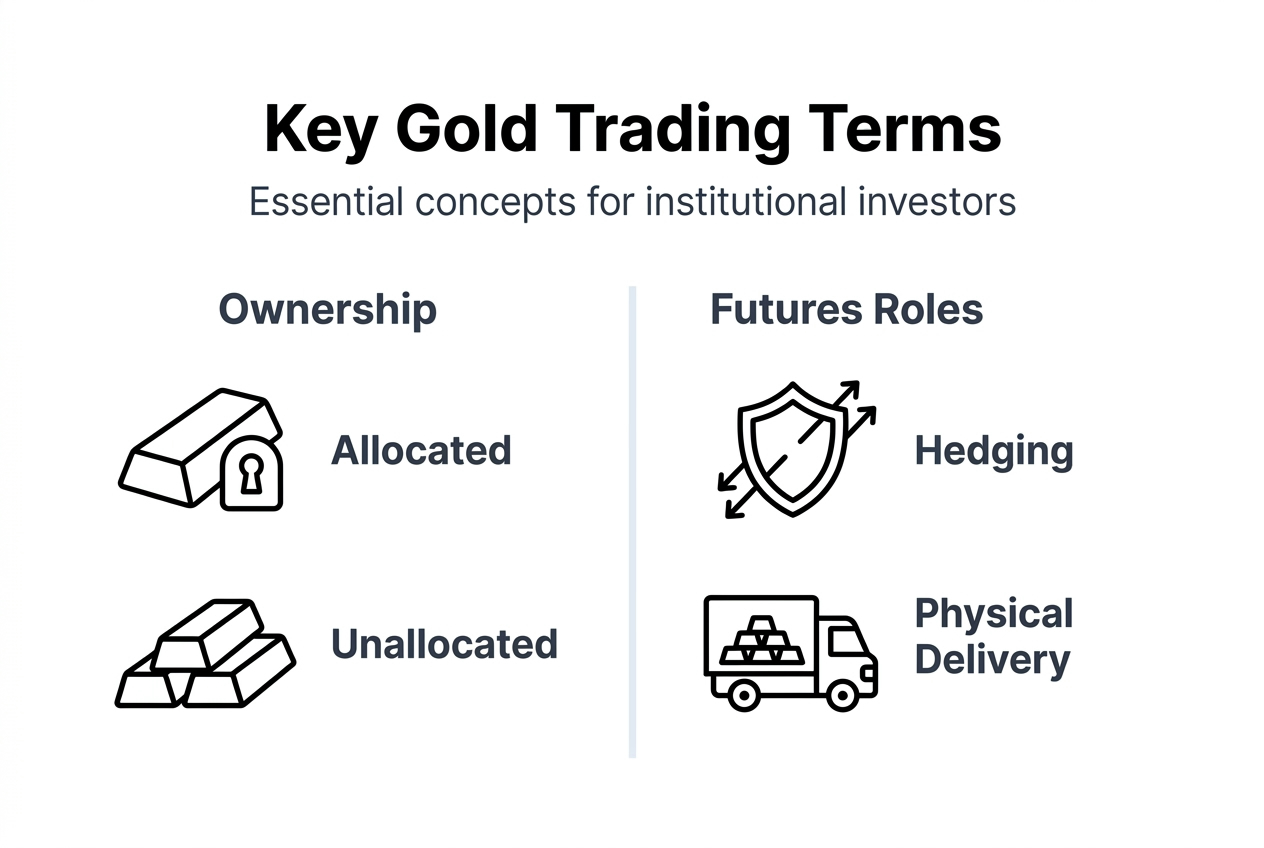
Understanding the difference between allocated and unallocated gold is fundamental. Allocated gold means you own specific, identifiable bars stored in a vault with serial numbers tied to your account, offering maximum security and control. Unallocated gold represents a claim on a pool of gold held by a bank or dealer, providing liquidity and lower storage costs but introducing counterparty risk. For institutional portfolios, this distinction affects everything from balance sheet treatment to regulatory capital requirements.
Futures contracts are standardized agreements to buy or sell gold at a predetermined price on a future date. Historically, these contracts served primarily for hedging and price discovery, with minimal physical settlement. The COMEX division of CME Group operates the world’s largest gold futures market, where contract specifications dictate 100 troy ounces per contract and strict delivery procedures. Physical delivery occurs when a contract holder takes possession of actual gold bars rather than cash settling, a trend that has accelerated dramatically since 2021.
LBMA’s Responsible Sourcing Programme promotes international ethical standards among refiners, addressing concerns about conflict minerals and environmental practices. This framework matters because institutional investors face increasing pressure to demonstrate ESG compliance in their precious metals holdings. Refiners must undergo third party audits to remain on the Good Delivery List, creating accountability that protects investor reputations.
Key gold trading terms institutional investors must know:
Good Delivery Bar: A gold bar meeting LBMA specifications (approximately 400 troy ounces, 995+ fineness) acceptable for settlement in London and major markets
Fineness: Purity measurement expressed in parts per thousand (e.g., 999.9 means 99.99% pure gold)
Troy Ounce: Standard measurement unit in precious metals (31.1035 grams), distinct from avoirdupois ounces used for other commodities
Spot Price: Current market price for immediate delivery, serving as the benchmark for derivatives and forward contracts
Contango: Market condition where futures prices exceed spot prices, reflecting storage costs and financing charges
Backwardation: Opposite of contango, where spot prices exceed futures, often signaling supply tightness or high physical demand
Pro Tip: Always verify that your gold custodian or trading partner maintains LBMA membership and uses Good Delivery List refiners. This verification protects against liquidity issues when you need to sell or transfer holdings, as non accredited bars require expensive remelting and recertification.
Understanding these fundamentals positions you to evaluate why gold trading attracts investors seeking portfolio diversification and inflation hedging through tangible assets with centuries of proven value.
The evolving role of gold futures and physical delivery in 2026
The gold futures market has undergone a structural transformation that every institutional investor must understand. Traditionally, less than 1% of COMEX futures contracts settled through physical delivery, with the vast majority cash settled or rolled forward to later months. This arrangement worked well for speculators and hedgers seeking price exposure without the complexities of storing and insuring physical metal. The futures market functioned primarily as a price discovery mechanism and risk management tool.

Since 2021, delivery volumes have surged, with spikes exceeding 14 million ounces in 50 day periods, representing roughly 10% of annual global gold production. This dramatic shift reflects institutional investors increasingly using COMEX as a physical acquisition channel rather than just a hedging venue. The trend accelerated through 2025, with record breaking delivery volumes transforming futures into a delivery engine.
Several factors drive this evolution. Geopolitical tensions and currency debasement concerns are pushing investors toward physical holdings rather than paper claims. Central banks have dramatically increased gold purchases, with many preferring direct ownership over derivative exposure. Supply chain disruptions exposed vulnerabilities in just in time logistics, making institutional investors value possession over promises. Trust in financial intermediaries has eroded following various market stresses, increasing appetite for allocated, segregated holdings.
This structural change creates five critical implications for institutional gold trading strategy:
Liquidity dynamics shift: As more contracts stand for delivery, fewer remain available for traditional futures trading, potentially increasing volatility during delivery months
Storage capacity constraints: COMEX approved vaults face space limitations, creating bottlenecks that can affect delivery timing and costs
Basis risk amplification: The spread between futures and spot prices may widen unpredictably as physical demand strains market infrastructure
Counterparty concentration: Heavy delivery activity concentrates risk among fewer vault operators and clearing members
Regulatory scrutiny intensifies: Authorities monitor delivery patterns more closely to ensure orderly markets and prevent manipulation
Institutional investors now evaluate futures positions differently. What once served purely as hedging tools now function as potential physical acquisition vehicles, requiring deeper analysis of delivery logistics, vault relationships, and transportation security. The types of gold trading you employ must account for these market structure changes.
This evolution also affects pricing relationships. When physical demand dominates, backwardation becomes more common, inverting the normal contango curve. This inversion signals market stress and creates opportunities for sophisticated traders who understand the underlying physical flows. Monitoring COMEX vault inventories, delivery notices, and vault transfer patterns provides insight into whether supply tightness will persist or ease.
For wealth managers, this means futures can no longer be treated as purely synthetic exposure. You must consider the operational capability to take delivery if market conditions favor physical acquisition through futures rather than spot purchases. This requires establishing relationships with approved carriers, understanding customs procedures for international transfers, and securing adequate insured storage.
The importance of trust, standards, and logistics in gold trading networks
Gold’s global liquidity depends on trust frameworks built over decades through organizations like LBMA. The Good Delivery Lists maintained by LBMA establish which refiners produce bars acceptable for settlement without question in London and other major markets. This accreditation system eliminates the need for assaying every bar during transactions, dramatically reducing friction and costs in international gold trade.
High standards enable unallocated gold trading, where banks and dealers maintain fungible pools that clients can access instantly. London serves as the global hub for this unallocated market, processing vast volumes daily through book entry transfers rather than physical movements. This efficiency supports gold’s role as a liquid asset class, allowing institutional investors to adjust positions quickly without the delays inherent in physical logistics.
However, current market dynamics are stressing this network. London is experiencing outflows as physical gold moves to New York to satisfy COMEX delivery demands, creating unusual strains on transport capacity and insurance availability. This geographic redistribution affects unallocated account holders who may face delays or costs if they suddenly request physical delivery.
Comparing physical and unallocated gold reveals critical distinctions:
Feature | Physical Allocated | Unallocated |
Ownership | Specific identified bars | Claim on pool |
Counterparty risk | Minimal (vault operator only) | Significant (dealer/bank solvency) |
Storage costs | Higher (segregated space) | Lower (shared pool) |
Liquidity | Requires physical movement | Instant book transfers |
Balance sheet treatment | Owned asset | Receivable/claim |
Institutional investors must understand these tradeoffs. Unallocated accounts offer operational convenience and cost efficiency but introduce dependencies on financial intermediaries. During market stress, dealers may restrict conversions from unallocated to allocated, leaving investors exposed. Physical allocated holdings eliminate this risk but require robust logistics partnerships and higher carrying costs.
Responsible sourcing adds another trust dimension. LBMA’s program requires refiners to trace gold origins, verify mining practices, and demonstrate environmental and social responsibility. Institutional investors increasingly need this documentation to satisfy their own ESG commitments and avoid reputational risks associated with conflict minerals or environmental damage. Bars lacking proper provenance may face liquidity discounts or outright rejection by certain buyers.
Pro Tip: Diversify your gold holdings across both allocated physical and unallocated claims, but monitor the financial health of institutions holding your unallocated positions. During periods of delivery stress or geopolitical tension, consider temporarily shifting toward allocated holdings to eliminate counterparty exposure.
Logistical integrity matters as much as financial trust. Transporting gold internationally requires specialized carriers, comprehensive insurance (typically Lloyd’s of London syndicates), and meticulous chain of custody documentation. Institutional investors should verify that their trading partners maintain relationships with established vault operators, understand customs procedures, and can execute secure transfers efficiently. Exploring operational mechanics of physical gold trading reveals the infrastructure supporting seamless institutional transactions.
Staying informed through resources like gold market insights helps you anticipate logistics bottlenecks and adjust positioning before problems emerge. The gold market’s trust infrastructure remains robust, but current delivery patterns create temporary stresses that sophisticated investors can navigate profitably.
Applying gold trading terminology for better investment strategy and risk management
Mastering gold trading vocabulary translates directly into superior investment outcomes. Misunderstanding whether you hold allocated or unallocated gold can lead to unexpected counterparty exposure during market turmoil. Confusing spot and futures pricing can result in unfavorable execution when rolling hedges. Overlooking the distinction between Good Delivery and non standard bars may create liquidity problems when you need to sell quickly.
Precise terminology comprehension prevents these costly errors. When evaluating gold investment vehicles, you can assess exactly what you own, where it resides, and what risks you bear. This clarity enables accurate portfolio modeling, appropriate balance sheet accounting, and realistic liquidity assumptions during stress scenarios. Institutional investors who speak the language fluently negotiate better terms with dealers, identify arbitrage opportunities, and avoid products with hidden operational complexities.
Integrate physical delivery trends into portfolio risk assessments. The shift toward futures delivery changes market dynamics in ways that affect optimal hedging ratios and timing. If you maintain short futures positions as portfolio hedges, rising delivery activity may increase basis volatility, requiring wider risk tolerances or more frequent rebalancing. Conversely, if you seek physical accumulation, understanding delivery patterns helps you time entries when vault congestion eases and premiums narrow.
Choose LBMA accredited sources exclusively for institutional gold holdings. This discipline ensures your holdings meet global standards, maintain maximum liquidity, and carry proper responsible sourcing documentation. LBMA’s commitment to leadership, integrity and transparency benefits all market participants by maintaining confidence in the gold market’s infrastructure. Deviating from these standards to save small premiums can create disproportionate risks and costs later.
Monitor responsible sourcing compliance continuously. ESG considerations are not peripheral concerns but core risk factors affecting asset valuations and stakeholder relationships. Institutional investors face increasing scrutiny over supply chain ethics in all holdings, including precious metals. Maintaining documentation proving your gold originates from verified, audited sources protects your reputation and ensures holdings remain acceptable to future buyers.
Actionable steps to optimize gold trading using clarified terminology:
Audit current holdings: Verify whether positions are allocated or unallocated, identify custodians and vault locations, and confirm LBMA Good Delivery status
Establish delivery capability: Build relationships with approved carriers and vault operators so you can take physical delivery from futures if advantageous
Map logistics networks: Understand gold flows between London, New York, Zurich, and other hubs to anticipate supply bottlenecks affecting pricing
Monitor vault inventories: Track COMEX and LBMA vault reports to gauge physical supply tightness and predict delivery pattern shifts
Review documentation: Ensure responsible sourcing certificates and chain of custody records meet current ESG standards and regulatory expectations
Pro Tip: Leverage LBMA membership benefits if your institution qualifies, gaining access to market data, networking with refiners and vault operators, and participating in standard setting discussions that shape future market infrastructure. This involvement provides early insight into regulatory changes and industry trends affecting gold trading.
Understanding why gold matters for institutional investors in 2026 extends beyond traditional inflation hedging. Gold’s role in portfolio construction now encompasses counterparty risk mitigation, currency diversification, and ESG aligned tangible asset exposure. Research demonstrates that gold enhances diversification while reducing portfolio volatility, making terminology mastery essential for capturing these benefits fully.
The terminology you master today directly improves the decisions you make tomorrow. As gold markets evolve with delivery trends, logistics stresses, and heightened standards, institutional investors who understand the language gain competitive advantages in execution, risk management, and strategic positioning.
Explore Galami Gold’s trusted gold investment solutions
Navigating the complexities of gold trading terminology and market evolution requires partners who understand institutional needs. Galami Gold operates as a physical gold trading platform built on disciplined execution, transparency, and rigorous risk management across established supply chains. Our investment solutions align with LBMA standards and responsible sourcing requirements, ensuring your holdings meet the highest industry benchmarks.

We serve wealth managers and institutional investors seeking audited, allocated physical gold positions with clear chain of custody documentation. Our expertise in market logistics, delivery mechanics, and regulatory compliance translates the terminology discussed in this guide into practical investment products. Whether you need to establish new gold allocations or optimize existing positions, Galami Gold’s investment solutions provide the trust, transparency, and operational excellence that sophisticated investors demand in 2026.
FAQ
What is the London Bullion Market Association (LBMA) and why does it matter?
LBMA manages quality standards and ethical sourcing requirements that ensure trust and liquidity in global gold markets. Its Good Delivery Lists define which refiners produce bars acceptable for settlement without additional verification, dramatically reducing transaction friction. For institutional investors, LBMA accreditation guarantees holdings maintain maximum marketability and meet regulatory expectations for why gold trading attracts investors seeking reliable value stores.
How has the gold futures market changed in recent years?
Physical deliveries on COMEX have spiked dramatically since 2021, with volumes exceeding 14 million ounces in 50 day periods. This represents a fundamental shift from futures serving primarily as hedging and price discovery tools to becoming physical acquisition channels. Institutional investors now use futures to secure actual gold rather than just synthetic exposure, requiring different operational capabilities and risk assessments when evaluating types of gold trading in 2026.
What are the risks related to gold trading logistics and trust?
Current market dynamics are stressing global gold logistics networks as physical metal moves from London to New York to satisfy delivery demands. These strains can affect liquidity for unallocated positions and create temporary bottlenecks in vault capacity and transportation. Choosing LBMA accredited sources and maintaining allocated holdings mitigates counterparty and delivery risks, as discussed in gold market insights covering evolving infrastructure pressures.
How can understanding gold trading terminology improve investment outcomes?
Clear terminology prevents misinterpretations that lead to unexpected risks, unfavorable execution, or liquidity problems during portfolio adjustments. Knowing whether you hold allocated or unallocated gold, understanding delivery mechanics, and recognizing quality standards enables accurate risk modeling and optimal positioning. Institutional investors who master this vocabulary can leverage delivery trends, negotiate better terms, and integrate gold more effectively into diversified portfolios as explained in why gold matters for institutional investors in 2026.
Recommended


Comments