


Gold trading regulations 2026: 75% AML penalties highlight risks
- Shannon B
- Mar 4
- 13 min read

Over 75% of enforcement actions against gold trading firms from 2020 to 2025 targeted AML violations, exposing a critical compliance gap institutional investors cannot afford to ignore. U.S. gold trading regulations involve multiple federal agencies, complex overlapping rules, and severe penalties for noncompliance. This guide equips institutional investors and wealth managers with essential knowledge of regulatory frameworks, compliance obligations, and practical strategies to safeguard investments and maintain legal standing in 2026.
Table of Contents
Key takeaways
Point | Details |
AML compliance failures | AML violations account for over 75% of regulatory penalties in gold trading from 2020 to 2025. |
Multiple regulatory bodies | SEC, CFTC, FinCEN, and IRS each govern different aspects of gold investments with distinct requirements. |
Product-specific rules | Physical gold faces AML and tax reporting laws, while derivatives encounter CFTC position limits and disclosure mandates. |
International standards matter | OECD due diligence guidelines shape responsible sourcing and conflict mineral disclosure obligations. |
Proactive compliance reduces risk | Robust compliance programs, staff training, and technology monitoring minimize legal and financial exposure. |
Introduction to gold trading regulations in the U.S.
Gold remains a cornerstone asset for institutional portfolios, providing diversification and hedging against inflation and currency volatility. However, the regulatory landscape governing gold trading in the United States is anything but simple. Multiple federal agencies oversee different facets of gold investment products, creating a web of compliance obligations that institutional investors must navigate carefully.
Noncompliance with gold trading regulations exposes firms to significant legal penalties, reputational damage, and operational disruptions. Regulatory enforcement has intensified in recent years, with AML violations leading the charge. Understanding the distinct compliance domains is critical for wealth management firms seeking to integrate gold investment strategies into client portfolios without incurring regulatory risk.
Key compliance domains include:
Securities law governing gold ETFs and related investment products
Commodities regulation for gold futures and derivatives trading
AML requirements for physical gold dealers and trading platforms
Tax reporting obligations for physical gold sales and transactions
Physical gold and derivative products face entirely different regulatory treatments under U.S. law. Physical gold trading invokes AML scrutiny and IRS reporting rules, while derivatives fall under CFTC jurisdiction with position limits and market manipulation safeguards. Institutional investors must recognize these distinctions to design compliant trading strategies and allocate resources effectively.
Pro Tip: Establish a cross-functional compliance committee early to coordinate legal, finance, and operations teams, ensuring no regulatory obligation falls through the cracks.
Overview of U.S. regulatory bodies for gold trading
Understanding which federal agencies regulate gold trading clarifies compliance responsibilities and helps institutional investors allocate oversight resources efficiently. Four primary U.S. regulatory bodies govern different aspects of gold investment activities, each with distinct mandates and enforcement powers.
The Commodity Futures Trading Commission (CFTC) oversees gold futures, options, and other derivatives traded on regulated exchanges. The CFTC enforces position limits to prevent market manipulation and requires detailed reporting from large traders. Institutional investors trading gold derivatives must register with the National Futures Association and comply with CFTC reporting thresholds.
The Securities and Exchange Commission (SEC) regulates gold ETFs, gold mining stocks, and other securities linked to gold. SEC rules mandate periodic disclosures, antifraud protections, and fiduciary duties for investment advisors recommending gold securities. Wealth managers must ensure their gold ETF recommendations align with SEC suitability standards and disclosure requirements.
The Financial Crimes Enforcement Network (FinCEN) enforces Bank Secrecy Act provisions on physical gold dealers and trading platforms. FinCEN requires AML programs, customer due diligence, and suspicious activity reporting for businesses dealing in physical gold. Platforms facilitating physical gold transactions must register as money services businesses and implement robust AML controls.
The Internal Revenue Service (IRS) monitors tax compliance for physical gold sales and capital gains reporting. Physical gold is classified as a collectible, subject to a 28% maximum capital gains tax rate. Dealers must report sales exceeding specific thresholds using Form 1099-B, and investors must track cost basis accurately.
These agencies’ jurisdictions sometimes overlap, requiring institutional investors to coordinate compliance efforts across multiple regulatory frameworks. The importance of gold trading platforms lies partly in their ability to integrate compliance with these varied regulatory bodies.
Key regulatory bodies:
CFTC for gold futures and derivatives
SEC for gold ETFs and securities
FinCEN for AML enforcement on physical gold
IRS for tax reporting and capital gains
Core regulatory requirements and compliance obligations
Institutional investors must satisfy a complex array of legal requirements when engaging in gold trading activities. These obligations span securities law, commodities regulation, AML enforcement, and tax compliance, each carrying significant penalties for noncompliance.
The Commodity Exchange Act governs gold derivatives trading, imposing position limits to prevent excessive speculation and requiring large traders to report positions daily. CFTC position limits vary by contract month and delivery type, with institutional investors often needing to aggregate positions across multiple accounts. Violating position limits can result in fines, trading bans, and reputational damage.
The Bank Secrecy Act mandates comprehensive AML programs for entities dealing in physical gold. Compliance requires customer identification programs, ongoing monitoring for suspicious transactions, and filing Suspicious Activity Reports (SARs) for potentially illicit activity. Physical gold dealers must also maintain records of transactions exceeding $10,000 and verify customer identities.
SEC regulations impose disclosure and antifraud obligations on gold ETFs and related securities. Fund managers must provide prospectuses detailing investment strategies, risk factors, and fee structures. Regular reporting to the SEC ensures transparency and protects investors from fraud. Wealth managers recommending gold securities must conduct suitability assessments and disclose conflicts of interest.
Physical gold trading invokes compliance with IRS Form 1099-B reporting rules for transactions exceeding $1,000. Dealers must report sales of physical gold bullion, coins, and bars to the IRS, providing detailed transaction records. Investors must track cost basis and holding periods to calculate capital gains accurately, given the 28% collectibles tax rate.
Compliance involves:
Implementing robust AML monitoring systems with transaction alerts and customer screening
Maintaining detailed records for at least six years to satisfy audit requirements
Filing timely reports with CFTC, SEC, FinCEN, and IRS as applicable
Conducting regular compliance audits to identify and remediate gaps
Training staff on evolving regulatory requirements and enforcement trends
Regulation | Requirement | Penalty for Noncompliance |
Commodity Exchange Act | Position limits and reporting | Fines up to $1 million per violation |
Bank Secrecy Act | AML programs and SARs | Criminal penalties and trading bans |
SEC Disclosure Rules | Prospectuses and periodic filings | Civil penalties and injunctions |
IRS Form 1099-B | Report gold sales exceeding $1,000 | Fines and back taxes with interest |
Pro Tip: Automate transaction monitoring and reporting using compliance technology to reduce manual errors and ensure timely filing with multiple agencies.
“Compliance is not a checkbox exercise. It requires continuous monitoring, staff education, and adaptation to evolving regulatory expectations across multiple federal agencies.”
Understanding the operational mechanics of physical gold trading helps institutional investors design compliant workflows that satisfy AML, tax, and securities obligations simultaneously.
Common misconceptions about gold trading regulation
Institutional investors frequently harbor misunderstandings about the regulatory landscape governing gold trading, leading to compliance gaps and enforcement risks. Correcting these misconceptions is essential for maintaining legal standing and avoiding costly penalties.
One widespread myth is that physical gold trading operates in an unregulated space. In reality, physical gold dealers face stringent AML requirements under the Bank Secrecy Act and state securities laws. FinCEN enforces AML compliance on platforms and dealers, requiring customer due diligence, transaction monitoring, and suspicious activity reporting. Believing physical gold is unregulated invites noncompliance and enforcement action.
Another misconception is that SEC regulations do not apply to gold investments. While physical gold bullion falls outside SEC jurisdiction, gold ETFs, mining stocks, and structured products are fully regulated securities. SEC rules mandate disclosure, antifraud protections, and fiduciary duties for advisors recommending these products. Wealth managers must recognize which gold investments trigger SEC obligations.
Some investors mistakenly assume AML compliance is solely a banking concern. In fact, gold dealers and trading platforms must implement comprehensive AML programs, including customer identification, transaction monitoring, and SAR filing. Platforms facilitating physical gold transactions must register as money services businesses and comply with FinCEN reporting requirements.
Mixing regulations across different gold product types causes partial compliance and penalties. Physical gold, gold derivatives, and gold securities each face distinct regulatory frameworks. Applying SEC rules to physical gold or CFTC rules to gold ETFs creates compliance gaps. Institutional investors must tailor compliance efforts to the specific product type.
Key misconceptions to avoid:
Physical gold trading is unregulated (false: AML and state securities laws apply)
SEC rules do not cover gold investments (false: gold ETFs and securities are fully regulated)
AML compliance is only for banks (false: gold dealers and platforms must comply)
One regulatory framework covers all gold products (false: rules vary by product type)
Pro Tip: Conduct a regulatory audit of your gold holdings to identify which agencies govern each product type, ensuring compliance efforts align with actual obligations.
Understanding common compliance pitfalls helps institutional investors avoid the mistakes that lead to enforcement actions and reputational damage.
Comparison of regulatory frameworks: physical gold vs gold derivatives
Physical gold and gold derivatives face entirely different regulatory treatments under U.S. law, requiring institutional investors to design distinct compliance strategies for each product category. Understanding these differences is critical for risk management and legal adherence.
Physical gold trading is primarily governed by AML laws enforced by FinCEN and IRS tax reporting requirements. Dealers must implement AML programs, file SARs for suspicious transactions, and report sales exceeding $1,000 using Form 1099-B. Physical gold is classified as a collectible, subject to a 28% maximum capital gains tax rate. State securities laws may also apply, depending on how physical gold is marketed and sold.
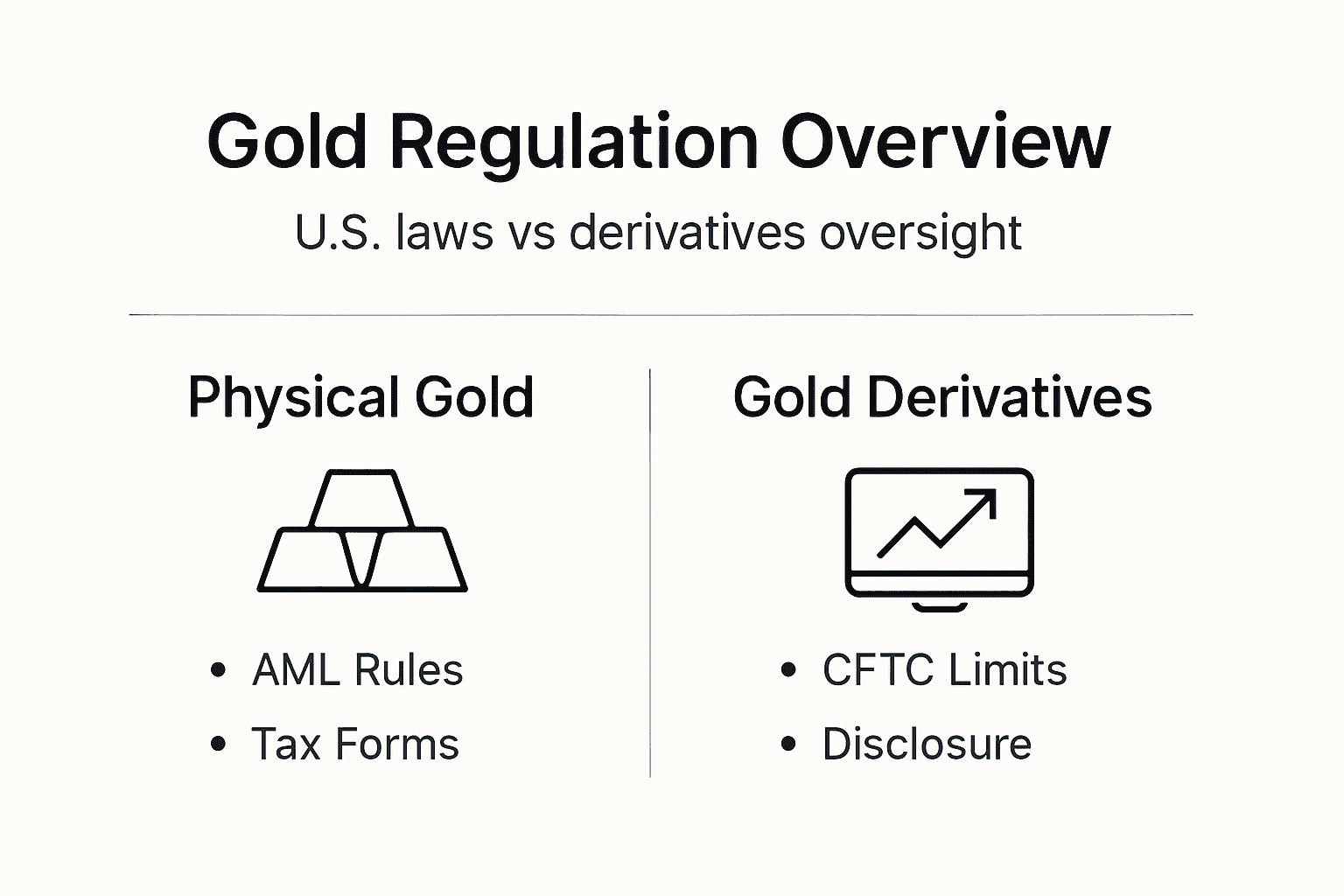
Gold derivatives, including futures and options, fall under CFTC jurisdiction with comprehensive market oversight. The CFTC imposes position limits to prevent excessive speculation, requires daily reporting from large traders, and enforces antimanipulation rules. Institutional investors trading derivatives must register with the National Futures Association and comply with margin requirements set by exchanges.
Gold ETFs and securities are regulated by the SEC, requiring prospectuses, periodic disclosures, and antifraud protections. Fund managers must report holdings, fees, and risk factors regularly. Wealth managers recommending gold ETFs must conduct suitability assessments and disclose conflicts of interest, ensuring recommendations align with client investment objectives.
Aspect | Physical Gold | Gold Derivatives | Gold ETFs |
Primary Regulator | FinCEN, IRS | CFTC | SEC |
Key Compliance | AML programs, Form 1099-B | Position limits, daily reporting | Prospectuses, periodic filings |
Tax Treatment | 28% collectibles rate | Ordinary income or capital gains | Capital gains based on holding period |
Registration Requirements | Money services business (platforms) | National Futures Association | Investment Company Act |
Monitoring Focus | Suspicious transactions | Market manipulation | Disclosure accuracy |
These differences affect compliance scope, monitoring intensity, and reporting obligations. Institutional investors must allocate resources based on the specific gold product types in their portfolios. Mixing compliance frameworks leads to gaps and enforcement risk.
Key distinctions:
Physical gold: AML and tax reporting focus
Gold derivatives: CFTC position limits and market oversight
Gold ETFs: SEC disclosure and antifraud requirements
Each product type requires tailored compliance strategies
Understanding regulatory differences physical gold vs derivatives informs product allocation decisions and compliance resource deployment.
International regulatory influence and ethical sourcing
Global standards increasingly shape U.S. gold trading practices, with international due diligence frameworks influencing responsible sourcing obligations and supply chain transparency. Institutional investors must recognize how international regulations impact domestic compliance and reputational risk.
OECD Due Diligence Guidance influences U.S. traders to enforce ethical sourcing and conflict mineral disclosures, ensuring supply chain responsibility. The OECD recommends a five-step due diligence framework covering risk assessment, supply chain traceability, independent audits, and public reporting. While not legally binding in the U.S., these guidelines set industry best practices that institutional investors increasingly adopt.
Ethical sourcing reduces reputational and regulatory risk for institutional investors. Sourcing gold from conflict zones or suppliers with poor labor practices invites scrutiny from regulators, investors, and advocacy groups. Implementing robust supply chain due diligence demonstrates commitment to responsible investing and protects brand reputation.
U.S. platforms integrate global compliance standards into policies for physical gold sourcing. Leading platforms verify supplier certifications, conduct independent audits, and maintain traceability records from mine to vault. These practices align with OECD guidelines and prepare firms for potential future U.S. regulations on conflict minerals.
Conflict mineral regulations require traceability and vendor disclosures. While current U.S. conflict mineral rules focus on tin, tantalum, tungsten, and gold used in manufacturing, expanding regulations may increase disclosure obligations for investment-grade gold. Institutional investors should anticipate stricter sourcing requirements and implement due diligence programs proactively.
Global standards increasingly shape domestic regulatory expectations. As international frameworks gain traction, U.S. regulators may incorporate similar requirements into enforcement priorities. Institutional investors adhering to OECD guidelines position themselves ahead of regulatory curves and reduce compliance risk.
Key international influences:
OECD five-step due diligence framework for supply chains
Ethical sourcing requirements to avoid conflict zones
Traceability and independent audit expectations
Anticipation of stricter U.S. conflict mineral disclosures
Understanding international gold trading standards helps institutional investors align their sourcing practices with evolving global expectations and protect against reputational damage.
Risk management and compliance challenges in gold trading
Regulatory risks in gold trading have intensified in recent years, with enforcement actions targeting AML failures, inadequate disclosure, and position limit violations. Institutional investors must understand key challenges and implement proactive risk management to maintain compliance.

AML violations represent over 75% of enforcement actions against gold trading firms from 2020 to 2025. FinCEN has increased scrutiny of physical gold dealers and platforms, penalizing inadequate customer due diligence, transaction monitoring failures, and delayed SAR filings. Firms lacking robust AML programs face fines, trading bans, and criminal prosecution.
Multi-agency regulatory overlap complicates compliance efforts. Gold trading activities may trigger obligations under CFTC, SEC, FinCEN, and IRS rules simultaneously. Coordinating compliance across these agencies requires dedicated resources, cross-functional teams, and comprehensive monitoring systems. Failure to satisfy any single agency’s requirements exposes firms to enforcement risk.
Common pitfalls include inadequate AML monitoring and mixing regulations across product types. Many firms deploy generic compliance programs that fail to address gold-specific risks, such as cash transactions, politically exposed persons, and high-risk jurisdictions. Applying physical gold compliance frameworks to derivatives, or vice versa, creates gaps that regulators exploit during examinations.
Recent enforcement case studies demonstrate the costs of noncompliance. In 2024, a major gold dealer paid $5 million to settle FinCEN charges for failing to file SARs on suspicious transactions. Another firm faced SEC sanctions for inadequate disclosure of gold ETF risk factors. These cases underscore the importance of tailored compliance programs and continuous monitoring.
Proactive risk assessments and governance minimize exposure. Institutional investors should conduct regular compliance audits, update policies to reflect evolving regulations, and train staff on emerging enforcement trends. Establishing compliance committees with legal, finance, and operations representation ensures accountability and rapid response to regulatory changes.
Key compliance challenges:
AML violations leading enforcement actions (75% of penalties)
Multi-agency regulatory overlap requiring coordinated compliance
Inadequate monitoring systems failing to detect suspicious activity
Mixing product-specific regulations creating compliance gaps
“Enforcement trends reveal regulators prioritize AML compliance, accurate disclosure, and adherence to position limits. Institutional investors must allocate resources accordingly to avoid becoming the next enforcement target.”
Implementing effective risk management strategies protects institutional investors from penalties, reputational damage, and operational disruptions caused by regulatory noncompliance.
Implementing robust compliance in gold trading strategies
Institutional investors can integrate effective regulatory compliance into gold trading operations by adopting best practices, leveraging technology, and fostering a culture of continuous improvement. Practical implementation steps reduce legal exposure and enhance operational efficiency.
Form cross-functional compliance governance teams including legal, finance, and operations personnel to coordinate oversight and accountability across regulatory obligations.
Implement ongoing staff training on AML, securities, and derivatives regulations, ensuring all personnel understand their compliance responsibilities and recognize red flags.
Leverage technology solutions for real-time transaction monitoring and reporting, automating alerts for suspicious activity, position limit breaches, and filing deadlines.
Regularly update compliance procedures to adapt to evolving regulations and enforcement patterns, conducting quarterly reviews of policies and controls.
Conduct periodic audits and risk assessments to ensure adherence, engaging independent auditors to identify gaps and recommend improvements.
Technology plays a critical role in modern compliance programs. Automated monitoring systems track transactions across multiple accounts, flagging suspicious patterns that warrant investigation. Reporting tools generate Form 1099-B filings, CFTC position reports, and SEC disclosures with minimal manual intervention, reducing errors and ensuring timely submission.
Compliance training must be ongoing and role-specific. Front-office traders need education on position limits and market manipulation rules, while operations staff require AML training focused on customer due diligence and SAR filing. Regular training updates keep staff informed of new regulations and enforcement priorities.
Governance structures provide accountability and leadership support for compliance initiatives. Compliance committees should meet quarterly to review audit findings, discuss regulatory changes, and allocate resources for program enhancements. Executive sponsorship ensures compliance receives adequate funding and organizational priority.
Pro Tip: Schedule annual compliance reviews with external legal counsel specializing in commodities and securities law to validate your program’s effectiveness and identify emerging risks before they become enforcement issues.
Integrating compliance into gold strategies from the outset reduces retrofitting costs and positions institutional investors to respond quickly to regulatory changes.
Enhance your gold trading compliance with Galami Gold
Navigating the complex regulatory landscape of gold trading requires trusted partners with deep compliance expertise and proven track records. Galami Gold offers audited, compliant physical gold trading solutions tailored for institutional needs, integrating advanced compliance frameworks aligned with 2026 U.S. regulations.

Our platform provides transparency, disciplined execution, and robust risk management across well-established gold supply chains. We implement comprehensive AML programs, maintain detailed transaction records, and ensure timely reporting to FinCEN, IRS, and other regulatory bodies. Institutional investors partnering with Galami Gold benefit from our commitment to regulatory excellence and ethical sourcing.
Learn from our expert market insights and risk management resources designed for sophisticated investors seeking to enhance their gold trading strategies. Our team stays ahead of regulatory changes, enforcement trends, and international standards, providing clients with actionable intelligence to maintain compliance and optimize portfolio performance.
Explore our trusted gold trading platforms and discover institutional gold investing best practices that safeguard your investments and enhance regulatory confidence in 2026 and beyond.
Frequently asked questions about gold trading regulations
What forms must institutional investors file for physical gold sales?
Institutional investors must file IRS Form 1099-B for physical gold sales exceeding $1,000, reporting transaction details, seller information, and proceeds. Dealers handling the sales typically file these forms, but investors must track cost basis and holding periods to calculate capital gains accurately for tax returns.
How does the CFTC position limit affect gold derivatives trading?
The CFTC imposes position limits on gold futures and options to prevent excessive speculation and market manipulation. Institutional investors must aggregate positions across accounts and report holdings exceeding thresholds daily. Violating position limits results in fines, trading restrictions, and potential criminal penalties.
Are gold ETFs regulated differently than physical gold?
Yes, gold ETFs are regulated as securities under SEC jurisdiction, requiring prospectuses, periodic disclosures, and antifraud protections. Physical gold faces FinCEN AML requirements and IRS tax reporting but not SEC securities rules. Wealth managers must apply different compliance frameworks based on the product type.
What are key AML compliance requirements for gold dealers?
Gold dealers must implement comprehensive AML programs including customer identification, transaction monitoring, and filing Suspicious Activity Reports for potentially illicit activity. Platforms must register as money services businesses with FinCEN, maintain records of transactions exceeding $10,000, and conduct ongoing customer due diligence.
How do international guidelines impact U.S. gold sourcing policies?
OECD Due Diligence Guidance influences U.S. gold traders to enforce ethical sourcing, supply chain traceability, and conflict mineral disclosures. While not legally binding, these international standards shape industry best practices and prepare firms for potential future U.S. regulations on responsible sourcing.
What penalties do institutional investors face for gold trading noncompliance?
Penalties vary by violation type but include fines up to $1 million per Commodity Exchange Act breach, criminal prosecution for Bank Secrecy Act failures, SEC civil penalties for disclosure violations, and IRS fines with interest for unreported gold sales. Repeat offenders face trading bans and reputational damage.
Recommended