


Gold trading platforms guide for institutional investors 2026
- Shannon B
- Mar 13
- 7 min read


Institutional investors often assume all gold trading platforms deliver the same transparency and security, but this misconception can lead to suboptimal portfolio diversification decisions. In reality, platforms vary dramatically in custody models, fee structures, and risk management capabilities. Understanding these differences is critical for institutions seeking reliable access to physical gold in 2026. This guide clarifies the key features and platform types that matter most, helping you differentiate offerings and apply insights to strengthen your gold investment strategy with confidence and precision.
Table of Contents
Key takeaways
Point | Details |
Platform models vary | Multi-dealer marketplaces, blockchain tokens, and algorithmic brokers offer distinct custody and access options |
Blockchain gold tokens | DGLD® provides secure, fee-free ownership with physical redemption starting at 1 gram |
Algorithmic risk management | Advanced platforms analyze market data streams to optimize trades and reduce emotional bias |
Top platforms differ | Swissquote and SolidusLink exemplify diverse product ranges, custody solutions, and institutional-grade security |
Overview of gold trading platforms and their models
Gold trading platforms have evolved beyond simple brokerage accounts into sophisticated ecosystems serving institutional investors. Multi-dealer trading platform SolidusLink aggregates liquidity from multiple financial institutions, integrating seamlessly with banks and custodians to streamline transactions and custody arrangements. This model reduces counterparty risk by distributing exposure across several liquidity providers rather than relying on a single dealer.
Tokenized gold ownership has emerged as a compelling alternative to physical metal handling, offering easier trading without sacrificing exposure to actual bullion. Platforms now provide access through various instruments:
Physical gold trading with vault storage and delivery options
Gold-backed exchange-traded funds providing liquidity and diversification
Contracts for difference enabling leveraged exposure without ownership
Blockchain-based tokens representing fractional ownership of audited bars
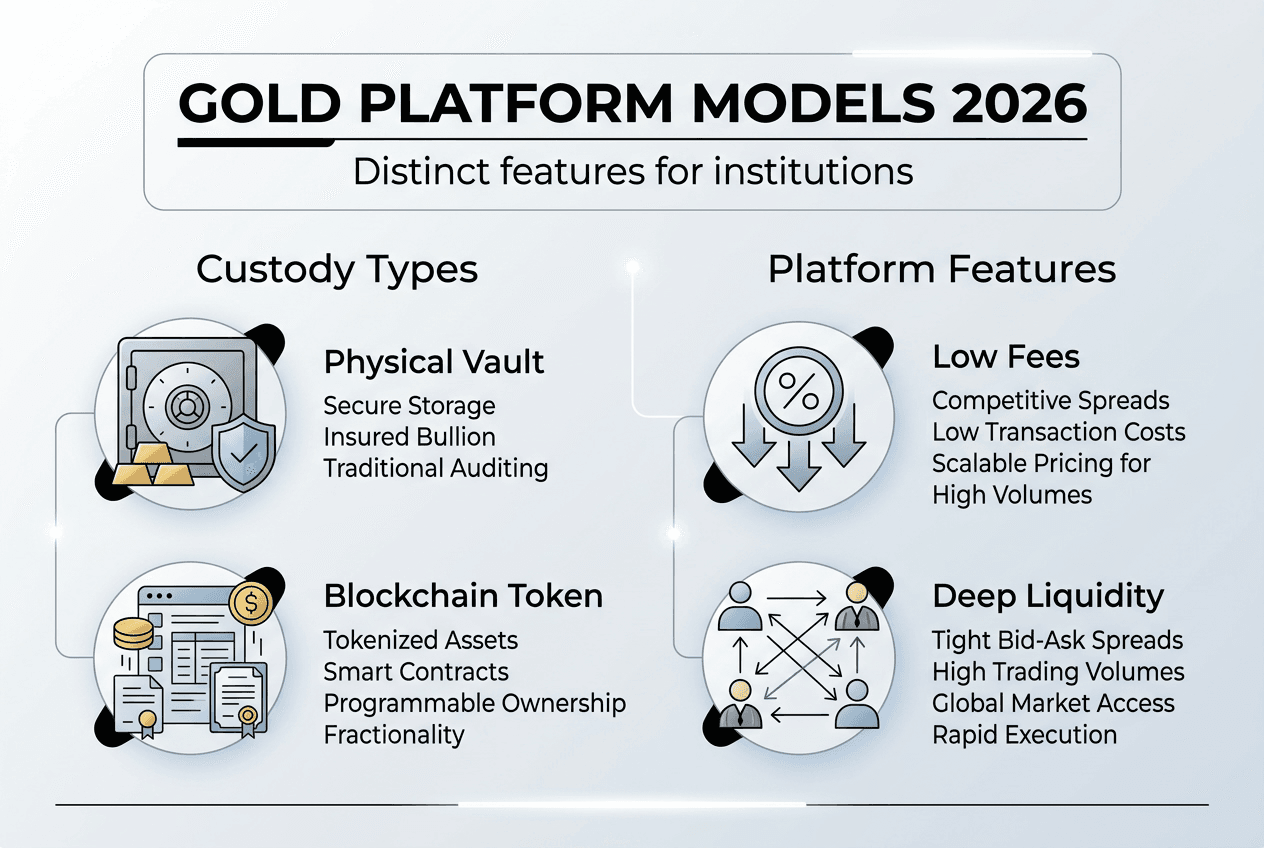
Each model balances custody security, transaction fees, liquidity depth, and operational transparency differently. Physical gold requires vault storage and insurance, adding ongoing costs but eliminating counterparty risk. ETFs offer liquidity but introduce management fees and potential tracking errors. CFDs provide leverage but carry higher risk profiles unsuitable for conservative allocations.
Understanding these advantages of gold trading models helps institutions match platform capabilities to specific portfolio objectives. A pension fund seeking long-term value preservation might prioritize physical-backed tokens with minimal fees, while a hedge fund exploiting short-term volatility could favor algorithmic platforms offering rapid execution and advanced analytics. The platform you select shapes not just your gold exposure but your operational efficiency and risk profile.
Blockchain-based gold ownership and token models
Blockchain technology has revolutionized gold ownership by eliminating traditional custody fees while maintaining institutional-grade security. DGLD blockchain gold token represents ownership of physical, investment-grade PAMP® gold, fully accessible 24/7 through blockchain wallets without custody or management fees. Each token corresponds to actual bullion, not a derivative or paper claim, providing direct ownership rights that traditional platforms cannot match.
The redemption process demonstrates the token’s practical utility. Token holders can convert digital holdings into physical gold starting at just 1 gram, far below the typical minimum bars required by conventional dealers. This flexibility allows institutions to adjust physical allocations precisely without being forced into large, indivisible positions. The gold backing each DGLD® token comes from PAMP® with over 60 years of refining expertise, stored in Swiss vaults that meet the highest security standards.
Blockchain architecture delivers transparency impossible with traditional custody arrangements:
Real-time verification of gold backing through public ledgers
Cryptographic proof of ownership without intermediary confirmation
Instant transfer capability across borders without customs delays
Elimination of reconciliation errors common in paper-based systems
Pro Tip: Institutions concerned about custody risk should verify that blockchain gold tokens provide direct claim rights to specific numbered bars, not pooled allocations that complicate redemption during market stress.
This model addresses a critical pain point for institutional investors who build trust in gold platforms by eliminating the opacity of traditional vault storage. You can audit your holdings independently rather than relying solely on custodian reports. The differences in gold ownership between blockchain tokens and conventional accounts become most apparent during redemption, where tokens offer superior speed and lower minimums. For institutions managing multiple strategies across geographies, blockchain tokens provide operational advantages that translate directly into cost savings and risk reduction.
Algorithmic gold trading platforms and risk management
Algorithmic trading platforms transform raw market data into actionable intelligence, enabling institutions to exploit gold market inefficiencies while managing downside risk systematically. Algorithmic gold trading strategies analyze continuous data streams to identify volume spikes, volatility clusters, and moving average crossovers that signal high-probability entry points. These systems process information faster than human traders, capturing opportunities that disappear within seconds.

Micro Gold Futures contracts have democratized algorithmic strategies by reducing capital requirements. MGC contracts represent one-tenth the size of standard gold futures, allowing institutions to test strategies with smaller positions before scaling. This capital efficiency matters for portfolio managers allocating across multiple asset classes who cannot dedicate large sums to a single commodity position.
Advanced platforms employ sophisticated data infrastructure to minimize execution lag:
In-memory databases like Redis store tick data for instant retrieval
Co-located servers reduce network latency to microseconds
Pre-calculated indicators update continuously rather than on-demand
Risk checks execute in parallel with order routing to prevent delays
Automated strategies reduce emotional bias, improving risk management consistency across market cycles by enforcing predetermined rules without hesitation or second-guessing.
Regular backtesting validates strategy performance across historical scenarios, revealing how algorithms would have performed during past crises. Sentiment analysis incorporates news flow and social media trends, adding qualitative context to quantitative signals. This combination enhances predictive accuracy beyond what pure technical analysis achieves.
For institutions trading gold strategically, algorithmic platforms offer precision impossible through discretionary approaches. You define exact entry criteria, position sizing rules, and stop-loss levels that execute automatically. This discipline prevents the common mistake of abandoning a sound strategy during temporary drawdowns. The best platforms provide transparent performance metrics, allowing you to evaluate algorithm effectiveness objectively and adjust parameters based on changing market conditions.
Comparing top gold trading platforms in 2026: features and institutional considerations
Leading platforms differentiate themselves through custody models, fee structures, and product diversity tailored to institutional requirements. Swissquote gold trading options span multiple instruments including XAU positions backed by physical bars, gold ETFs providing liquidity, CFDs enabling leverage, and thematic portfolios combining gold with related assets. This range allows institutions to express varying conviction levels and time horizons within a single platform relationship.
Physical-backed XAU positions at Swissquote store gold bars in secure vaults, eliminating counterparty risk while maintaining tradability. Gold ETFs on the platform provide diversification across multiple funds with different geographic focuses and expense ratios. CFDs suit tactical traders seeking short-term exposure without the commitment of physical delivery.
Key institutional considerations extend beyond product availability:
Custody security including vault location, insurance coverage, and audit frequency
Transaction costs encompassing spreads, commissions, and hidden fees
Liquidity depth measured by average daily volume and bid-ask spreads
Redemption flexibility covering minimum sizes, delivery timeframes, and geographic options
Integration capabilities with existing portfolio management and risk systems
Platform | Custody Model | Fee Structure | Product Range | Risk Management |
SolidusLink | Multi-dealer with bank integration | Transaction-based | Spot, forwards, options | Distributed counterparty exposure |
DGLD® | Blockchain with Swiss vault storage | Zero custody fees | Tokenized physical gold | Cryptographic ownership proof |
Swissquote | Segregated vault storage | Spread plus custody | XAU, ETFs, CFDs, themes | Position limits and margin controls |
Algorithmic platforms | Broker-dependent | Performance-based | Futures, options | Automated stop-loss and position sizing |
Pro Tip: Evaluate platform custody arrangements during market stress scenarios by reviewing their performance during the 2020 gold volatility spike, when some platforms restricted redemptions while others maintained normal operations.
Institutional investors should prioritize platforms offering transparent custody with independent audits, competitive fee structures that align with long-term holding strategies, and operational integration that minimizes manual reconciliation. The GALAMI GOLD news and updates section provides ongoing analysis of platform developments affecting institutional users. Your platform choice impacts not just trading costs but operational risk, regulatory compliance, and strategic flexibility as market conditions evolve throughout 2026 and beyond.
Explore GALAMI GOLD solutions for secure gold investment
Institutional investors seeking transparent, audited gold trading solutions can leverage GALAMI GOLD’s platform designed specifically for sophisticated portfolios. The platform emphasizes disciplined execution across established supply chains, delivering high ROI potential through efficient capital deployment and professional custody arrangements. Institutions diversifying into physical gold gain access to trusted vault storage, competitive pricing, and seamless integration with existing investment workflows.

GALAMI GOLD combines the security of physical bullion with the operational efficiency institutions require in 2026. Professional support teams guide investors through platform features, redemption processes, and portfolio optimization strategies tailored to your specific risk tolerance and return objectives. Explore GALAMI GOLD physical gold investment opportunities to complement your diversification strategy with confidence, transparency, and institutional-grade security that aligns with your fiduciary responsibilities.
Frequently asked questions about gold trading platforms
Are gold tokens like DGLD® fully backed by physical gold?
Yes, each DGLD® token represents ownership of specific investment-grade PAMP® gold bars stored in Swiss vaults with full audit trails. The blockchain ledger provides real-time verification of backing ratios, eliminating the opacity common in traditional gold certificates.
What risk management features do algorithmic gold trading platforms provide?
Algorithmic platforms offer automated stop-loss orders, position sizing based on volatility, and real-time risk metrics tracking drawdowns and exposure limits. These systems execute predetermined rules without emotional interference, maintaining discipline during volatile market conditions.
How do custody fees vary among popular gold trading platforms?
Custody fees range from zero for blockchain tokens like DGLD® to 0.25% annually for traditional vault storage platforms. Some brokers bundle custody into spreads rather than charging explicit fees, making total cost comparison essential for accurate evaluation.
Can institutional investors redeem digital gold holdings for physical gold?
Most reputable platforms allow redemption starting at minimum weights ranging from 1 gram for blockchain tokens to 400-ounce bars for wholesale platforms. Redemption timeframes vary from same-day for tokens to several weeks for large physical deliveries requiring vault coordination.
What are the key differences between trading gold ETFs and physical gold?
Gold ETFs provide superior liquidity and eliminate storage concerns but introduce management fees and potential tracking errors. Physical gold offers direct ownership without counterparty risk but requires vault arrangements and insurance, making it better suited for long-term strategic allocations rather than tactical trading. Understanding the importance of gold trading platforms helps institutions match instruments to specific portfolio objectives and operational constraints.
Recommended


Comments