


Gold's role in portfolio risk management 2026
- Shannon B
- Mar 14
- 10 min read


Gold occupies a misunderstood position in institutional portfolios. Many investors assume gold automatically protects against every market downturn, yet recent empirical research reveals a more nuanced reality. Gold is consistently a hedge, offsetting losses in equities and bonds, but its safe haven properties depend heavily on market conditions, geographic location, and the nature of economic stress. For institutional investors and high-net-worth individuals evaluating gold as a strategic asset in 2026, understanding these distinctions is critical for effective portfolio construction and risk management.
Table of Contents
Key takeaways
Point | Details |
Hedge versus safe haven | Gold reliably hedges against market losses but does not guarantee protection during all extreme events. |
Negative correlation advantage | Gold’s negative correlation with stocks intensifies during crises, significantly enhancing diversification benefits. |
Optimal allocation target | Empirical evidence suggests 18% gold allocation maximizes risk-adjusted returns in diversified portfolios. |
Context-dependent effectiveness | Gold’s portfolio role varies with market volatility, interest rate movements, and geopolitical conditions. |
Strategic insurance value | Gold functions as long-term portfolio insurance rather than a short-term yield enhancer. |
Understanding gold’s role as a hedge versus a safe haven
Institutional investors frequently conflate two distinct concepts when evaluating gold. A hedge is an asset that maintains negative or low correlation with other portfolio holdings during normal market conditions, offsetting routine losses. A safe haven, by contrast, provides protection specifically during extreme market turmoil, when correlations across traditional assets converge and diversification fails. Gold consistently demonstrates hedging properties, but its safe haven status is conditional.
Empirical research examining gold’s relationship with equity markets reveals important limitations. Studies show gold hedges reliably but no distinct safe haven state exists between gold and UK or US stock markets. This finding challenges the conventional wisdom that gold universally protects portfolios during crises. The effectiveness varies significantly by country, with gold showing stronger safe haven characteristics in some markets like Canada and Germany compared to others.
Gold’s qualities as a real asset have gained importance in 2026’s fragmented geoeconomic environment. As a non-sovereign store of value, gold maintains purchasing power without counterparty risk, a property that becomes particularly valuable during periods of currency debasement or financial system stress. This distinguishes gold from financial assets that depend on institutional stability.
Several misconceptions persist about gold’s protective attributes. Investors often assume gold prices rise during every equity market decline, yet correlations shift dynamically based on the crisis type. Monetary policy shocks, geopolitical events, and credit crises each produce different gold price responses. Understanding these nuances allows institutional investors to set realistic expectations for gold as a safe-haven asset class within their portfolios.
“Gold’s hedge properties remain consistent across market conditions, but its safe haven effectiveness depends critically on the nature of the crisis, the geographic market, and prevailing monetary policy dynamics.”
Key distinctions institutional investors should recognize:
Gold hedges against routine equity volatility but does not guarantee positive returns during all crisis periods
Safe haven properties strengthen during currency crises and geopolitical conflicts more than during equity bear markets
Gold’s effectiveness as portfolio insurance increases when traditional diversification between stocks and bonds breaks down
Real asset characteristics provide protection against inflation and currency devaluation independent of safe haven status
Gold’s diversification benefits and empirical portfolio impacts
The correlation between gold and equities forms the foundation of gold’s diversification value. During normal market conditions, gold typically maintains low or slightly negative correlation with stocks. This correlation intensifies during periods of market stress, when gold’s negative correlation with stocks makes it a valuable portfolio diversifier, especially during economic crises. This dynamic correlation pattern provides exactly the protection investors need when traditional diversification fails.
Empirical evidence demonstrates substantial portfolio improvements when gold is included. The following table compares key performance metrics for portfolios with varying gold allocations during crisis periods:
Portfolio Composition | Annualized Return | Volatility | Sharpe Ratio | Maximum Drawdown |
100% Equities | 8.2% | 18.5% | 0.44 | -52% |
90% Equities / 10% Gold | 8.6% | 16.1% | 0.53 | -44% |
82% Equities / 18% Gold | 9.1% | 14.8% | 0.61 | -38% |
75% Equities / 25% Gold | 9.0% | 14.2% | 0.63 | -35% |
International portfolio diversification receives additional benefits from gold inclusion. Research demonstrates that gold improves international diversification of U.S. portfolios with stochastic dominance during and after crisis periods. This means gold-enhanced portfolios consistently outperform traditional stock-bond portfolios across multiple risk metrics, not just in isolated scenarios.

Pro Tip: Monitor gold’s rolling correlation with your equity holdings quarterly. When correlation approaches zero or turns positive during calm markets, this signals reduced diversification benefit and may warrant tactical allocation adjustments.
Diversification benefits manifest across different economic regimes:
During inflationary periods, gold maintains purchasing power while nominal bonds lose real value
In deflationary crises, gold’s liquidity and zero counterparty risk provide stability when credit markets freeze
Throughout periods of financial repression, gold offers returns uncorrelated with artificially suppressed interest rates
When geopolitical tensions escalate, gold benefits from safe haven flows while equities face risk premium expansion
The reduction in portfolio drawdowns represents perhaps the most valuable diversification benefit for institutional investors. Maximum drawdown, the peak-to-trough decline during market stress, directly impacts investor behavior and long-term plan sustainability. Gold’s ability to safeguard diversification benefits becomes particularly evident during simultaneous equity and bond market declines, a scenario that occurred multiple times in recent years and challenges traditional 60/40 portfolio construction.
For institutional investors in 2026, these empirical findings translate into concrete portfolio construction decisions. The evidence supports treating gold as a distinct asset class rather than a commodity, with allocation decisions driven by diversification objectives rather than return expectations alone.
Optimal allocation and factors influencing gold’s portfolio role
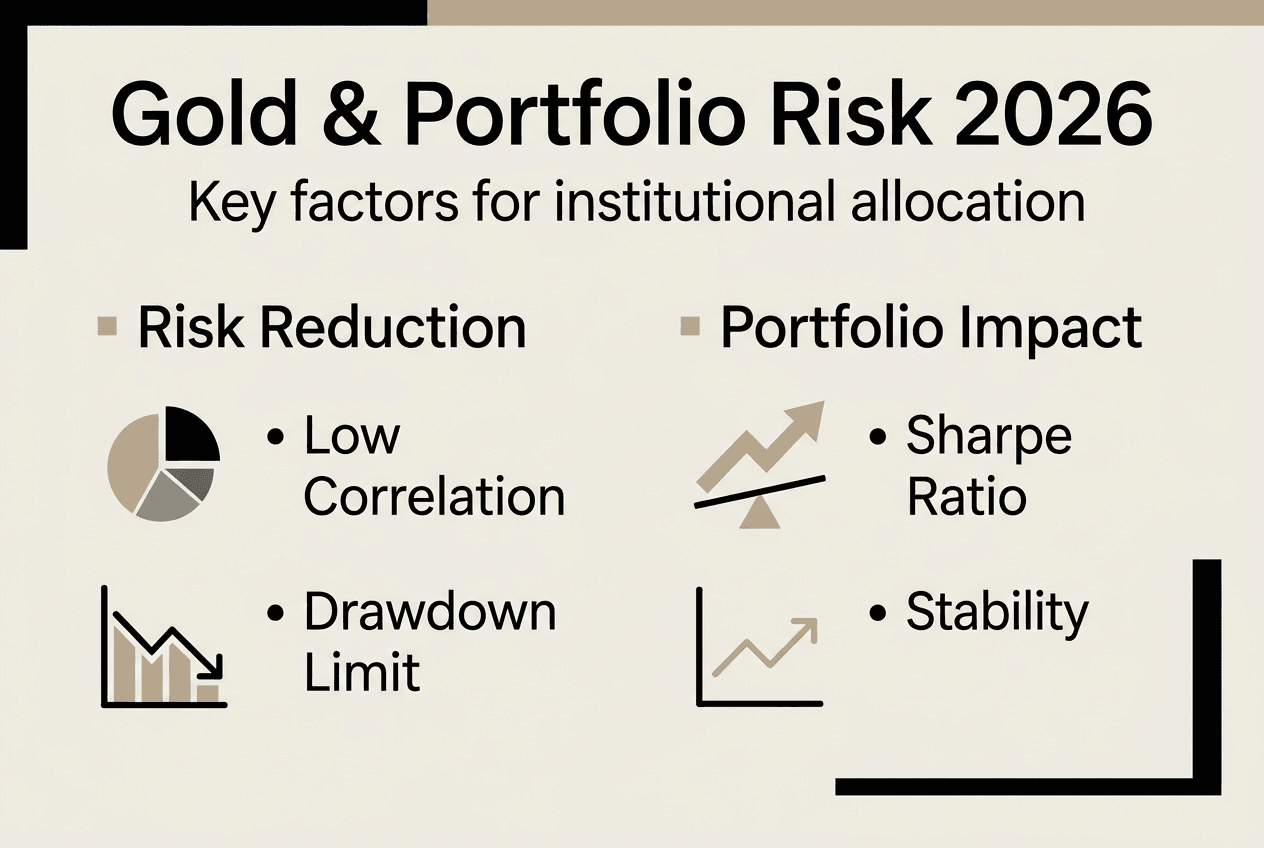
Determining the appropriate gold allocation requires balancing risk reduction against opportunity cost. Empirical research across multiple market cycles provides clear guidance. Studies demonstrate that 18% gold allocation enhances risk-adjusted returns across various portfolio constructions, representing a sweet spot where diversification benefits peak relative to foregone equity exposure.
The following comparison illustrates how different allocation levels affect portfolio outcomes:
Gold Allocation | Expected Return Impact | Volatility Reduction | Sharpe Ratio Change | Drawdown Protection |
0% | Baseline | Baseline | Baseline | Baseline |
10% | +0.2% | -1.8% | +0.09 | Moderate |
18% | +0.5% | -3.2% | +0.17 | Substantial |
25% | +0.4% | -3.8% | +0.19 | Maximum |
The 18% target emerges from optimization across risk-return dimensions rather than arbitrary convention. At this allocation level, portfolios achieve maximum improvement in Sharpe ratio, the standard measure of risk-adjusted returns. Beyond 25%, the marginal diversification benefits diminish while opportunity costs from reduced equity exposure increase.
Several critical factors influence gold’s effectiveness and optimal allocation:
Market volatility regime: Gold’s diversification value increases during high volatility periods when correlations across traditional assets rise
Interest rate environment: Gold benefits depend on interest rate dynamics, with real rates below 2% historically supporting gold performance
Geopolitical risk premium: Elevated political uncertainty, sanctions activity, and trade conflicts enhance gold’s safe haven appeal
Currency market conditions: Dollar weakness amplifies gold returns for U.S. investors, while currency hedging decisions affect international exposure
Inflation expectations: Rising inflation expectations increase gold’s appeal as an inflation hedge, though the relationship is complex
Investor-specific factors also matter. Risk tolerance influences optimal allocation, with more conservative portfolios potentially holding higher gold percentages. Investment horizon affects the decision as well, since gold’s diversification benefits compound over longer periods while short-term volatility can be substantial. Liquidity requirements may constrain allocation for investors needing regular portfolio distributions.
Pro Tip: Treat gold allocation as strategic portfolio insurance rather than a tactical bet on gold prices. Set target allocation based on your risk management objectives, then rebalance systematically rather than timing gold market movements.
For institutional investors implementing gold investment strategies, the 18% benchmark provides a starting point for customization. Portfolios with higher equity allocations or greater sensitivity to geopolitical risks might justify allocations toward the upper end of the 15-25% range. Conservative portfolios already holding substantial fixed income might optimize at lower gold percentages.
The allocation decision also depends on implementation method. Physical gold, gold ETFs, gold mining equities, and gold futures each carry different risk-return characteristics and correlation properties. Physical gold and ETFs backed by physical bullion most closely deliver the pure diversification benefits discussed in research, while mining stocks introduce equity market correlation that dilutes the diversification effect.
Regular portfolio reviews allow adaptation to evolving market conditions. Managing gold investment risk requires monitoring the factors that influence gold’s effectiveness and adjusting allocation when structural changes occur in interest rate regimes, geopolitical landscapes, or monetary policy frameworks.
Gold’s strategic importance amid evolving geopolitical and economic risks
Gold’s portfolio role has intensified in 2026 due to converging macroeconomic and geopolitical forces. Central banks have dramatically increased gold accumulation, with purchases reflecting a secular shift driven by geopolitical events and U.S. dollar uncertainty. This institutional demand provides fundamental support for gold prices while signaling sophisticated risk managers’ assessment of systemic vulnerabilities.
ETF inflows have accelerated alongside central bank buying, indicating retail and institutional investors share concerns about traditional portfolio construction. The combination of official sector demand and private investment flows creates a more stable foundation for gold prices than speculative trading alone would provide. This demand profile suggests gold’s elevated importance reflects structural changes rather than temporary sentiment.
Geopolitical fragmentation has elevated gold’s value as neutral collateral and non-sovereign store of value amid fiscal and geopolitical uncertainty. As economic blocs increasingly operate with distinct regulatory frameworks, payment systems, and reserve preferences, assets that transcend national boundaries gain importance. Gold’s unique position as a universally accepted, politically neutral asset becomes more valuable in this fragmented landscape.
Several specific risks drive gold’s strategic importance:
U.S. fiscal trajectory concerns, with debt-to-GDP ratios reaching levels historically associated with currency debasement
Reserve currency uncertainty as central banks diversify away from dollar dominance and explore alternative settlement systems
Sanctions proliferation that has weaponized dollar-based financial infrastructure, motivating reserve managers to seek sanction-proof assets
Banking system vulnerabilities exposed by rapid interest rate increases and commercial real estate stress
Inflation persistence despite aggressive monetary tightening, raising questions about central bank credibility
Gold prices surged through mid-October 2025, reaching record highs above $2,700 per ounce before experiencing a correction in late 2025 and early 2026. This price action reflected competing forces: safe haven demand from geopolitical tensions and fiscal concerns versus headwinds from rising real interest rates and dollar strength. The subsequent consolidation phase has created entry opportunities for institutional investors implementing strategic allocations.
“Gold has proven its value during periods when both stocks and bonds decline simultaneously, a scenario that traditional portfolio theory assumed was unlikely but has occurred repeatedly in recent years, validating gold’s role as essential portfolio insurance.”
The de-dollarization trend, while gradual, represents a structural shift with long-term implications for gold demand. As countries reduce dollar reserve holdings and develop alternative payment systems, gold serves as a neutral alternative that avoids dependence on any single nation’s monetary policy or geopolitical alignment. This trend supports sustained central bank demand regardless of short-term price fluctuations.
For institutional investors evaluating gold’s strategic importance in 2026, these developments suggest gold has evolved from an opportunistic investment to an essential component of prudent risk management. The convergence of fiscal stress, geopolitical fragmentation, and monetary policy uncertainty creates an environment where gold’s unique properties as a real, non-sovereign, liquid asset provide diversification benefits that traditional portfolio construction cannot replicate.
The key insight is that gold’s portfolio role extends beyond short-term crisis protection to long-term insurance against systemic risks that threaten traditional financial assets simultaneously. This perspective shifts gold allocation from a tactical decision based on market timing to a strategic choice based on comprehensive risk assessment.
Invest in gold strategically with GALAMI GOLD
Implementing the strategic insights from this analysis requires a reliable partner with deep expertise in physical gold markets. GALAMI GOLD operates as a dedicated physical gold trading platform, emphasizing disciplined execution, transparency, and risk management across established supply chains. For institutional investors and high-net-worth individuals seeking to optimize portfolio diversification with the 18% gold allocation target discussed here, GALAMI GOLD provides verified access to physical gold investment.

The platform’s focus on trust, integrity, and efficient capital deployment aligns with the sophisticated risk management approach institutional portfolios require. Rather than speculative trading, GALAMI GOLD facilitates strategic gold accumulation that delivers the diversification benefits and crisis protection empirical research validates. Explore how GALAMI GOLD’s physical gold trading can help you implement evidence-based gold allocation strategies tailored to your portfolio’s risk profile and return objectives.
Frequently asked questions
What is the difference between gold as a hedge and as a safe haven?
A hedge is an asset that maintains negative correlation with portfolio holdings during normal market conditions, offsetting routine losses. A safe haven provides protection specifically during extreme market turmoil when traditional diversification fails. Gold consistently hedges but its safe haven properties vary by crisis type and geographic market.
How much gold should be allocated in a diversified institutional portfolio?
Empirical research supports an 18% gold allocation as optimal for maximizing risk-adjusted returns in diversified portfolios. This allocation level provides substantial volatility reduction and drawdown protection while maintaining sufficient equity exposure for long-term growth. Conservative portfolios might allocate 15-25% depending on specific risk tolerance and investment objectives.
Does gold perform well in all economic crises?
No, gold’s performance varies by crisis type. Gold typically performs strongly during currency crises, geopolitical conflicts, and periods of financial repression. However, during liquidity crises or rapid deleveraging events, gold can decline initially as investors sell liquid assets to meet margin calls. Gold’s effectiveness depends on whether the crisis stems from monetary, geopolitical, or credit factors.
How do interest rate changes affect gold’s portfolio role?
Real interest rates, adjusted for inflation, significantly influence gold’s attractiveness. When real rates fall below 2%, gold becomes more competitive since it generates no yield. Rising real rates increase the opportunity cost of holding gold, potentially reducing its appeal. However, if rate increases occur alongside elevated geopolitical or fiscal risks, gold’s safe haven properties can offset the negative rate impact.
What are the main risks of investing in gold for institutions?
Key risks include price volatility in the short term, no income generation, storage and insurance costs for physical holdings, counterparty risk with certain gold investment vehicles, and opportunity cost from foregone equity returns during strong bull markets. Additionally, gold’s effectiveness as a diversifier can diminish during certain market conditions. Understanding these examples of gold investment risks for institutions helps in developing appropriate risk management frameworks.
How can institutional investors optimize their gold investment approach?
Optimization requires setting strategic allocation targets based on portfolio risk objectives rather than gold price forecasts, implementing systematic rebalancing to maintain target weights, selecting appropriate gold investment vehicles that deliver pure diversification benefits, and regularly reviewing allocation as macroeconomic and geopolitical conditions evolve. Optimizing investment strategies with gold involves treating gold as portfolio insurance rather than a speculative position.
Recommended

Comments