


Gold broker roles: Institutional trading edge in 2026
- Shannon B
- 2 hours ago
- 9 min read

TL;DR:
The global gold market is mainly an OTC system led by bullion banks and brokers handling over $100 billion daily.
Brokers add value through liquidity aggregation, risk management, structuring, and market intelligence.
Digital and hybrid trading models aim to improve efficiency but do not fully replace broker relationships for large institutional trades.
Gold doesn’t trade itself. Behind every large institutional position sits a web of brokers, bullion banks, and market infrastructure that most investors never fully see. The LBMA OTC market handles roughly 90% of global gold trade, with average daily volumes exceeding $100 billion, yet the mechanics driving that volume remain opaque to many sophisticated investors. Understanding exactly how brokers operate, where they generate value, and when to challenge them is what separates institutions that consistently capture alpha from those that quietly absorb unnecessary costs and risks.
Table of Contents
Key Takeaways
Point | Details |
Brokers drive market access | Institutional investors depend on brokers for liquidity, execution, and risk management in gold trading. |
Know your broker’s value | Beyond order execution, brokers offer key services such as proprietary trading, custody, and compliance—vital for large transactions. |
Weigh digital alternatives | On-chain and tokenized gold trading models offer efficiency but still lack the institutional depth of broker-mediated markets. |
Strategic broker selection matters | Careful evaluation and partnership with the right broker enhance returns and reduce risks for institutional portfolios. |
Understanding the structure of the global gold market
The global gold market is not a single exchange. It is a layered, decentralized system dominated by over-the-counter trading, where deals are struck directly between counterparties rather than on a centralized platform. This structure gives institutions flexibility but also places enormous responsibility on choosing the right intermediaries.
At the core sits the London Bullion Market Association, known as the LBMA. It sets the standards for gold trading globally, covering everything from bar specifications to clearing and settlement. The LBMA’s framework is what makes the OTC market trustworthy at scale. Without it, the bilateral nature of OTC deals would create unmanageable risk for institutions moving large positions. You can review LBMA trading standards to see how these rules translate into practical compliance requirements.
Bullion banks are the market’s engine. Institutions like HSBC, JP Morgan, and UBS act as market makers, continuously quoting bid and ask prices. This means you can execute a $50 million gold trade in minutes, not days. That liquidity does not appear by accident. It is manufactured and maintained by these banks, who absorb inventory risk and manage their books across spot, forward, and options markets simultaneously.
Key participants in the institutional gold market:
Bullion banks: Market makers providing continuous liquidity and pricing
Brokers: Intermediaries connecting clients to market makers and managing execution
Central banks: Major holders and occasional large-scale sellers or buyers
Institutional investors: Pension funds, sovereign wealth funds, hedge funds, and HNWIs
Clearing members: Firms handling settlement through the LBMA clearing system
Market segment | Daily volume estimate | Primary participants |
LBMA OTC spot | $50B+ | Bullion banks, institutions |
OTC forwards/swaps | $30B+ | Banks, corporates, hedgers |
Exchange-traded (COMEX) | $20B+ | Speculators, funds |
Physical delivery | Smaller fraction | Refiners, central banks |
For institutions new to this space, the institutional gold trading guide breaks down how these segments interact and where your capital actually flows when you execute a trade.
Key insight: The LBMA OTC market processes over $100 billion daily, making it larger than most sovereign bond markets. Yet it operates almost entirely outside public view.
What brokers actually do: Beyond order execution
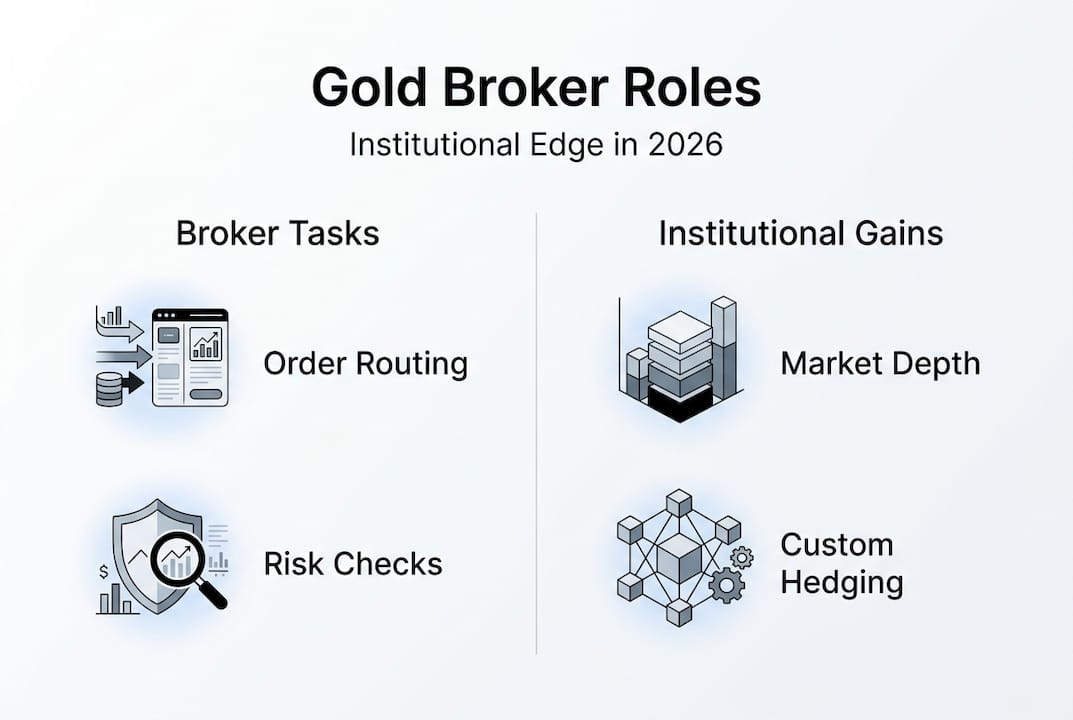
Most institutions think of brokers as order routers. You send a ticket, they fill it. That framing is dangerously incomplete. The real value of a skilled gold broker operates across at least four distinct dimensions that directly affect your bottom line.
1. Liquidity aggregation. A broker with strong bullion bank relationships can source liquidity from multiple market makers simultaneously, improving your fill price on large orders. Without this, you are at the mercy of a single bank’s quote.
2. Counterparty risk management. In OTC markets, every trade carries counterparty exposure. Brokers with robust credit frameworks vet counterparties, structure ISDA agreements, and monitor exposure in real time. This is not administrative overhead. It is risk management that protects your capital.
3. Hedging and structuring. Sophisticated brokers offer forward contracts, lease rate products, and options structures tailored to your specific exposure. An institution holding physical gold, for example, can use lease rates to generate yield while maintaining ownership.
4. Market intelligence. Brokers sitting at the center of large order flow see the market differently than any single participant. That flow information, shared appropriately, helps you time entries and exits more effectively.
Bullion bank revenue comes from bid-ask spreads and financing, including lease rates, custody fees, and proprietary trading. Only around 12 LBMA-recognized market makers operate at this level globally, which means the market is concentrated. That concentration is both a feature and a risk. It ensures depth but limits competition on pricing.
Broker type | Typical spread | Key strength | Best for |
Bullion bank | 0.5-2 pips | Deep liquidity, full service | Large institutions |
Independent broker | 2-5 pips | Flexibility, niche access | Mid-size funds |
Digital platform | 5-15 pips | Speed, transparency | Smaller HNWIs |
Pro Tip: Negotiate your spread explicitly before signing any institutional agreement. A 0.5 pip improvement on a $100 million annual trading volume translates to $50,000 in direct savings. Brokers expect this conversation from serious counterparties.
Building a productive long-term relationship also requires understanding trust in gold trading, particularly how transparency in reporting and counterparty verification creates durable partnerships.
Brokerage vs. direct and digital gold trading: Pros, cons, and emerging trends
The argument for cutting out brokers sounds compelling on paper. Eliminate the spread, reduce counterparty risk, accelerate settlement. On-chain and direct trading models promise exactly this. The reality for institutional volumes is more complicated.
Direct and on-chain gold trading bypasses brokers to eliminate retail spreads of 20 to 30 pips and removes custody risk and KYC delays. For retail participants or smaller HNWIs, this is genuinely attractive. For an institution moving $200 million in a single session, the liquidity simply is not there. Decentralized platforms cannot absorb that order size without significant price impact.
The more interesting development is hybrid infrastructure. The World Gold Council and Linklaters have launched a vision for next-generation gold infrastructure that uses digital technology to reduce counterparty risk in unallocated trading, enabling tokenized gold with shared custody and automated reconciliation. This is not about replacing brokers. It is about making broker-mediated trading more efficient and auditable.
“The future of institutional gold trading is not broker-free. It is broker-enhanced by technology that reduces friction without sacrificing depth.”
What digital gold infrastructure offers institutions:
Faster settlement cycles, potentially moving from T+2 toward near real-time
Automated reconciliation reducing operational errors
Tokenized ownership enabling fractional exposure and programmable hedges
Improved audit trails for regulatory reporting
Trading model | Liquidity depth | Cost efficiency | Regulatory clarity | Counterparty risk |
Broker-mediated OTC | Very high | Moderate | High | Managed |
Exchange-traded | High | Good | High | Low |
On-chain/direct | Low | High | Evolving | Variable |
Hybrid digital+OTC | Growing | Improving | Developing | Reduced |
For institutions focused on optimizing gold transactions, the practical answer in 2026 is to use traditional broker relationships for volume execution while selectively integrating digital tools for reporting and smaller, tactical positions. Understanding the full spectrum also means revisiting the differences between physical and trading gold to align your model with your actual objectives.
Practical considerations for institutions: Choosing and working with a broker
Selecting a gold broker is not a procurement exercise. It is a strategic decision that affects your execution quality, risk exposure, and regulatory standing for years. Here is how to approach it with discipline.
Broker vetting checklist:
Confirm LBMA membership or recognized market maker status
Review audited financial statements for the past three years
Assess credit rating and capital adequacy ratios
Verify regulatory licenses in your jurisdiction
Request references from comparable institutional clients
Evaluate technology infrastructure and reporting capabilities
Negotiating institutional terms:
Start with spread compression. Institutional accounts should receive tighter spreads than retail. Benchmark against the LBMA’s published statistics.
Negotiate custody terms separately. Allocated versus unallocated storage carries different risk and cost profiles.
Clarify margin and collateral requirements upfront. Surprises here create operational problems at the worst possible moments.
Define reporting frequency and format. You need real-time or same-day position reporting, not weekly summaries.
Establish a clear escalation path. Know exactly who to call when something goes wrong at 2 AM in a volatile market.
The LBMA OTC market processes over $100 billion daily, which means your broker has access to enormous liquidity. The question is whether they will share it with you on fair terms. Ongoing monitoring matters as much as initial selection. Markets change, broker financial health shifts, and regulatory requirements evolve.

Pro Tip: Run a quarterly broker scorecard covering execution quality, reporting accuracy, responsiveness, and pricing competitiveness. Share it with your broker. The best ones welcome the feedback. Those who resist it are telling you something important.
For a broader framework on managing these relationships over time, the institutional gold investing best practices resource covers portfolio-level considerations that complement your broker selection process.
Ongoing risk monitoring priorities:
Daily mark-to-market of open positions
Monthly counterparty exposure review
Quarterly review of custody and settlement arrangements
Annual full broker due diligence refresh
Rethinking the broker’s role for institutional gold success
The prevailing view treats gold brokers as a necessary cost, a toll booth between you and the market. We think that framing is exactly wrong, and it costs institutions real money.
A broker who understands your portfolio, your risk tolerance, and your liquidity needs is not a middleman. They are a strategic partner with access to market intelligence, financing structures, and technology integrations that you cannot replicate independently. The bullion banking model, built on spreads, lease rates, and custody fees, exists because it delivers genuine value at scale. The 12 LBMA market makers did not earn their positions by being expensive. They earned them by being indispensable.
The mistake we see repeatedly is institutions cutting broker costs without understanding what they are cutting. Tighter spreads negotiated aggressively are smart. Eliminating broker relationships in favor of unproven digital platforms for large positions is not smart. It is false economy.
The institutions that consistently outperform in gold are those that treat their broker relationships as assets to be managed, not costs to be minimized. If you want to understand why gold remains essential to institutional portfolios in 2026, start by understanding who actually makes that market function.
Empower your gold strategy with expert guidance
Knowledge of how brokers operate is only valuable when paired with the right execution partner. Galami Gold works with institutional investors and HNWIs who want disciplined, transparent access to physical gold markets without the operational friction that undermines returns.

Our platform is built on audited processes, strict compliance with institutional gold standards, and a focus on efficient capital deployment across well-established supply chains. If you are ready to move from understanding the market to acting in it with confidence, explore what professional gold broker solutions at Galami Gold can do for your portfolio. The market moves fast. Your execution partner should move faster.
Frequently asked questions
How do brokers facilitate institutional gold trading?
Brokers provide access to deep OTC liquidity through bullion bank networks, handle large orders without significant price impact, manage counterparty risk via ISDA agreements, and ensure regulatory compliance. The LBMA OTC market processes over $100 billion daily, and brokers are the primary conduit for institutional participation in that volume.
What are the main risks and rewards for institutions using brokers?
Institutions gain brokered liquidity, hedging access, and market intelligence that would otherwise be unavailable. The key risks involve spread costs, custody terms, and the broker’s own financial health. Bullion bank revenue from spreads and financing means every basis point you negotiate matters at institutional scale.
Is direct or digital gold trading a viable alternative to using brokers?
For smaller positions, direct and on-chain models offer real cost and efficiency advantages. For large institutional volumes, on-chain direct trading lacks the liquidity depth required to execute without significant market impact, making broker-mediated OTC the practical standard.
How are brokers and bullion banks regulated in the gold market?
Reputable brokers operating in the OTC market follow LBMA global standards covering financial transparency, risk controls, and operational conduct. The LBMA framework applies to all recognized market makers and shapes the compliance baseline that institutional investors should require from any counterparty.
Recommended
Comments